


Dream Aerospace, a deep-tech Indian startup building satellite propulsion systems, has raised Rs 10 crore (about $1.05 million) in a pre-Series A round led by 247VC and the Campus Angels Network.
The deal also included participation from the Chandigarh Angels Network and other angel investors, marking a notable step for the company founded by Hari Krishnan KJ as it moves closer to its first in-orbit demonstration.
The funding will be used to finish flight qualification tests for its ATOM thruster series and CUBEHOOD propulsion module, expand its production and testing facility at IIT Kanpur, and execute the company’s first in-orbit demonstration of the CUBEHOOD module in a mission scheduled for 2026.
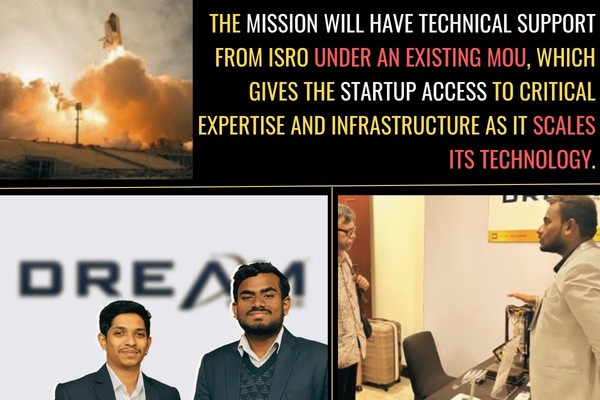
That mission will have technical support from ISRO under an existing Memorandum of Understanding, which gives the startup access to critical expertise and infrastructure as it scales its technology.
Dream Aerospace focuses on building indigenous satellite propulsion tech that is more efficient and significantly cheaper than international alternatives. The company, which has offices in Chennai and Kanpur, has already completed a pre-seed round of Rs 3 crore led by Inflection Point Ventures to develop its Atom Thruster and set up an in-house high-altitude test facility.
This latest raise fits into a broader trend of Indian deep-tech and space startups gaining traction with investors as the country’s private space sector opens up.
Satellite propulsion is a high-stakes area because it is essential for orbit control, station keeping, and mission longevity, yet it remains a segment where many space startups still rely on foreign suppliers.
By pushing for an indigenous solution, Dream Aerospace is positioning itself as a potential domestic alternative for satellite makers and research programs that need reliable thrusters without the cost and import hurdles.
The investment from 247VC, a Mumbai-based seed-stage fund, and the Campus Angels Network also signals strong belief in the startup’s early-stage technology and team.
Campus Angels, which runs a network of student-led angel groups across Indian universities, has been active in backing campus-first deep-tech ventures, and this deal adds aerospace to its portfolio.
For India’s space ecosystem, it shows that early-stage investors are willing to fund complex hardware programs that require years of testing and qualification before they can be deployed in space.
With ISRO’s backing and a clear path to an in-orbit demo in 2026, Dream Aerospace could  become one of the first Indian startups to prove a fully indigenous satellite propulsion system in real space conditions.