

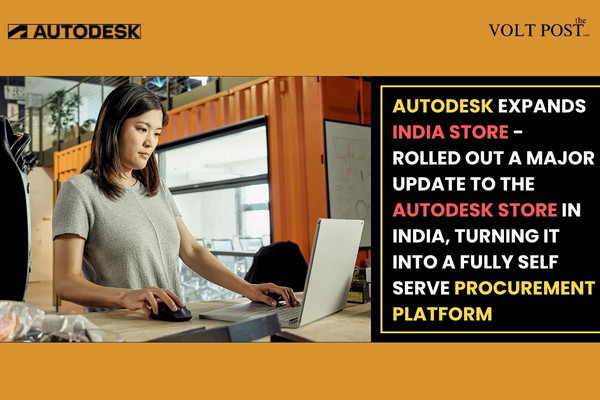
Autodesk expands India Store – rolled out a major update to the Autodesk Store in India, turning it into a fully self serve procurement platform aimed at making professional design and make technology more accessible to startups, freelancers, entrepreneurs, and small and medium businesses. The move reflects Autodesk’s broader shift toward a digital first go to market approach, simplifying how customers discover, evaluate, purchase, and manage its solutions.
The timing aligns with India’s rapid digital expansion. With 958 million active internet users, according to the Internet and Mobile Association of India, the country has become one of the world’s largest and fastest growing digital economies.
As a result, expectations around how professional software is evaluated and purchased have evolved significantly, especially among newer and more digitally native users.
Autodesk is clearly leaning into this shift. Since launching in 2017, the platform has grown into one of its most important customer acquisition channels in India. Today, startups, freelancers, and emerging businesses account for more than half of first time users on the Store, highlighting both the scale of India’s entrepreneurial base and the growing preference for digital procurement.
This trend is also spreading beyond major metros. Tier 2 and Tier 3 cities now contribute over 20 percent of Autodesk’s online customers, pointing to a broader wave of digital adoption and innovation emerging from new business hubs across the country.
The updated platform introduces purchasing options that better reflect how smaller and independent businesses operate. Customers now have access to the full Autodesk product portfolio in India, with more than 60 products available through payment options such as credit cards, debit cards, net banking, and UPI.
Subscription flexibility is another key addition. Professionals can now opt for monthly subscriptions, with entry pricing starting at ?1,062 per month for AutoCAD Web. This model suits short term projects, whether it is a freelance architect working on a limited engagement, a startup building its first prototype, or a small team handling a defined design assignment.
Autodesk has also introduced Flex tokens, a usage based model available exclusively through the India Store. Teams can purchase tokens starting at ?29,300 for 100 tokens, valid for a year and usable across multiple users and select Autodesk products. This adds another layer of flexibility for businesses managing variable workloads.
The platform is designed to be fully self directed, removing the need for sales callbacks. Users can generate and share quotes internally, complete multi product purchases in a single transaction, renew subscriptions, and manage GST compliance, all within the platform.
To support this digital first experience, Autodesk has expanded its payment ecosystem to include UPI alongside debit cards, credit cards, and net banking. This ensures customers across India can transact using familiar and widely adopted payment methods.
With this update, the company is not just refining its online store, it is aligning closely with how India’s next generation of businesses discover and adopt professional technology.
 Leadership Comments
“India has nearly a billion active internet users — and for this generation, digital is not a channel. It is the expectation. Today, the Autodesk creator community that includes designers, animators, manufacturers want to explore, evaluate and purchase professional technology instantly, just as they would any other product or service online.” said Kamolika Gupta Peres, Vice President, Autodesk India and SAARC.
“Over the past year, we analysed the online buying behaviour and preferences of our customers and Autodesk’s creator community across India. The insights and feedback have shaped the evolution of the Autodesk Store into a more intuitive, inclusive, seamless and locally relevant experience, designed around the needs of modern Indian businesses and professionals. As Autodesk’s reach expands across Bharat, we are making it easier to access professional design technology, regardless of where they are located.” Gupta added.
To Know More: CLICK HERE