Infineon launches EU flagship project Moore4Power to drive the next generation of sustainable power electronics.
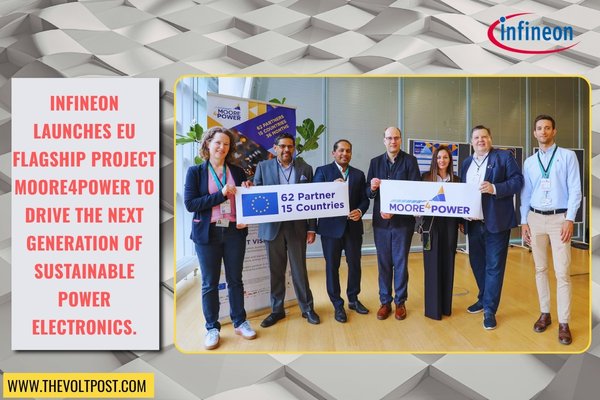
Kick-off event project Moore4Power (from left to right): Daniela Maier (Projectlead Infineon), Ganesh Chandramouli (Head of Innovation ALSTOM), Jain Chacko (Research Scientist at Fraunhofer ENAS), Joonas Leppanen (Senior Principal Engineer R&D at ABB Finland),Vicky Chatzidogiannaki (Director at INNOVATION DISCO), Jochen Koszescha (Project Coordinator Moore4Power Infineon), Iñigo Polo (General Technology Manager at INGETEAM)
Europe has just kicked off one of its most ambitious semiconductor R&D efforts to date with the launch of “More than Moore for Disruptive Innovations in Power Electronics” aka Moore4Power.
Led by Infineon Technologies, the project brings together 62 partners across 15 countries, including major industry players, SMEs, and leading research institutes.
Backed by a €91 million budget and supported under the Chips Joint Undertaking, the three-year initiative aims to drive the next wave of smart, efficient, and sustainable power electronics while reinforcing Europe’s technological sovereignty.
Shifting The Focus To System-Level Innovation
For decades, Moore’s Law defined progress in electronics shrinking transistors to boost performance and reduce cost. But as scaling approaches its physical and economic limits, Moore4Power shifts the focus to system-level innovation.
Instead of optimizing individual components in isolation, the project looks at how technologies, materials, and functions can be combined more intelligently to unlock gains in efficiency, reliability, and power density.
At the heart of Moore4Power is heterogeneous integration bringing together silicon (Si), silicon carbide (SiC), and gallium nitride (GaN), alongside sensing, control, and communication functions, into tightly integrated systems.
Each technology is used where it performs best, enabling higher efficiency, improved reliability, and more compact designs.
The project also advances power chiplet architectures, allowing scalable and modular designs that can be adapted across applications while maintaining competitive cost structures.
This builds on the earlier PowerizeD project, completed in 2025, which delivered significant improvements in both efficiency and reliability.
The initiative targets sectors where power conversion plays a critical role in cost, performance, and emissions. In wind energy, it aims to improve turbine efficiency and increase energy yield.
In e-mobility, the goal is near-lossless, bidirectional charging with efficiencies approaching 99%. And in rail systems, it targets at least a 30% reduction in propulsion losses translating directly into better energy efficiency and lower operating costs.
Moore4Power is not just about better hardware it is also rethinking how power electronics are developed. The project integrates AI-driven models, digital twins, and automated workflows to dramatically shorten development cycles.
Hardware and software will be designed in parallel, reducing simulation time while improving accuracy.
One striking goal is to mitigate the time from initial fab samples to a validated datasheet from several weeks to just one.
Faster development means lower costs, quicker industrialization, and a stronger competitive edge for Europe. Early demonstrators will be validated under real-world conditions.
Sustainability is embedded from the ground up. A key feature is the Digital Product Passport (DPP), integrated directly into power modules with wireless access.
This allows continuous tracking of lifecycle data such as operating conditions, health status, and remaining lifetime.
The result is smarter maintenance, longer product life, improved reuse, and reduced raw material consumption delivering measurable CO? savings and supporting Europe’s circular economy goals.
Co-funded by participating countries and the Horizon Europe Chips Joint Undertaking, Moore4Power brings together 62 partners in a coordinated push to reshape the future of power electronics moving beyond traditional scaling toward smarter, more integrated, and more sustainable systems.
Leadership Comment
“Power electronics are a decisive enabler for energy efficiency and sustainability. With Moore4Power, we are setting the next level of smart integration to achieve significantly higher energy and resource efficiency,” said Jochen Koszescha, Coordination Lead for the project at Infineon. “We are proud to collaborate with a strong consortium from academia, research, and industry to make a meaningful contribution to Europe’s Clean Industrial Deal.”
TVP Bureau is The Volt Post’s internal Editorial Team, dedicated to providing in-depth coverage of the Tech B2B ecosystem. The team is tasked with tracking the latest trends and developments across the tech industry, with a strong focus on emerging technologies and innovations. They are responsible for creating insightful editorial content, managing event coverage, and conducting research on new breakthroughs shaping the industry. TVP Bureau also plays a key role in ensuring that The Volt Post remains a trusted resource by staying ahead of the curve in reporting real-time news, views, and strategic industry insights




 power electronics moving beyond traditional scaling toward smarter, more integrated, and more sustainable systems.