


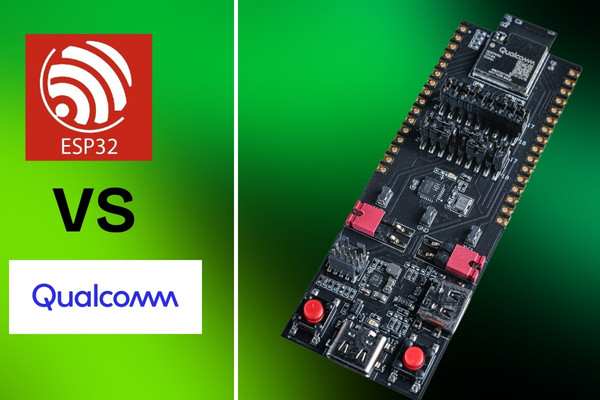
Espressif’s ESP32 has dominated the wireless microcontroller space for years, becoming the go-to choice for everything from hobbyist projects to commercial IoT deployments. But Qualcomm just entered the arena with a challenger that looks suspiciously designed to take market share – meet the new Qualcomm QCC74x tri-radio system-on-chip.
What Makes Qualcomm QCC74x Different
The QCC74x isn’t just another Wi-Fi/Bluetooth combo chip. It integrates three wireless protocols into a single package:
The standout feature is Wi-Fi 6 support at this price point. Most ESP32 variants still use older Wi-Fi 4 technology,which means better power efficiency, improved performance in crowded networks, and higher throughput on the QCC74x.
Pricing That Can’t Be Ignored
Here’s where Qualcomm gets serious about competing with Espressif’s price advantage. The QCC748M evaluation board, the highest-tier version with 8 MB PSRAM built-in lists for just $13 before taxes and tariffs.
That’s startlingly close to ESP32 module pricing, historically Qualcomm’s weakness in the maker and SMB market.
Developer Experience – Promise and Questions
The SDK lives on CodeLinaro and uses a FreeRTOS-based stack, which should feel familiar to embedded developers. Qualcomm also offers open-source support with a VS Code IDE market extension, development kits, and documentation that appears fairly complete at first glance.
However, there are red flags. Bluetooth and Zigbee support currently show as “not supported” in the SDK, though this may simply reflect work-in-progress status.
Community comments also note the absence of a publicly available detailed datasheet, a significant hurdle for engineers designing custom boards.
Who Actually Wins?
The QCC74x clearly upgrades Qualcomm’s older QCC730 MCU, which ran at just 60 MHz compared to the new chip’s 325 MHz. For home automation, smart sensors, and edge AI applications requiring Thread or Zigbee support, this could be compelling.
However, Espressif isn’t standing still. The upcoming ESP32-S31 appears positioned to match or exceed the QCC74x on most metrics. Meanwhile, Espressif’s established ecosystem ESP-IDF, vast community support, and proven reliability across millions of deployments remains a significant advantage.
Community sentiment also matters. After Qualcomm’s Arduino acquisition, some developers expressed distrust, though others correctly noted this was a normal M&A transaction rather than a hostile takeover.
 IoT Developers Stands on The Edge
For now, the QCC74x represents Qualcomm’s most serious attempt to crack the mass-market IoT microcontroller segment.
If software support matures and pricing holds at current levels, we could see this chip in:
- Smart home hubs requiring Thread/Zigbee
- Industrial sensors with Wi-Fi 6 connectivity
- Battery-powered devices benefiting from Wi-Fi 6 power efficiency
- Applications needing all three radios in a single chip
The real test comes when final pricing and full SDK support are confirmed. Until then, ESP32 retains its crown as the default wireless microcontroller, but Qualcomm just made the throne feel a bit less stable.
References:
Hackaday – Qualcomm’s New QCC74x Appears To Target The ESP32 MCUs
Reddit – QCC74x tri-radio chipset details
Qualcomm Official – QCC74xM Product Page
Espressif – ESP32 Chip Series Comparison
Qualcomm Product Brief – QCC74x Specifications