


– Barley Li, Applications Engineering Manager – Technical Content, APAC, DigiKey
Air quality measurement is a critical way to ensure the health and safety of both indoor and outdoor environments. Measurement methods have greatly evolved over the last several decades, from manual techniques to electronic sensors and continuous monitoring, and now to satellite imaging, enabling deeper insights into ultrafine particles through real-time data.
As technology has enabled closer monitoring and research, significant health risks associated with poor air quality have been revealed, driving increased health advisories and guidelines from the World Health Organization (WHO) and national air quality standards from individual nations.
In 2021, the WHO updated its guidelines to recommend lower air quality limits and tightened its standards for six key pollutants that are dangerous to breathe. An under-the-radar hazard is indoor air, since most people spend the majority of their time indoors. WHO data estimates 3.8 million people worldwide die annually from illnesses attributed to harmful indoor air.
Technology movement
With increased emphasis on pending regulations, the race is on for new and better technology that can detect damaging particles in the air, particularly in buildings. The market is rapidly expanding from specialized tools to scalable devices that are AI-enabled and monitored in real time.
DigiKey, the global distribution leader of electronic components and automation products, is a major supplier to companies that make and sell air quality products. DigiKey provides everything from miniature integrated sensors to full evaluation kits that help engineers design and integrate necessary components into innovative solutions and devices.
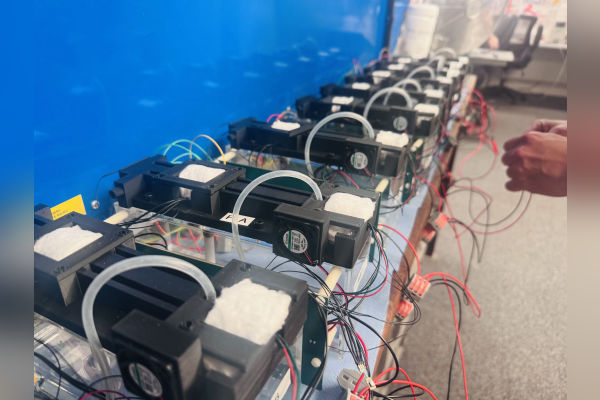
its production up to thousands of units as it grew. (Image source: Aetosense)
In the case of its customer, Aetosense, a Cambridge, England-based startup dedicated to the pursuit of clean air, DigiKey is an integral partner on its path to creating the first-to-market mini nanoparticle detector that’s smarter, smaller and less expensive than competitive products.
Aetosense CEO Molly Haugen says, “Indoor air quality poses greater risks than people realize since 90% of inhaled particles, including pollution, nanoplastics and viruses, cannot be measured by any of the current air-quality sensors on the market. We’re testing the solution of the future.”
What’s behind product development
Aetosense’s detector unit works by sampling a constant aerosol stream through a 3D-printed unibody design. A fan pulls the stream through a condenser region, causing nanoparticles to grow according to precise thermodynamic and fluid dynamic principles.
These grown particles then scatter an LED light onto a photodiode detector on a continuous basis. The Aetosense team can correlate the scattered light intensity with the number of particles in the air.
As this information is gathered, it can be fed back into building management systems, providing a new, real-time data source dashboard that allows building managers and maintenance teams the ability to monitor and stay on top of air filtration and energy usage in their buildings.
Early results have been encouraging, showing that Aetosense’s product features a highly reliable sensor that can be used across a range of applications, from low-particle concentrations, such as in data centers, to high concentrations, like when a fire starts, with increased sensitivity.
Aetosense’s differentiators include its miniature size and patented technology for aerosol entry and particle conditioning. The objective is to become a consumable part that’s widely integrated into facilities’ operating and maintenance systems.
Reliance on partners to scale the solution
From the start, the goal was to create a smaller, lighter nanoparticle detector, as Haugen had found that previous models were too large and heavy to function effectively in certain conditions and for the much-needed widespread monitoring called for by the WHO.
DigiKey provides thermocouples, pressure sensors, flow sensors, heat mats, LED lights and more to Aetosense as the solution continues to be refined.
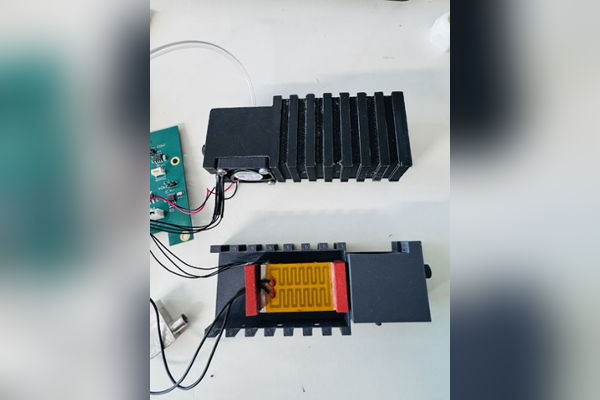
and more to Aetosense as its solution continues to be refined. (Image source: Aetosense)
Aetosense’s current prototype has 26 components, and it takes 10 minutes to assemble. Haugen and her team did not want off-the-shelf, one-off components. They wanted low-cost parts and reliable suppliers, plus the ability to scale up to thousands of units right from the start.
In working with DigiKey, Aetosense has been able to significantly reduce its bill of materials and offer a market price unmatched by competitors.
“Growing up in Thief River Falls, where DigiKey is located, I know the company is reliable and has great quality assurance on parts,” said Haugen. “At Aetosense, we need to be able to make 100s of units and be confident they are all going to work. This is a big deal for us.”
Looking ahead
With funding and credible partners backing Aetosense, the company is poised to scale its solution next year and beyond. With current customers in Singapore, Germany and England, and future expansion opportunities in California, New York and Boston, product demand is increasing for the startup. Plus, the company is receiving interest from multiple market segments, including the fire prevention and environmental sectors.
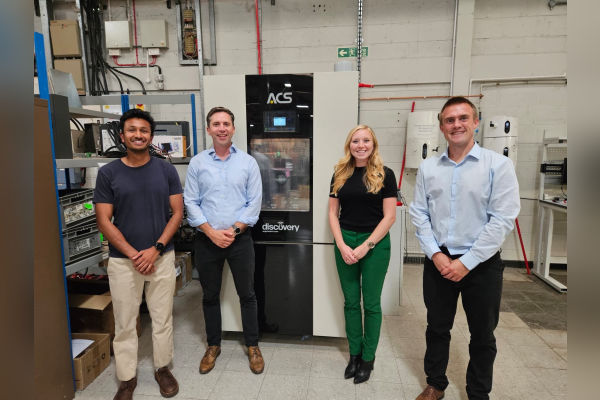
its solution in the coming years. (Image source: Aetosense)
Concerns about air quality were heightened during the pandemic and continue to be a critical issue, particularly as more companies push to bring workers back into the office. Building managers need to be proactive about ensuring there is proper indoor air quality for the safety and health of occupants.
Advanced technology like Aetosense’s ultrafine particle detectors will not only get more people safely and confidently back to work and gathering in other public spaces, but they are poised to be an important tool for capturing data insights to demonstrate air quality is meeting or even exceeding regulations in the areas where Aetosense’s unit is showing up.
To learn more about DigiKey’s parts and components that support air quality and energy usage products, you can visit www.digikey.com.
DigiKey is the global distribution leader of electronic components and automation products, providing over 17 million components from more than 3,000 quality name-brand manufacturers.?