


The new Honeywell Biocrude Upgrading technology is complementary to its renewable fuels portfolio, which includes Ecofining, Ethanol to Jet technology, Fischer-Tropsch (FT) Unicracking technology and UOP eFining, a process that converts green hydrogen and carbon dioxide into e-fuels.
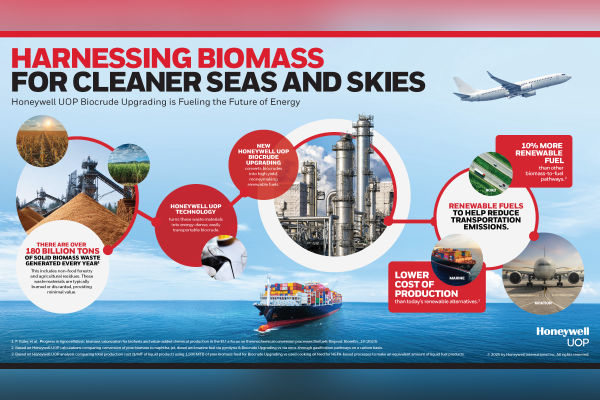
Honeywell revealed a ground-breaking technology that is said to transform forestry and agricultural waste into ready-to-use renewable fuels for industries, including the maritime sector. The method uses inexpensive and readily available biomass sources, such as wood chips and crop leftovers, to create lower-carbon marine fuel, gasoline, and sustainable aviation fuel (SAF).
These ready-to-use or “drop-in” fuels offer ship operators a less expensive and carbon-intensive substitute for conventional heavy fuel oil. This renewable marine fuel can increase a vessel’s range without requiring expensive engine upgrades because it has a higher energy density than many existing biofuel alternatives.
Transport expenses can be minimized by converting plant and agricultural waste into lower carbon biocrude at the feedstock collecting sites. Biocrude may then be refined at large facilities to create SAF, gasoline, or marine fuel thanks to Honeywell’s new process technology. This aids in resolving long-standing issues in turning biocrudes into fuels that perform on par with conventional fuel.
A prefabricated modular plant is one way that Biocrude Upgrading process technology can be supplied. Thus, by streamlining site building activities, Honeywell can assist clients in lowering risk and expediting project deadlines.
The launch of Honeywell’s Biocrude Upgrading process technology aligns with shipping firms’ efforts to lower their carbon footprints as a result of regulatory and consumer expectations. The primary energy source for the maritime industry since the 1960s has been heavy fuel oil, which is a byproduct of the refining of gasoline, diesel, and kerosene. It also contributes around 3% of the world’s greenhouse gas emissions.
For more than a decade, Honeywell has provided process technologies for renewable and alternative fuels using various feedstocks.
The new Biocrude Upgrading technology is complementary to its renewable fuels portfolio, which includes Ecofining, Ethanol to Jet technology, Fischer-Tropsch (FT) Unicracking technology and UOP eFining, a process that converts green hydrogen and carbon dioxide into e-fuels.
 Leadership Comments
“Honeywell’s Biocrude Upgrading technology tackles key challenges in renewable fuel production—cost and feedstock availability—by converting low-cost, locally available residues such as forest and agricultural waste into lower-carbon fuels at reduced production costs,” said Ranjit Kulkarni, Vice President and General Manager, Energy and Sustainability Solutions, Honeywell India. “The innovation reinforces our commitment to advancing India’s energy transition through scalable, sustainable, and economically viable solutions that help industries meet the nation’s clean energy goals.”
Honeywell will spotlight this and other transformative technologies at the Honeywell Growth Symposium 2025, taking place on 30-31 October in Bengaluru, India. The event will bring together business leaders, technology experts and Honeywell’s senior leadership to explore emerging technologies, co-innovate solutions, and shape the future of sustainable growth in the region.
To Know More About Honeywell’s Renewable Fuels Portfolio: CLICK HERE