


The standard for sustainable exhibitions has once again been raised by BenQ Group. The Group completed all 22 ESG goals with third-party certification at the 2025 COMPUTEX Taipei, and they implemented the new ISO 20121:2024 sustainable event management system.
According to its official release, it is the only company globally to obtain ISO 20121 certification at COMPUTEX for three years in a row, and the first company in Taiwan to be accredited under the revised standard.
BenQ Group elevated its green exhibition strategy in 2025 by curating its booth under the sustainability idea of “Together, Make the World Better” in an effort to reduce waste at large-scale shows. Building on a 15% carbon reduction in 2024, this year’s booth increased in size, employed only circular materials, and used design and reuse techniques to reduce carbon emissions by 30%. In keeping with their strong commitment to sustainable legacy, booth materials were given back to their design partner, KY-POST, for use at the 2025 SDG Asia Expo in September.
BenQ Group General Manager Joe Huang stressed that the Group has gathered 23 subsidiaries to demonstrate AI innovation and assist clients in their green transitions, as COMPUTEX continues to be a global tech standard.
Along with spearheading the adoption of ISO 20121:2024, BenQ Group’s exhibit included smart healthcare, AI financial fraud detection, and climate mitigation. It highlighted supply chain sustainability, inclusivity, responsible sourcing, and digital responsibility.
BenQ Group is dedicated to promoting sustainability and creating a green value chain with partners as the first company in Taiwan to receive certification under the new standard.
30% Carbon Reduction and Circular Reuse for a Sustainable Legacy
From 3R design in 2023 to a 15% carbon reduction in 2024 to its full-scale green exhibition 3.0 update in 2025, BenQ Group has progressed its sustainable practices. The Group greatly reduced its carbon footprint by using low-impact techniques, renting equipment, and using 100% circular materials.
The Industrial Technology Research Institute (ITRI) reports that even though the booth area was doubled, emissions from electricity use and construction decreased by more than 30% compared to 2024.
The booth installations were sent back to KY-POST for disassembly and reuse in order to prolong the material life. A traceable sustainability record will be left behind when a portion of the structure is reused at the 2025 SDG Asia Expo in September, enhancing the sustainable legacy through upstream design and cross-venue reuse.
Certified to ISO 20121:2024 – All 22 ESG Goals Achieved
BenQ Group achieved all 22 ESG targets across three pillars in accordance with ISO 20121:2024: Carbon Footprint in the Environment 100% reusable utensils, 90% digitization of printed materials, and booth design verification.
Social: more than 50% AI green smart solutions, a Green Travel Guide, and presents made from recycled booth materials.
Governance: 80% of construction materials are from Taiwan, 90% of souvenirs and gifts are supplied locally, and all catering is 100% vegan. Planning, post-event effect, and including customers, partners, schools, foundations, social welfare organizations, and suppliers were all included in these initiatives.
Among the new 2025 projects was the environment, which addressed climate change by utilizing only circular materials. Digital responsibility through AI financial fraud prevention and hospital management; sharing circular design strategies at Taipei Computer Association forums; holding campus seminars to increase students’ sustainability literacy; and livestreaming AI sessions during the expo to broaden the audience and practice digital accessibility. Governance: To generate shared value, local sourcing from B Corps, NGOs, and social enterprises should be prioritized.
Co-Creation and Prosperity: Calling on 30 Partners to Respond to Sustainable Actions
BenQ Group invited 30 sustainability partners to join its ISO 20121:2024 COMPUTEX initiative. Group companies included BenQ, Qisda, ACE PILLAR, ACE Energy, AEWIN, Alpha Networks, APLEX, Data Image, DFI, DIVA, DKABio, DSIGroup, D8AI, Ecolux, Epic Cloud, FiberLogic, Grandsys, Hitron, MetaAge, MetaGuru, Marketop Smart Solutions, Partner Tech, WiXtar.
External collaborators included KY-POST Design International, Mepax, CHINGPIAO, uCup, inBlooom, CircuPlus, and Unity Sustainability Services, contributing AI and sustainability efforts.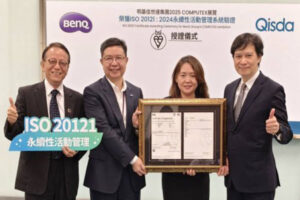
According to ISO (www.iso.org), ISO 20121:2024 emphasizes climate action, human rights, DEI, and legacy. It uses the High-Level Structure (HLS) for alignment with other systems, promotes stakeholder engagement, and introduces themes like supply chain responsibility, digital responsibility, and governance resilience—embedding sustainability into organizational culture.