For use in automotive applications, Toshiba Electronic Devices & Storage Corporation has introduced a range of 2-channel high-speed standard digital isolators. Four devices in the new “DCM32xx00 Series” support steady operation with a high data transmission rate of 50Mbps (max) and a high common-mode transient immunity (CMTI) of 100kV/?s (typ.). The AEC-Q100 standard for reliability and safety of vehicle electronic components is met by all.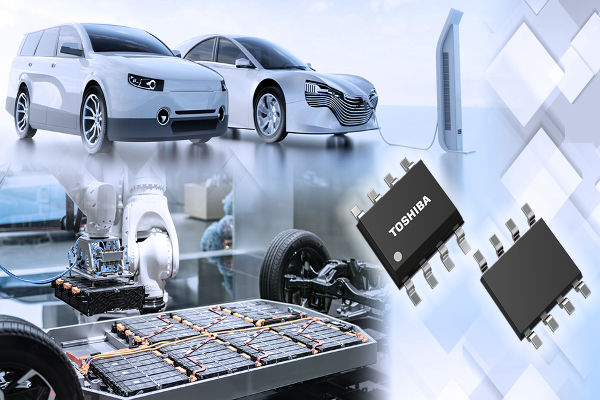
Devices that provide isolation and stop noise propagation are necessary for the safety and dependability of battery management systems (BMS) and on-board chargers (OBC) in electric cars (EV) and hybrid-electric vehicles (HEV).
Automotive standard digital isolators address the high CMTI and multi-channel high-speed communications needed by these isolation devices.
The new isolators achieve a high CMTI of 100kV/?s (typ.) by using Toshiba’s own magnetic coupling type isolated transmission technique.
This allows for steady control signal transmission, helps to stable equipment functioning, and provides high level resistance to electric noise between input and output in isolated signal transmission.
Additionally, a data transmission rate of 50Mbps (maximum) and a low pulse width distortion of 0.8ns (typical) are attained. I/O interfaces with CAN communications are among the 2-channel high-speed communication applications that the new products can be used for.
Toshiba already mass produces 4-channel automotive standard digital isolators, and has now extended its product lineup to 2-channel small SOIC8-N packages.
Going forward, the company will expand its range of channels and packages for automotive and industrial equipment.
It will continue to provide high-quality isolation devices and photocouplers that support the reliability and real-time data transmission required by automotive equipment.
[1] Test conditions: VDD1=VDD2=4.5 to 5.5V, VCM=1500V, Topr=-40 to 125°C
[2] Test conditions: VDD1=VDD2=4.5 to 5.5V, Topr=-40 to 125°C
[3] CAN (Controller Area Network): A serial communications standard, primarily used for automotive communication networks.
- Battery management system (BMS)
- Automotive on-board charger (OBC)
- Inverter control
Features
- High common mode transient immunity: CMTI=100kV/?s (typ.)[1]
- High-speed data rate: tbps=50Mbps (max)[2]
- Low pulse width distortion: PWD=0.8ns (typ.)[2]
- 2-channel support (see Main Specifications for details on each device):
One forward channel and one reverse channel; Two forward channels and no reverse channel
Applications
Automotive equipment
Availability
Shipments begin today.