


A decade ago, smart homes were defined by isolated devices—a Wi-Fi light bulb, a thermostat app or a smart security lock. Now, they’re evolving into intelligent ecosystems. Today, the modern home is more than just a place to stay; it’s an extension of one’s mood, habits, and routines. As technology becomes inseparable from life, smart home automation is no longer a luxury but a fundamental aspect for convenience, personalisation and comfort.
A Growing Ecosystem
Beyond convenience, home automation can redefine everyday living. Routine tasks become effortless with remote control access and intelligent presets, allowing for an unparalleled level of ease. Personalised comfort is no longer a luxury but a standard; automated temperature control, adaptive lighting, and customised settings ensure that your home aligns perfectly with your lifestyle.
According to a recent article by Swift Beacon, it is estimated that the number of smart homes will increase from 411 million to a whopping 470 million within a year. The Precedence Research states that the smart home market is projected to surge nearly 1,000% to $1.4 trillion by 2034. While this data speaks volumes, it also reveals an underlying shift in how we relate to our living spaces. Smart homes are no longer about solving a specific problem; they consist of various interconnected systems that communicate seamlessly.
In fact, this global shift toward smart home platforms, such as Amazon Alexa, Google Nest, Apple HomeKit, or Samsung SmartThings, highlights the move from product-first to platform-first thinking. These platforms unify all devices under a single roof, allowing for more flexible and convenient living experiences.
Personalised Comfort
Platforms today offer the ability to tailor spaces to reflect deeply individual needs—whether that’s setting preferences for different family members or coordinating with domestic staff through simple, visual interfaces. In culturally diverse households, this kind of inclusive design can make a significant difference.
Curtains and blinds responding to your routines, lights that adjust based on your moods and playlists curated just for you; the goal here is to calibrate, because the best systems aren’t the ones with the highest features but ones that require the least amount of attention and manual intervention.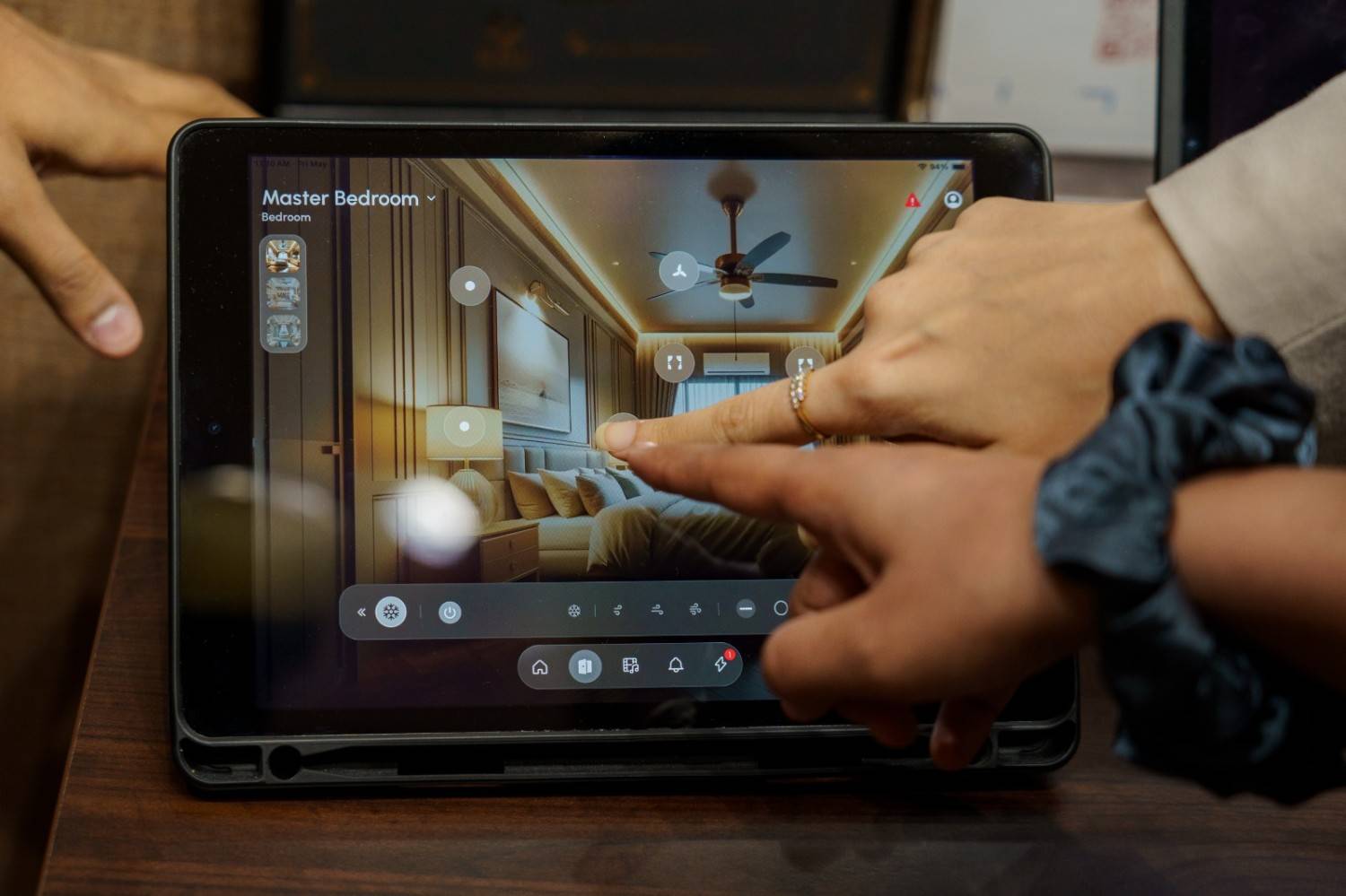
The Question of Sustainability
Smart homes use intelligent technology to automatically power down lighting and cooling when rooms are empty, eliminating energy waste effortlessly while ensuring optimal comfort. New systems are constantly being explored and developed to track usage patterns and suggest efficiency tips for users, as well as respond to real-time grid data to reduce energy consumption during peak hours.
Globally, studies indicate that access to real-time energy data can help reduce consumption by up to 15%—a modest shift that can have a significant impact on your bills and the environment.
For instance, homes in warmer climates can integrate automated blinds that close during peak daylight to reduce indoor temperatures by as much as 5°C, which in turn minimises reliance on air conditioning. As climate consciousness becomes increasingly crucial to home design, the smart home brain must now consider comfort, convenience and conservation.
Smart, Secure and Seamless
Questions of security breaches and privacy are inevitable when it comes to smart homes. In the last few years, several incidents involving hacked cameras to compromised voice control have led to safety concerns.
The stakes are higher in multi-generational homes, and that means a stronger safeguard, which involves data encryption, two-factor authentication and a stronger commitment to transparency on how data is collected and used.
Smart security systems are equipped to detect suspicious activities and intruders by identifying unusual login attempts, rapid system data spikes or irregular access patterns and flag them. Integrating features such as biometric authentication, facial or voice recognition allows secure access only to registered users of the space or app.
Some systems are equipped to detect suspicious behaviour, like unusual login attempts, rapid data spikes, or irregular access patterns, and flag them in real-time. Others use biometric authentication, such as facial or voice recognition, to allow secure access only to registered users. The goal is not just to lock the door, but to ensure the door recognises you before it opens.
A Silent Companion for Your Well-Being
Perhaps the most transformative aspect of all is the increasing empathy built into these homes. As technology becomes intuitive and immersive, it also engages with humans on a more personal and emotional level by understanding our needs, moods and routines.
A typical room might identify increased stress levels in your voice and adjust the ambient lighting and sounds to calm you down. Users can also preset experiences focused on wellness, sleep and rest on smart home apps.
Well-being, once confined to spas and retreats, is now being woven into the design of everyday life. Intelligent homes can monitor air quality and activate purifiers. Bedrooms can be fine-tuned with circadian lighting, white noise and temperature adjustments, which help us to wind down.
Architects and interior designers are collaborating with wellness experts and technologists to integrate health-oriented design cues into layouts, such as home gyms that auto-light during your preferred workout hours or meditation nooks that activate ambient settings for a specific hour.
In this way, a home becomes a silent companion, working in the background for one’s well-being. As the spaces we occupy become more in line with our lifestyles, routines, and rhythms, they begin to become true extensions of ourselves.
Predictive, Ambient and Human-Centric
Looking ahead, the evolution of smart living is far from over. The current wave of smart living systems will likely move from reactive to predictive ones. Homes will soon be able to detect early signs of device failure and security breaches.
Interfaces will continue to fade into the background by relying less on screens and more on human gestures, emotions and voices. Intelligence will be ambient, and a home will understand who’s in the room, what their needs are, and how best to serve them.
About The Author:
Muskan Salgia, VP, Residential Solutions at CasaDigi, a leading pioneer of luxury home automation solutions.
Inheriting an esteemed legacy from its parent brand DigiValet—trusted for its technological prowess by the world’s foremost hospitality, real estate and healthcare brands—CasaDigi promises to usher in the same degree of luxury hospitality experience to upscale residences.
Passionate about the intersection of lifestyle and technology, Muskan Salgia leads the CasaDigi team with her strong analytical skills, an eye for design and an innate curiosity for innovation.
A graduate from the Wharton School of Business at the University of Pennsylvania, with majors in finance and strategy and a minor in computer science, Muskan Salgia brings a sense of detail and process to drive the platform’s growth globally.
Under her stewardship, the brand recently launched CasaDigi 4.0, a next-generation platform that marks a paradigm shift in the perception of home automation products. The discreet system grants homeowners unprecedented autonomy over every aspect of their lifestyle, integrating experiential features such as butler service, personalised meal plans, and even multi-home support.
A speaker at the Cedia Tech Summit 2022 and 2023, Muskan is an active voice in the domain of experiential technology and regularly participates in panels and conferences to represent the brand globally. She has also been consistently featured in Smart Home Magazine, India’s leading magazine that covers the latest trends in home control solutions and smart devices.