Q.ANT’s Stuttgart Facility Becomes a Beacon of Photonic Innovation, Ushering in a New Era of High-Speed, Sustainable Computing
State-of-the-Art Line for Next-Gen Photonic AI Chips
In the heart of Stuttgart, Germany, tech major Q.ANT has unveiled a cutting-edge production line for photonic AI chips, marking a major shift in how the world approaches AI hardware. This facility exclusively manufactures chips using thin-film lithium niobate (TFLN)—a crystal material prized for its superior optical properties.
Unlike traditional silicon-based chips that rely on the movement of electrons, TFLN-based chips enable ultra-fast manipulation of light for data transmission and computation, drastically improving performance and energy efficiency.
Transforming Semiconductor Economics
Q.ANT’s breakthrough doesn’t stop at technology—it also revolutionizes semiconductor production strategy. Instead of building new fabrication plants from scratch, the company repurposes existing semiconductor facilities with photonic upgrades. This reduces:
- Capital expenditure (CapEx)
- Environmental impact
- Time-to-market for AI chip solutions
With a €14 million investment, Q.ANT positions itself at the forefront of cost-effective, scalable, and sustainable chip manufacturing.
Leadership Perspective: Bold Vision for Global Impact
Dr. Michael Förtsch, CEO of Q.ANT, described the development as setting “a new benchmark for AI chip manufacturing,” and emphasized the importance of energy independence and supply chain resilience, especially in the face of growing geopolitical tensions and silicon shortages.
Photonic Chips: Powering the Next Generation of AI
From Electricity to Light: A Paradigm Shift in Processing
How Photonic Neural Processing Units Work
Photonic NPUs (Neural Processing Units) replace electrical currents with photons to perform data-intensive computations. The core components include:
- Waveguides to guide light
- Modulators to encode data onto light
- Interferometers to perform mathematical operations via light interference
- Photodetectors to interpret output signals
These chips process information through optical interference patterns, achieving lightning-fast matrix multiplications—a fundamental operation in AI model training and inference.
Real-Time Speed with Minimal Heat
By leveraging light instead of electrons, photonic chips virtually eliminate thermal bottlenecks. This leads to:
- Higher clock speeds (several GHz)
- Stable performance under load
- Longer chip lifespan due to reduced thermal wear
The Power of Parallelism with Wavelength Multiplexing
Simultaneous Multistream Processing
One of photonics’ most powerful features is Wavelength-Division Multiplexing (WDM). Multiple wavelengths (colors) of light travel concurrently through a single waveguide, each carrying separate data channels. This means:
- Massive parallel processing
- Unmatched throughput and bandwidth
- Lower power draw compared to parallel electronic architectures
Hybrid Computing for Precision AI
While analog photonic systems excel at raw speed, digital electronics still offer better accuracy for certain tasks. As a result, hybrid photonic-electronic architectures are emerging, combining the best of both worlds:
- Photonics handle high-volume computations
- Electronics manage data conversion and accuracy corrections
Why Photonic Chips Matter for the Future of Computing
Performance and Sustainability in Perfect Harmony
Benchmark Results: 50x Faster, 30x Greener
Recent internal benchmarks at Q.ANT show that photonic chips can:
- Deliver 50 times the processing speed
- Use 30 times less energy
- Eliminate cooling infrastructure in many use cases
- Minimize carbon footprint in data centers
These metrics make photonic NPUs an ideal fit for applications such as:
- Large-scale AI model deployment
- Real-time image and speech recognition
- Smart cities and IoT infrastructure
- Climate modeling and scientific simulations
Solving the Data Center Crisis
Infrastructure Limits Are Near
Global data centers are reaching their power and thermal limits, especially with the explosion of generative AI, LLMs, and high-resolution streaming. Q.ANT’s photonic chips offer a sustainable path forward, reducing:
- Cooling costs
- Hardware footprint
- Operational carbon emissions
Industry Expert Insights
Prof. Dr. Jens Anders, CEO of the semiconductor institute collaborating with Q.ANT, remarked:
“These chips set a blueprint for energy-efficient next-generation computing. As AI demand explodes, our traditional infrastructure simply can’t keep up—this is the answer.”
What This Means for the Global Tech Landscape
Europe Steps Up in the Semiconductor Race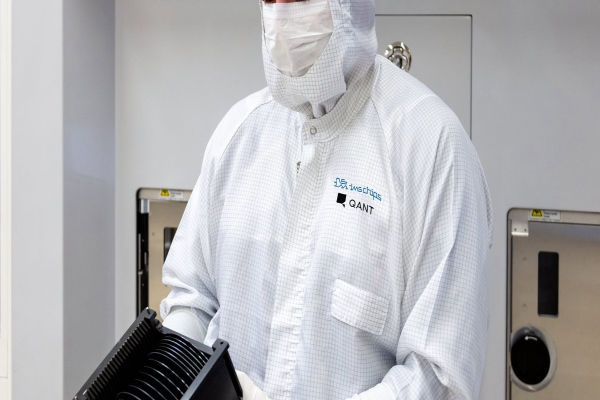
With this breakthrough, Europe makes a strategic move to reduce its dependence on non-European chipmakers. Q.ANT’s project serves as a lighthouse initiative for sovereign AI infrastructure.
- Reduces reliance on Asian chip supply chains
- Strengthens Germany’s tech leadership
- Opens doors for EU-wide photonics collaborations
The Road Ahead for Photonic AI
While challenges remain—such as integration complexity, scaling photonic components, and ensuring analog accuracy—the potential of photonic chips is clear. As hybrid architectures mature, the future of AI computing could very well be powered by light.