
Singapore’s semiconductor ecosystem is refocusing squarely on photonics and talent as it prepares for the next big wave of chip-driven growth. The Singapore Semiconductor Industry Association (SSIA) has unveiled a new industry-led photonics committee and a portfolio of talent-development partnerships, cementing its ambition to become a global hub for advanced semiconductor technologies.
Backed by S$800 million in public R&D funding under the Research, Innovation and Enterprise 2030 (RIE2030) plan, Singapore is lining up institutional support with strong private?sector collaboration to deepen capabilities in integrated photonics, advanced packaging, and power electronics.
This dual-track strategy pushing technology depth while overhauling the workforce positions the city-state as a key node in the global AI and high-performance computing supply chain.
A New Photonics Committee For Regional Connectivity
At the core of SSIA’s latest move is the launch of a photonics committee built to knit together an “intricate regional photonics network” that links Singapore with partners in Taiwan, the Netherlands, and other advanced semiconductor markets.
The committee’s job is to align integrated photonics and co-packaged optics with Singapore’s existing strengths in advanced packaging and test, creating a coherent roadmap for the region.
Photonics is fast becoming a critical enabler for AI-driven data centres, next-generation communications, and high-speed interconnects, where light-based data transmission can outpace traditional electrical signalling by a wide margin.
By setting up a dedicated committee, SSIA is giving the industry a single platform to coordinate joint roadmaps, share best practices in design and manufacturing, and reduce the risk of betting on new photonics-based products.
This move also fits Singapore’s broader goal of becoming a trusted hub for high?impact semiconductor technologies in an era of supply?chain uncertainty.
With around 6% of GDP tied to semiconductors, the government and industry are treating this not just as a growth sector, but as a strategic lever for economic resilience and innovation.
From Deep-Tech To Mid-Career Transitions
Alongside the photonics push, SSIA has locked in three major talent-focused partnerships that span the full talent lifecycle from fresh graduates and mid-career switchers to cross-border ecosystems.
NTUC LearningHub – Upskilling The Semiconductor Workforce
SSIA has signed a memorandum of understanding (MOU) with NTUC LearningHub to support workforce transformation across the semiconductor ecosystem.
The Collaboration Will Focus On:
- Designing industry-relevant training programmes in areas like agentic AI, AI-driven robotics and automation, process excellence, and supply-chain resilience.
- Facilitating mid-career transitions into semiconductor roles, helping professionals from other sectors move into engineering and technical functions.
- Building foundational semiconductor knowledge for new entrants, especially as the sector pushes into advanced packaging, AI-class hardware, and emerging materials.
With Singapore’s tight labour market, opening these pathways is critical to scaling expertise quickly as fabs, OSATs, and design houses ramp projects and adopt new technologies.
SGInnovate – Deep-Tech Talent Pipeline
SSIA has also partnered with SGInnovate, the government-backed deep-tech incubator, to strengthen Singapore’s deep-tech semiconductor talent pipeline. Their work will pull in initiatives such as:
- Summation, SGInnovate’s deep-tech apprenticeship programme, which places talent in high-impact R&D projects.
- PowerX, a mid-career upskilling programme that helps workers move into highly specialised roles in areas like photonics and advanced packaging.
Together, both organisations will conduct ecosystem research to map industry maturity, capability gaps, and talent demand across emerging semiconductor technologies. That insight will help universities, polytechnics, and private training providers fine?tune their offerings to match real-world needs.
 India Partnership – Building A Trusted Semiconductor Corridor
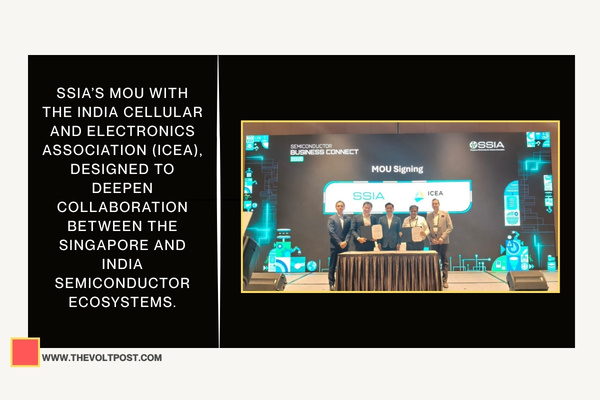
Perhaps the most strategic move is SSIA’s MOU with the India Cellular and Electronics Association (ICEA), designed to deepen collaboration between the Singapore and India semiconductor ecosystems. The partnership aims to:
- Establish a robust and trusted semiconductor corridor between the two countries, focusing on supply-chain partnerships, technology co-development, and two-way business collaboration.
- Jointly study supply-chain complementarities and readiness, pinpointing where Indian and Singaporean companies can plug into each other’s value chains from design and IP to manufacturing, advanced packaging, and system integration.
For India’s growing semiconductor ecosystem driven by India Semicon India, the DLI, and upcoming fabs this link offers access to Singapore’s strengths in advanced packaging, R&D infrastructure, and global market channels. For Singapore, it opens a vast, talent-rich pool and bolsters regional supply-chain resilience at a time when global linkages are under pressure.
Together, these moves show Singapore turning its semiconductor ecosystem into something more than just a collection of fabs and design houses.
To Know More: CLICK HERE