



Lumotive has achieved a major breakthrough in solid-state LiDAR tech, pairing its LM10 Light Control Metasurface (LCM) with Adaps Photonics’ ADS6311 “Hawk” dTOF sensor to create a fully solid-state 180° LiDAR platform that hits 30 frames per second for outdoor autonomy applications.
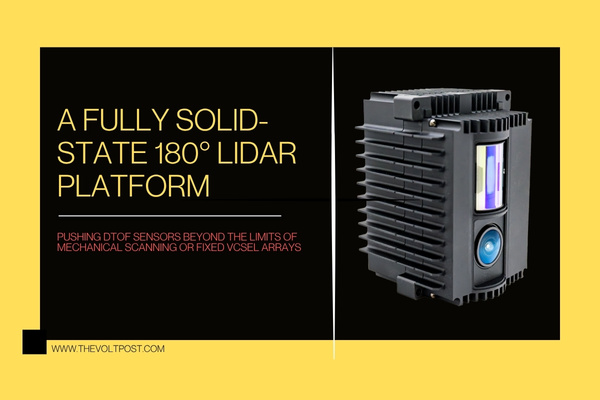
This eliminates blind spots entirely, tracks fast-moving objects in real time, and cuts costs by reducing the number of sensors needed for advanced safety and autonomy requirements.
Key advantages:
- 180° horizontal coverage (plus up to 140° vertical, software-configurable) removes dangerous blind spots
- 30 fps full-frame scanning (up to 900 Hz in regions of interest) doubles typical dTOF performance
- 50-meter range with reliable operation in rain, dust, and low visibility
- Software-defined sensing lets you program scan patterns, resolution, and regions of interest dynamically
- All-solid-state reliability-no moving parts means better durability and vibration resistance
The LCM electronically steers light at semiconductor speeds, pushing dTOF sensors beyond the limits of mechanical scanning or fixed VCSEL arrays. It delivers cleaner point clouds by reducing multipath interference, blooming, and sensor crosstalk.
The reference design is now available to LiDAR developers and module makers building next-gen sensing solutions.
Leadership Comments
“180° perception is already a breakthrough, but Lumotive’s real innovation is achieving it while simultaneously doubling frame rate, extending range and improving point cloud quality. This will advance a long list of robotics, heavy equipment and smart infrastructure applications that have been waiting for highly accurate 3D sensors with wider coverage to achieve their safety and autonomy objectives,” said Apurva Jain, SVP of Product & Marketing at Lumotive. “Our LCM platform addresses fundamental limitations that have held back autonomous systems by delivering software-programmable beam steering with semiconductor manufacturing scalability – turning optics into a programmable layer that accelerates the entire dTOF ecosystem.”
 “The combination of Lumotive’s programmable LCM beam steering with our ADS6311 ‘Hawk’ chip with Adaps Photonics’s proprietary dTOF architecture unlocks a new class of sensing performance,” said Andrew Lee, VP of System at Adaps Photonics. “By enabling ultra-wide 180° coverage and higher frame rates without mechanical scanning, Lumotive’s platform allows advanced dTOF sensors to operate at capabilities that were previously not achievable. This collaboration demonstrates how programmable optics and high-performance time-of-flight sensing at the chip-level can accelerate the next generation of autonomous systems.”
To Know More About Lumotive’s Programmable Optical Semiconductor Technology, CLick Here