



As drones move from niche deployments to critical infrastructure across agriculture, logistics, and defense, the question of safe, high-performance energy storage is becoming harder to ignore. Bengaluru-based Dreamfly Innovations is betting that the answer lies not just in better batteries, but in fundamentally rethinking how they are built, cooled, and controlled.
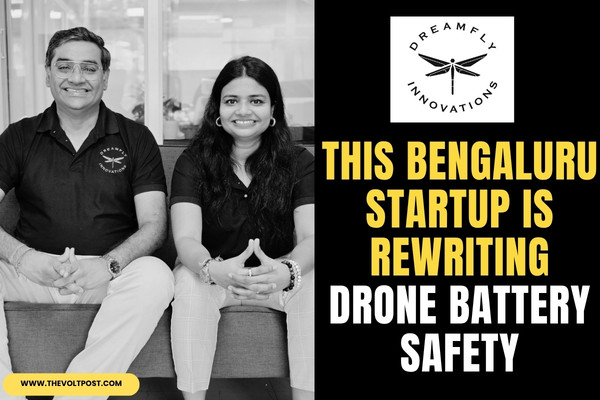
In a conversation with The Volt Post’s Editor, Niloy Banerjee, Kajal Shah, Co-Founder and CEO and an IISc-trained materials scientist, outlines how the company is engineering “non-explosive” battery systems for extreme environments and urban air mobility. Joined by Co-Founder Saurabh Markandeya, an IIT graduate focused on rugged battery electronics, the leadership team discusses thermal innovation, certification challenges, and what it will take to build a globally competitive deep-tech battery company from India. The Volt-Age Edited Excerpts Below.
Your solid-state batteries and graphene-based batteries architecture is said to work from -40°C all the way to +65°C. What material science breakthroughs actually make that temperature range possible?
DFI’s battery architecture relies on a proprietary thermal composite material system designed to absorb heat from cells at extremely high rates, distribute it uniformly across the battery pack, and dissipate it efficiently through the battery surface.
This system can manage heat fluxes nearly 10 times higher than conventional EV batteries while adding only around 3% extra weight.
At sub-zero temperatures, the composite material conserves and redistributes heat across the pack, maintaining temperature uniformity without requiring active heaters.
At high temperatures, it rapidly absorbs and spreads heat generated during high-discharge operations, keeping overall temperature rise below 10°C even at high C-rates.
Graphene-enhanced thermal pathways further improve heat transfer and reduce localized thermal buildup, enabling operation across extreme environmental conditions.
You talk about “non-explosive battery” chemistry as essential for urban air mobility. Can you walk us through the electrochemical design that removes thermal runaway risks, and how does that affect certification timelines for drone operators in crowded cities?
DFI’s “Safety-First” architecture combines advanced thermal composites, graphene-enhanced heat-spreading pathways, intelligent battery management, and fire-containment structures.
The system is designed to prevent thermal runaway before it begins by rapidly removing heat from stressed cells and identifying underperforming cells through real-time diagnostics.
A key differentiator is DFI’s proprietary gallium nitride (GaN)-based battery controller, which can isolate a failing cell or cell stack before the issue spreads across the battery pack.
In addition, ceramic fibres, epoxy composites, mica barriers, and honeycomb structures are used to prevent cell-to-cell fire propagation and contain thermal events within individual modules.
Regarding certification, DFI believes non-explosive battery systems with active redundancy and fire-containment capabilities will become a critical requirement for future urban air mobility regulations. The company also references compliance expectations aligned with international aviation safety frameworks and future standards similar to AIS-156 for drone batteries.
With partnerships alongside Tata and L&T, what’s your current production capacity in battery pack units per month? And what’s your roadmap to scale and meet demand from India’s projected $13 billion drone market by 2030?
We’re currently working with leading global cell technology providers to deliver high-performance battery systems to customers, including major Indian industrial players.
Simultaneously, the company has begun engaging with multiple Indian cell manufacturers to explore partnerships around advanced cell chemistries.
Its long-term objective is to gradually adopt locally manufactured cells as the domestic ecosystem matures, ultimately enabling the production of advanced air-mobility battery packs that are fully manufactured in India. However, the company has not disclosed production capacity figures or monthly output numbers.
 India still imports most advanced battery cells. What percentage of your battery stack is sourced domestically, and which critical components like cathode materials or BMS chips which still need to be imported?
India’s advanced battery ecosystem is still evolving, particularly when it comes to aerospace-grade cells and specialised semiconductor components.
At present, we work with a combination of global technology partners and domestic suppliers to ensure access to best-in-class battery technologies for our customers.
At the same time, we are actively engaging with Indian cell manufacturers and component suppliers to increase localisation across the value chain.
Our long-term vision is to build advanced drone and urban air mobility battery systems that are increasingly designed, engineered, and manufactured in India while maintaining global performance and safety standards.
Solid-state batteries have always been expensive. How does your per-Wh cost compare to conventional Li-ion cells today, and when do you expect to reach cost parity that makes drone operations economically viable for small-scale farmers?
For high-performance drone applications, total mission efficiency, safety, reliability, and lifecycle performance are often more important metrics than upfront cell cost alone.
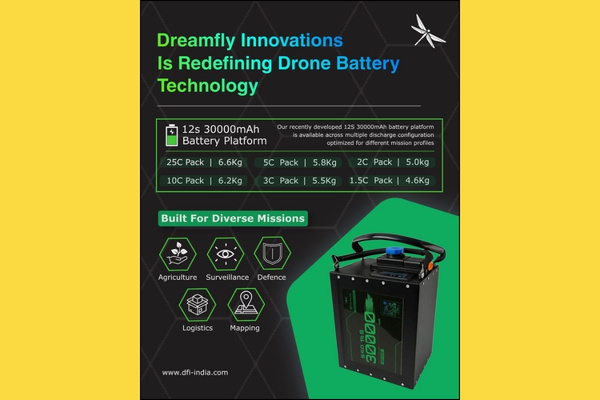
Our focus has been on delivering batteries that improve operational reliability, thermal safety, and mission readiness for demanding applications such as agriculture, logistics, surveillance, and defence.
As the ecosystem matures and advanced battery manufacturing scales both globally and within India, we expect the cost of next-generation battery technologies to become increasingly competitive.
We believe that innovation in materials, manufacturing, and supply-chain localisation will play a key role in making advanced battery solutions accessible to a wider range of drone operators.
Drone manufacturers need batteries that plug seamlessly into existing power management systems. What communication protocol do you use for battery-to-drone telemetry, CAN, I2C, UART, and how quickly can OEMs integrate DFI packs into their platforms?
Interoperability is an important consideration for drone OEMs. Our battery systems are designed with integration flexibility in mind, enabling compatibility with a wide range of drone platforms and mission profiles.
We work closely with OEM partners during the integration process to ensure seamless communication between the battery system, flight controller, and power management architecture.
Our engineering teams support customers throughout deployment to ensure optimal performance and safety across different drone platforms.
How do you position against global solid-state battery players like QuantumScape or Factorial Energy? What gives Dreamfly Innovations a strong foothold in India’s emerging drone battery market?
Companies such as QuantumScape and Factorial Energy are focused primarily on automotive-scale energy storage challenges.
Our approach is different. We are focused on solving the unique requirements of drone and advanced air mobility applications, where power density, thermal management, weight optimisation, safety, and operational reliability are critical.
Our advantage lies in combining battery technology, thermal-material innovation, intelligent battery management systems, and deep domain expertise in aerospace and drone operations.
In addition, our batteries have already accumulated significant field deployment experience across multiple drone segments in India, providing valuable operational feedback that helps us continuously improve our products.
DGCA drone regulations are changing fast. What certifications have you secured so far (ISO 26262, UN 38.3, others), and what’s your timeline for obtaining type certification for commercial aviation applications?
Battery safety is a foundational requirement for the future of drone operations and urban air mobility. We closely monitor evolving regulatory frameworks and continue to align our technology development with emerging safety and certification requirements.
As advanced air mobility applications evolve, we believe battery systems will need to meet increasingly stringent standards related to thermal safety, fire containment, fault tolerance, and system redundancy.
Our ongoing investments in battery architecture, thermal management, and intelligent battery control systems are aimed at supporting future certification pathways and regulatory requirements.
Beyond Avaana Capital’s backing, what’s your funding strategy for the next 18-24 months to fund R&D, scale manufacturing, and grow your engineering team, especially in materials science and power electronics?
Innovation in advanced battery technology requires long-term investment across research, engineering, testing, and manufacturing.
Our priority remains building strong technology foundations and translating research into commercially deployable products for the drone and advanced air mobility sectors.
As the market continues to expand, we will remain focused on strategic partnerships, technology development, manufacturing scale-up, and talent acquisition to strengthen our capabilities in areas such as battery materials, thermal management, power electronics, and intelligent battery systems.
Finally, what are your thoughts on India’s growing deep-tech startup ecosystem? What key challenges are you seeing, and where do you see the biggest opportunities emerging in this space?
 India’s deep-tech ecosystem is entering a very exciting phase. We are seeing increasing collaboration between startups, industry, investors, research institutions, and government bodies, particularly in areas such as aerospace, mobility, energy storage, robotics, and advanced manufacturing.
The biggest challenge remains the long development cycles and capital requirements associated with deep-tech innovation. Unlike software businesses, hardware and materials-based technologies require sustained investment, extensive testing, and robust manufacturing ecosystems.
At the same time, this presents a tremendous opportunity. India has the potential to become a global innovation hub in areas such as drone technology, advanced batteries, urban air mobility, space technologies, and next-generation manufacturing. Companies that can combine world-class engineering with scalable manufacturing will be well-positioned to lead this transformation.