



Microchip Technology has rolled out Revision 2.0 of its PolarFire FPGA Ethernet Sensor Bridge, a production-ready board that leverages NVIDIA Holoscan Sensor Bridge (HSB) technology to standardize multi-sensor connectivity over 10Gb Ethernet.
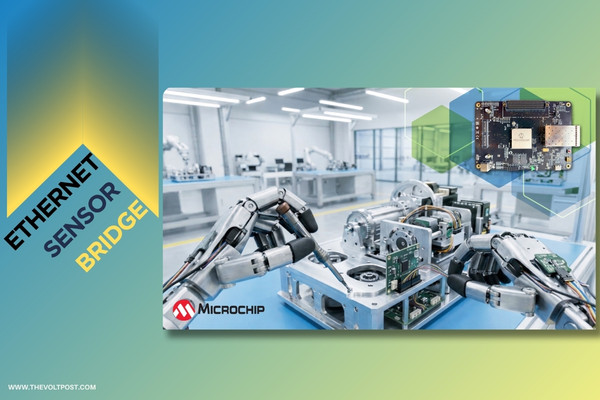
The new PolarFire FPGA Ethernet Sensor Bridge rollout addresses the growing demand of Edge AI as it pushes sensor architectures toward tighter, more power-efficient designs that still scale securely across medical, industrial and robotics workloads.
The new board trims the footprint by 60 percent, doubles camera support, runs off USB-C power for easier rack deployment and lands at a lower price than the first generation.
This let designers swap out tangled, multi-interface sensor cabling for cleaner, scalable Ethernet links that cut system cost and simplify the bill of materials especially on NVIDIA edge platforms like Jetson and IGX.
What’s new in Rev 2.0
- Up to four cameras supported, with a connector scheme compatible with NVIDIA Jetson modules.
- On-board optical latency measurement circuitry enables end-to-end latency validation from sensor capture through AI inference using the NVIDIA Latency Display Analysis Tool.
- An FPGA Mezzanine Card (FMC) expansion connector opens the door to future features, while native support spans interfaces such as MIPI CSI-2, I²C, UART and GPIO.
- The flexible I/O plan can handle multiple video and sensor protocols like SLVS-EC 2.0, 12G-SDI, HDMI and DisplayPort without redesigning the core platform. A standard PMOD connector adds further extensibility.
By leaning on the power efficiency, security and reliability of PolarFire FPGAs, the HSB-enabled board delivers real-time, multi-sensor processing over Ethernet in compact, power-constrained edge environments. Built-in safety and security features are aimed at protecting edge AI devices and supporting long-term, reliable deployments.
Faster development with Holoscan SDK
Integration with the NVIDIA Holoscan SDK accelerates development by providing optimized libraries, AI models and reference applications tailored to sensor?bridge workloads.
For teams building on Jetson AGX Orin and IGX, the platform ships preprogrammed with dual MIPI CSI-2 support, converting video streams to 10G Ethernet for fast edge-to-cloud integration.
Additional protocols including CoaXPress, SLVS?EC, SDI and JESD204B are in development.
What’s in the box
The offering bundles cameras, cables, a reference design, board schematics and design collateral, with RTL development supported by Microchip’s Libero SoC Design Suite.
Integrated Microchip timing and power-management ICs including the MCP16701 PMIC are validated for PolarFire FPGAs, helping teams ship production-ready power and clocking while reducing third-party integration risk.
That integrated approach is designed to shorten development cycles, lower total cost of ownership and de-risk Ethernet-based AI inferencing at the edge particularly in robotics and industrial automation, where deterministic latency, power efficiency and compact form factors are non-negotiable.
Leadership Comment
 “Developers want to spend their time building high-value edge AI applications, not stitching together proprietary sensor interfaces,” said Shakeel Peera, vice president of Microchip’s FPGA business unit. “With low power PolarFire FPGA technology at its core, this second-generation Ethernet sensor bridge delivers a power-efficient, secure foundation in a significantly reduced form factor to help teams move faster from development to deployment in edge AI systems.”
More details and resources are available on Microchip’s PolarFire Ethernet Sensor Bridge page and NVIDIA’s Holoscan Sensor Bridge overview.
To Know More About Microchip’s Full Portfolio of PolarFire Devices, CLICK HERE
Pricing and Availability
The Rev 2.0 PolarFire FPGA Ethernet sensor bridge can be purchased directly from Microchip or contact a Microchip sales representative or authorized worldwide distributor.