


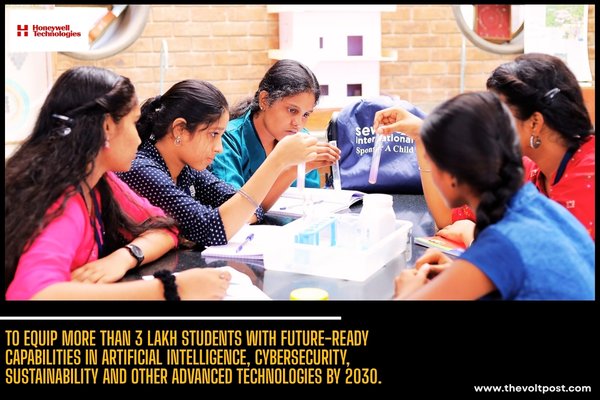
Honeywell Technologies is ramping up its education push in India with a fresh commitment to equip more than 3 lakh students with future-ready capabilities in artificial intelligence, cybersecurity, sustainability and other advanced technologies by 2030. The effort falls under the company’s flagship Saksham initiative, which has already reached over 13 lakh beneficiaries in the last decade.
Partnerships to drive scale
To deliver the large-scale skilling programs, school transformation initiatives and innovation-led interventions that will impact 3 lakh students across India, Honeywell Technologies is partnering with the Indian Institute of Technology Bombay, BharatCares, the Ladli Foundation and the Foundation of Science, Innovation and Development, an arm of the Indian Institute of Science Bangalore.
As industries accelerate adoption of digital and sustainable technologies, building a future-ready workforce has become critical to sustaining economic growth and competitive advantage.
However, India is witnessing a growing gap between industry demand and talent readiness. According to the India Skills Report 2026, employability has risen to 56.35 percent, yet demand for skills in AI, data, cloud and cybersecurity continues to outpace talent supply.
Key programs under Saksham
To bridge the gap between talent demand and readiness in India, key skilling programs under Saksham include:
IIT Bombay-Honeywell Technologies Centre of Excellence for Future Skills and Innovation
The centre will reach over 1 lakh undergraduate students across the country through its network of colleges on expert-led courses across five tracks: Sustainability Reporting, Sustainable Finance, Energy Security, Sustainability Infrastructure and Policy Advocacy.
It will also support applied research projects, research fellows and startup incubation, strengthening industry-academia collaboration.
Honeywell Technologies Future Skills Edge
Aims to train 2 lakh students in AI and cybersecurity through hybrid, project-based learning, supported by four Centres of Excellence in government institutions in Maharashtra, Haryana, Karnataka and Telangana.
Implemented with BharatCares, the program targets 50 percent women participation and aligns with national initiatives such as Skill India, NEP 2020 and Digital India.
Honeywell Technologies Saksham School Transformation Program
In partnership with Ladli Foundation, Honeywell Technologies will transform 12 government and government-aided girls’ schools across Maharashtra, Delhi, Haryana and Karnataka, benefiting more than 12,000 underprivileged students.
The program integrates smart classrooms, digital skills training, health and hygiene awareness and leadership development, alongside teacher training and community engagement.
Startup Incubation and Innovation Support
Honeywell Technologies has been working with FSID-IISc since 2018 and by the end of 2030 will support nearly 75 early-stage deep-science startups and Entrepreneurs-in-Residence across areas such as AI, renewable energy, sustainability, cybersecurity and digitization.
Startups will receive seed funding, mentorship and access to advanced R&D infrastructure, with a focus on founders from underrepresented communities.
Prime Minister’s Internship Scheme
Honeywell Technologies engages over 50 underprivileged interns every year through the Prime Minister Internship Scheme.
The initiative aims to provide graduating students with hands-on industry exposure, mentorship and practical workplace experience. Bridging the gap between academic learning and industry needs, the program enables upskilling, career readiness and employability enhancement.
Philanthropic arm drives execution
 The flagship Saksham initiative is implemented through Hometown Solutions India Foundation, Honeywell’s philanthropic arm in India.
It is designed to expand access to quality STEM education, drive inclusive and sustainable growth and build a pipeline of future-ready talent aligned with evolving industry needs, while supporting India’s ambition to become a global technology and innovation hub.
To Know More: CLICK HERE