


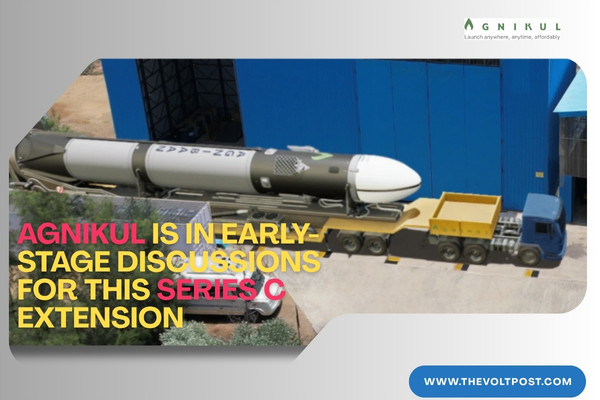
India’s spacetech trailblazer Agnikul Cosmos is negotiating a $50-75 million funding extension to supercharge its 3D-printed rocket production. Valued at a steady $500 million, the Chennai startup aims to ramp up launches amid booming small satellite demand.
Funding Talks Heat Up
Agnikul is in early-stage discussions for this Series C extension, following a $17 million raise in November 2025 at the same valuation.
Backers like Mayfield India, Celesta Capital, and Anand Mahindra have fueled over $75 million total since 2017, with recent Tamil Nadu government support via TIDCO’s ?25 crore investment.
The fresh capital will expand aerospace component factories, push stage-recovery tech, and build a 350-acre manufacturing-testing campus in Tamil Nadu for frequent orbital missions.
3D-Printed Engine Edge
Agnikul’s Agnibaan rocket stands out with fully 3D-printed Agnilet engines, slashing build time to 7 days from months and ditching hundreds of parts.
Recent tests fired three semi-cryogenic engines together and the larger Agnite booster, prepping for 300kg low-Earth orbit payloads using LOX and aviation fuel.
This single-piece additive manufacturing cuts costs and complexity, positioning Agnikul for dedicated small-sat launches over rideshares.
 Skyroot Aerospace hitting $1 billion valuation post-$60 million round. Agnikul, from IIT Madras Research Park, eyes revenue growth beyond FY24’s ?9 crore amid ?43 crore losses, betting on customizable orbits.