


In a compelling deep dive into the future of all-weather autonomous driving, The Volt Post editor Niloy Banerjee interviewed Matt Fisch, AEye’s Chairman & CEO, to explore how the company’s groundbreaking partnership with South Korea’s MoveAWheeL is reshaping ADAS perception stacks.
As most autonomous systems still treat environmental perception and vehicle dynamics as separate domains, this North America-South Korea collaboration is bringing them together fusing AEye’s long-range Apollo lidar with MoveAWheeL’s tactile road-surface intelligence to create a more complete understanding of driving conditions.
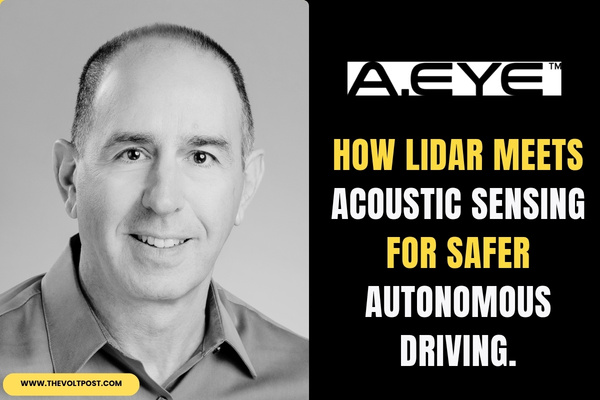
From tackling adverse weather challenges to justifying acoustic sensing in mass-market vehicles, Fisch shared how this partnership could move the industry closer to regulatory confidence in all-weather autonomy while delivering real safety value for OEMs globally. Read The Volt-Full Edited Excerpts Below.
Most ADAS stacks still treat perception and vehicle dynamics as separate domains. How does combining lidar-based vision with real-time friction prediction change decision-making at the control layer, especially in safety-critical situations?
Traditionally, perception systems focus on understanding what is happening around the vehicle, while vehicle dynamics systems focus on how the vehicle can respond.
The opportunity we’re exploring with MoveAWheeL is bringing those two perspectives closer together. For example, it’s one thing for a perception system to identify an obstacle ahead.
It’s another to understand that the road surface may be wet, icy, or otherwise affecting available traction.
Combining environmental perception with road-surface intelligence has the potential to provide a more complete understanding of the driving environment, enabling more informed decision-making by downstream ADAS and vehicle-control systems.
Apollo is positioned as a long-range, software-defined lidar with object detection up to 1 km. In adverse weather, signal degradation is inevitable, so how do you ensure reliability and accuracy when fusing lidar data with acoustic sensing inputs?
One of the reasons the industry increasingly relies on sensor fusion is that no individual sensing technology is perfect in every scenario. Different sensors provide different information and have different strengths.
The goal is not to have one sensor replace another, but rather to combine complementary sources of information to improve overall situational awareness.
Through this collaboration, we are exploring how Apollo’s long-range 3D perception capabilities can complement MoveAWheeL’s road-surface intelligence to provide a more comprehensive understanding of environmental conditions.
Because this work is currently in an active PoC stage, a key objective will be understanding how these data streams can best work together across a variety of real-world operating conditions.
MoveAWheeL‘s approach adds a tactile intelligence layer to the perception stack. Do you see road-surface sensing evolving into a standard category alongside camera, radar, and lidar in future autonomous architectures?
As vehicles become increasingly automated, understanding the operating environment becomes more important.
Today, most perception systems focus primarily on understanding objects and events around the vehicle.
Road-surface intelligence introduces another potentially valuable layer of context. Whether it ultimately becomes a standard category will depend on how much value it delivers to OEMs and end users, but we believe there is growing interest in technologies that can help vehicles better understand not only what’s ahead, but also the conditions under which they must operate.
From an OEM integration standpoint, what are the biggest challenges in harmonizing two fundamentally different sensing modalities, optical and acoustic, within existing ADAS platforms?
Whenever new sensing technologies are introduced, the challenge is less about the individual sensors and more about how the information is processed, validated, and integrated into existing vehicle architectures.
OEMs are increasingly adopting centralized compute platforms capable of ingesting information from multiple sensor types.
The key is ensuring that each sensing modality contributes meaningful information that improves overall system performance without introducing unnecessary complexity. That is one of the areas we intend to explore through this collaboration.
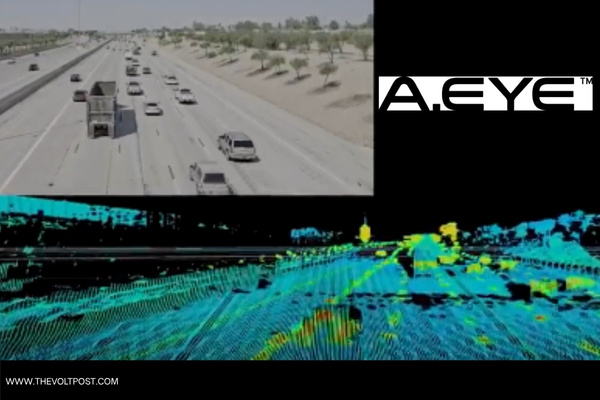
AEye often emphasizes Apollo’s software-defined architecture. Can you explain how that flexibility enables dynamic adaptation to new sensor inputs without requiring hardware redesign?
Software-defined sensing provides flexibility that traditional fixed-function systems often lack. Different applications have different requirements for range, resolution, field of view, and performance characteristics.
Because Apollo is software-defined, customers can optimize sensing performance through software rather than redesigning hardware. That flexibility becomes increasingly valuable as perception stacks evolve and new sensing technologies are introduced or as the needs of the OEM change.
It allows OEMs to adapt to changing requirements while leveraging a common hardware platform. Our software-defined sensing, because it limits or eliminates the need for costly hardware changes, also results in a lower total cost of ownership (TCO), making it more attractive to the OEM and their customers.
Adverse weather remains one of the toughest barriers for higher levels of autonomy. Does this partnership move the industry meaningfully closer to regulatory confidence in all-weather ADAS and autonomous driving?
Regulatory confidence ultimately comes from demonstrated safety and real-world performance. We would not suggest that any single technology or partnership solves that challenge on its own.
What we do believe is that improving a vehicle’s understanding of both its surroundings and road conditions has the potential to contribute to safer operation in challenging environments. This collaboration is focused on exploring technologies that may help expand the operational capabilities of future ADAS and autonomous systems.
In addition to our work with MoveAWheeL, we are also engaged with work going on at the University of Toronto through their WinTOR program which is focused on delivering sensing technology that works even in the harshest weather.
Given the pressure to control ADAS costs, how do you justify the added complexity of integrating acoustic road-sensing alongside lidar in mass-market vehicles?
The automotive industry is always balancing capability, safety, and cost. The question isn’t whether a new technology adds complexity; it’s whether it provides sufficient value.
If additional environmental intelligence can help improve safety, expand operational capability, or increase customer confidence in advanced driving systems, OEMs will evaluate those benefits against implementation costs.
Ultimately, market adoption will depend on whether solves meaningful real-world problems. We believe the packaging of AEye Lidar and MoveAWheeL EG-Way is perfectly positioned to deliver this value.
This is a North America–South Korea collaboration with clear OEM implications. How do you see this partnership influencing adoption among global automakers, particularly in markets like India where road conditions are highly variable?
 One of the interesting aspects of this collaboration is that it addresses challenges that are not unique to any single geography. Road conditions, weather variability, and complex driving environments exist around the world.
Certain markets present particularly diverse operating conditions, which can place greater demands on perception and vehicle intelligence systems.
While it’s still early in the collaboration, we believe technologies that help vehicles better understand both their environment and the conditions of the road itself could have broad global relevance across a variety of markets and use cases.