



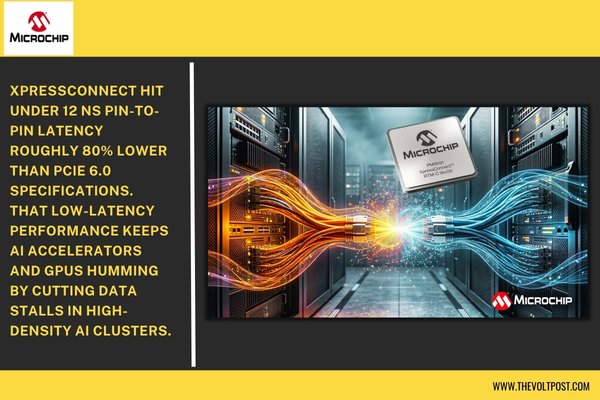
XpressConnect hit under 12 ns pin-to-pin latency roughly 80% lower than PCIe 6.0 specifications. That low-latency performance keeps AI accelerators and GPUs humming by cutting data stalls in high-density AI clusters.
As AI workloads keep scaling, data center architects are hitting a hard wall with limited signal reach and rising latency. This reults to valuable memory sitting underutilized across massive GPU clusters. And it gets worse as interconnect speeds climb.
At 64 GT/s (giga transfers per second), signal integrity issues start dictating system scale and burdening server architectures. Microchip Technology’s new XpressConnect PCIe® 6.0 and CXL® 3.1 retimers is designed to unlock memory expansion and resource disaggregation in large-scale AI fabrics.
What Makes These Retimers Different
These retimers extend signal reach beyond conventional PCIe Gen 5 and Gen 6 electrical limits, opening up more flexible system designs across complex baseboards, riser cards, and cabled interconnects.
They deliver higher-bandwidth connectivity while respecting the tight thermal and power budgets modern AI fabrics demand.
XpressConnect retimers hit under 12 ns pin-to-pin latency roughly 80% lower than PCIe 6.0 specifications. That low-latency performance keeps AI accelerators and GPUs humming by cutting data stalls in high-density AI clusters.
Built Into Microchip’s Full Data Center Ecosystem
XpressConnect retimers complete Microchip’s data center portfolio, engineered to work seamlessly with:
- 3-nm Switchtec™ PCIe Gen 6 switches
- Adaptec® SmartRAID controllers and Host Bus Adapters (HBAs)
- Flashtec™ NVMe® controllers
Together, they create a pre-validated, interoperable fabric. What’s more, XpressConnect PCIe Gen 6 and CXL 3.1 integrate with PCIe Gen 3, Gen 4, and Gen 5 platforms when needed cutting time to market.
Monitoring That Actually Works
The retimers plug into Microchip’s ChipLink diagnostic ecosystem, delivering a unified graphical interface for real-time 2D eye capture and four-level pulse amplitude modulation (PAM4) telemetry.
Data center operators can monitor link health more effectively and troubleshoot faster reducing total cost of ownership.
Why Hyperscalers Should Care
Engineered as an industry-standard, drop-in solution, the new announcement reduce single-vendor dependency risk for hyperscalers. The devices support flexible link bifurcation configurations (1×16, 2×8, and 4×4) and align with widely adopted retimer footprint guidelines.
Enterprise-class features round out the package:
- Hot-plug support
- End-to-end data integrity
To Delve Deeper into Microchip Technology’s Data Center Solutions For High-Performance Compute, Storage, And Connectivity, CLICK HERE
Development Tools
Microchip’s ChipLink diagnostic tools offer comprehensive debug, diagnostics, configuration and analysis through an intuitive graphical user interface (GUI).
ChipLink connects via in-band PCIe or sideband signals such as UART, TWI and EJTAG, enabling flexible, efficient monitoring and troubleshooting throughout design and deployment.
 Leadership Comment
“AI data centers are increasingly constrained not by compute, but by the ability to move data efficiently across the system. As PCIe 6.0 pushes speeds to 64 GT/s, signal reach and latency become critical design challenges,” said Brian McCarson, corporate vice president and GM of Microchip’s data center solutions business unit. “Our XpressConnect retimers are designed to act as the high?performance nerve center of the AI server, helping customers build more scalable, power?efficient fabrics by reducing latency and improving connectivity across dense GPU clusters. This system?level approach allows data center architects to reclaim underutilized resources and improve overall platform efficiency at scale.”
Pricing and Availability
The new rollout can be purchased directly from Microchip or contact a Microchip sales representative or authorized worldwide distributor.