

Tower Semiconductor’s AI Photonics Momentum Shows Why Silicon Photonics Is Moving Center Stage
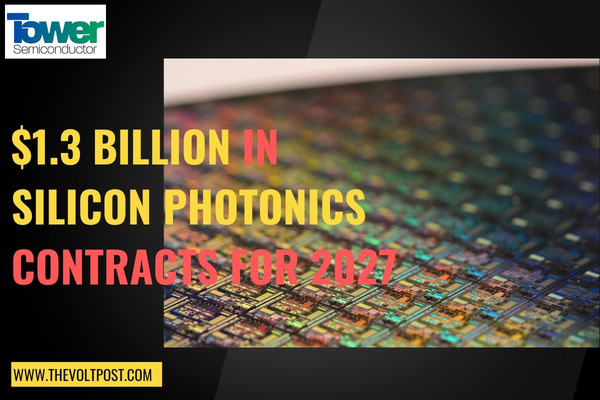
Tower Semiconductor is entering a new phase of growth with silicon photonics. The company recently announced $1.3 billion in silicon photonics contracts for 2027, along with $290 million in customer prepayments for capacity reservation, highlighting how AI infrastructure demand is reshaping its business outlook.
These long-term commitments came alongside Tower’s first-quarter 2026 results, which showed revenue of $414 million, up 15% year over year, and a second-quarter revenue guide of $455 million, the highest quarterly target in its history.
For investors and technology watchers alike, the contrast is striking, while many semiconductor companies are still building the AI narrative, Tower is already converting that demand into booked business.
Silicon Photonics Fuelling Growth
At the center of this story is silicon photonics, or SiPho, a technology that uses light instead of electrical signals to move data at very high speeds.
That makes it especially important for AI data centers, where bandwidth, latency, and power efficiency are becoming increasingly critical.
Tower said the $1.3 billion in contracts came from its largest SiPho customers, with even larger wafer commitments already lined up for 2028 and additional prepayments due by January 2027.
The company also said it has a broad SiPho customer base of more than 50 active customers across multiple applications, which gives it wider visibility than a single-program story usually would.
Product Maturity, Supply-Chain Confidence and Operational Trust
The real significance of Tower’s announcement is not just the size of the orders, but the visibility they create. In semiconductor manufacturing, long-duration customer commitments and prepayments are often a strong sign of product maturity, supply-chain confidence, and operational trust.
For Tower, that matters because it is in the middle of a broader capacity ramp designed to support worldwide SiPho demand.
This is also where the AI angle becomes more concrete. Tower is positioning its SiPho roadmap around next-generation connectivity needs, including pluggable optical transceivers, Near-Packaged Optics, and Co-Packaged Optics, all of which are becoming more relevant as AI clusters scale up.
Leadership Comment
 CEO Russell Ellwanger framed the contracts as proof of customer confidence in Tower’s technology roadmap and execution ability. He said the agreements strengthen the company’s position in the fast-growing optical connectivity market and reflect strong belief in its multi-generational silicon photonics strategy.
Ellwanger also linked the SiPho momentum to Tower’s broader growth path, saying the company is well positioned for continued revenue and margin expansion through 2026, while advancing toward its longer-term model of $2.8 billion in revenue and $750 million in net profit by 2028. That combination of near-term momentum and long-term ambition is exactly what investors want to hear in a capital-intensive business.
AI in Interconnect and Computing Chips
AI is increasingly driving demand not only for compute chips, but also for the high-speed interconnect technologies that keep data moving between servers, accelerators, and memory systems. As data centers grow larger and more power-constrained, photonics is becoming more central to the performance equation.
To Know More: CLICK HERE