

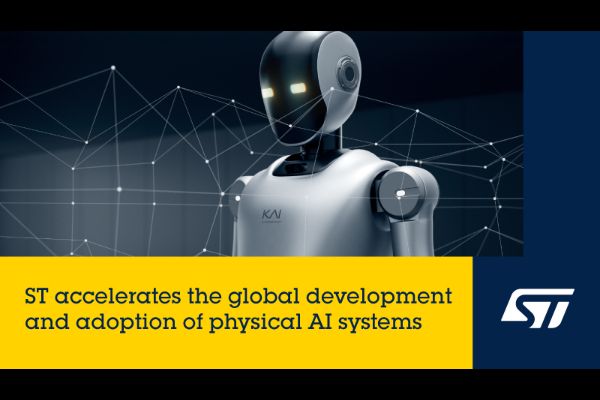
STMicroelectronics is ramping up global development of physical AI systems from humanoid and industrial robots to service and healthcare bots by teaming up closely with NVIDIA.
Streamlining Sensors for NVIDIA Holoscan
ST is folding its full robotics portfolio into NVIDIA’s Holoscan Sensor Bridge (HSB) reference components. They’re also building high-fidelity NVIDIA Isaac Sim models of ST parts to speed up sim-to-real R&D across both ecosystems.
Right now, developers can grab Leopard Imaging’s ST-powered depth camera integrated with HSB, plus a precise ST IMU model in Isaac Sim.
The HSB makes it dead simple to unify data from multiple ST sensors and actuators synchronizing, standardizing, and logging everything seamlessly.
That foundation cuts the sim-to-real gap, accelerates AI learning, and pairs ST’s STM32 MCUs, IMUs, imagers, ToF sensors, and motor controls with NVIDIA Jetson platforms. Take Leopard’s stereo depth camera: it leverages ST’s imaging and motion tech for humanoid designs, industrial apps, and research projects.
Tackling Modeling Headaches
Advanced robotics means big costs and tricky simulations think GPU-hungry randomization, massive datasets, and expertise to dial in realistic parameters. Get it wrong, and models flop in the real world.
ST and NVIDIA are delivering hardware-calibrated, high-fidelity models of ST’s full lineup, starting with that IMU and expanding to ToF sensors, actuators, and more. These come from real-world benchmark data captured with ST tools, optimized for Isaac Sim. The HSB even plugs into ST’s toolchain.
The payoff is that the robots can now train faster in simulations that mirror reality, mitigating development time and costs for humanoid and physical AI apps.
 Leadership Comments
“ST is well engaged within the robotics community, providing robust support and a well-established ecosystem,” said Rino Peruzzi, Executive Vice President, Sales & Marketing, Americas & Global Key Account Organization at STMicroelectronics. “Our collaboration with NVIDIA aims to unleash the next wave of cutting-edge robotics innovation with developer and customer experience streamlined at every step, from the inception of AI algorithms to the seamless integration of sensors and actuators. This will accelerate the evolution of sophisticated AI-driven physical platforms.”
“Accelerating the development of next-generation autonomous systems requires high-fidelity simulation and seamless hardware integration to bridge the gap between virtual training and real-world deployment,” said Deepu Talla, Vice President of Robotics and Edge AI at NVIDIA. “The integration of STMicroelectronics’ sensor and actuator technologies with NVIDIA Isaac Sim, Holoscan Sensor Bridge and Jetson platforms provides developers with a unified foundation to build, simulate and deploy physical AI at scale.”
To Know More About NVIDIA Holoscan Sensor Bridge (HSB), Click Here.
To Know More About ST Solutions To Accelerate Physical Ai Development With NVIDIA, Click Here.