



Space-based semiconductor manufacturing has taken a major step toward commercial reality as startups and space agencies move from lab experiments to multi-mission pilot production in orbit.
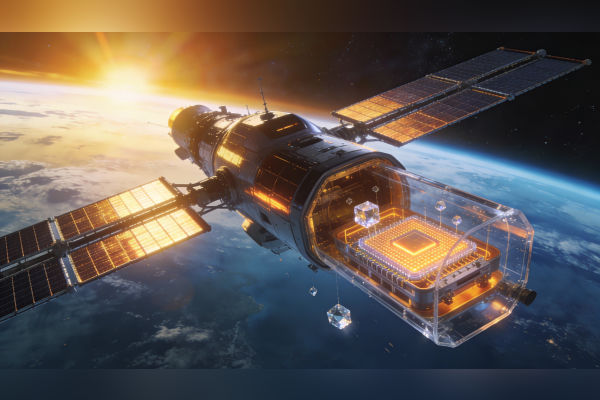
By exploiting microgravity, vacuum and abundant solar energy, these projects aim to grow higher quality semiconductor crystals than are typically possible on Earth, potentially reshaping global chip supply chains over the next decade.
What has just advanced
Specialized Space-based semiconductor manufacturing capsules have now demonstrated fully automated crystal growth and safe return of sensitive materials through hypersonic reentry, proving that precision manufacturing can be done in orbit without a human operator on board.
New joint development agreements between in-orbit manufacturing specialists and semiconductor materials companies are moving the concept of Space-based semiconductor production from one-off demonstrations toward repeatable, multi-flight programs focused on commercial semiconductor crystal production.
Why space is attractive for chips
Microgravity reduces convection, turbulence and gravity-driven defects during crystal growth, enabling more uniform semiconductor crystals and potentially higher performance devices.
The natural vacuum of space and access to solar power can cut the energy and infrastructure needed to create ultra-clean conditions on Earth, which are among the most expensive parts of conventional semiconductor manufacturing.
Emerging players and programs
Space-based semiconductor manufacturing companies are developing autonomous, reentry-capable satellites that host payloads for microgravity research and industrial production, including semiconductor and sensor materials.
These platforms have already supported multiple orbital missions, with additional flights planned, allowing partners to iterate on materials recipes, process windows and device concepts using real in-space data rather than simulations alone.
Industry and company comments
Executives from in-orbit manufacturing firms emphasize that demonstrating machine-only crystal growth and return is a turning point because it shows that “semiconductor crystal manufacturing can happen in space just using machines,” lowering the cost and risk compared with crewed facilities.
Semiconductor partners involved in these joint programs say microgravity-grown crystals could unlock new device architectures and more reliable power and RF components, while also offering an alternative path to reduce dependence on a few terrestrial supply hubs for advanced materials.
 What comes next
Over the next several years, companies plan to scale from experimental batches to pilot semiconductor materials production, using repeated missions to refine process stability, yield and cost per wafer-equivalent.
Space agencies and national labs view these commercial efforts as a testbed for broader microgravity manufacturing, with lessons from semiconductor crystal growth expected to spill over into other high-value materials such as advanced sensors, photonics and quantum devices.
Space Forge to Produce Semiconductor in Space
The goal of Space Forge is to produce semiconductors in space without the need for human labor. Additionally, the U.K.-based aerospace startup revealed that it has made significant progress toward that objective by producing plasma, or superheated gas, on a commercial satellite for the first time.