
NG eCall testing simulates 4G/5G RAN impairments, including handover failures, packet loss exceeding 1%, and latency spikes beyond 150ms, which degrade MSD delivery critical for the 112 emergency call chain.
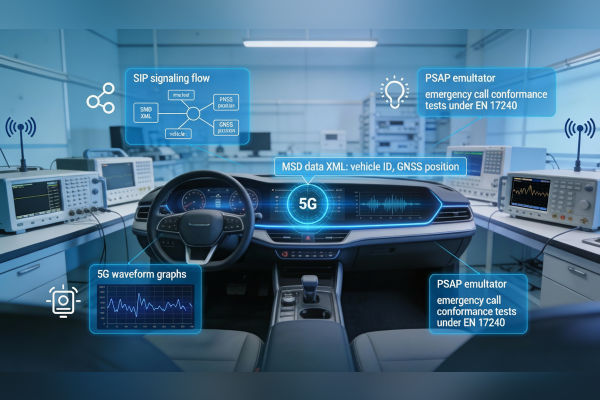
Next Generation eCall (NG eCall) mandates packet-switched emergency communications over 4G/5G networks, replacing legacy 2G/3G systems by January 2026 for all new EU vehicles. This shift demands rigorous testing of In-Vehicle Systems (IVS) and Public Safety Answering Points (PSAP) to ensure interoperability under real-world impairments.
Industry leaders prioritize conformance to EN 17240:2024 and ETSI TS 103 683 for seamless Minimum Set of Data (MSD) transmission and IMS-based SIP signaling.
Regulatory Evolution Driving 2025 Testing
EU Regulation (EU) 2025/1871 updates eCall standards, mandating EN 17184:2024 and EN 17240:2024 from January 2027, with enhanced backup power testing requiring 5 minutes of calls plus 56 minutes standby.
The NG eCall Plugtests 2025 in Bonn validated end-to-end interoperability across 48 vendors, testing nearly 3,000 scenarios for MSD data, SIP flows, and PSAP integration over LTE.
These events exposed challenges like network fallback in Hybrid eCall setups, where systems switch between CS eCall and NG eCall based on coverage.
Testing now emphasizes IP Multimedia Subsystem (IMS) call setup, precise GNSS-derived location accuracy within 10 meters, and audio codec resilience (AMR-WB) under AWGN noise.
C-suite executives must note the €2.72 billion automotive eCall market’s 12.6% CAGR, fueled by compliance deadlines that could delay type approvals otherwise.
Technical Challenges in NG eCall Validation
NG eCall testing simulates 4G/5G RAN impairments, including handover failures, packet loss exceeding 1%, and latency spikes beyond 150ms, which degrade MSD delivery critical for the 112 emergency call chain.
Engineers face protocol complexities: SIP REGISTER/INVITE sequences must align with 3GPP Rel-16 IMS specs, while HLAP (High Level Application Protocol) ensures MSD XML parsing at PSAPs per ETSI TS 103 683.
Power-constrained IVS require validation of backup batteries under EN 16072:2025, simulating total discharge over extended rescue scenarios.
Hybrid eCall introduces dual-stack testing: legacy modem fallback when 4G fails, verified via noisy PCM signals and multi-RAT emulation.
For C-level strategy, non-compliance risks recalls; 2025 Plugtests data shows 90% interoperability pass rates only after iterative protocol tweaks.
 Top 5 Test & Measurement Companies Focusing on NG eCall Testing
Leading firms dominate NG eCall validation with certified PSAP emulators and automated conformance suites. Their solutions integrate network simulation, audio analysis, and TAP-compliant scripting for scalable lab-to-field testing.
| Company | Key Solution | Core Capabilities | 2025 Certifications/Highlights |
| Rohde & Schwarz | CMX-KA098 + CMX500 | End-to-end 4G/5G PSAP emulation, IMS SIP control, EN 17240:2024 conformance | Cetecom certified; Qualcomm Snapdragon verification |
| Keysight | UXM 5G/EXG + KS82055B TAP | NG eCall automation (EN17240/ETSI 103683), V2X integration, WaveBee IVS toolchain | HEAD acoustics collab; ATE 2025 demos |
| Anritsu | MD8475B + MX703330E Hybrid | PSAP simulation for eCall/NG/Hybrid, noisy MSD testing, ERA-GLONASS support | Industry-first Hybrid eCall; CEN/TS 17240 |
| Spirent | eCall Simulator/Test Pack | IVS/PSAP conformance (CEN TS 16454: 55 cases), GNSS scenarios, automation | EU 2017/79 GNSS compliance; open automation |
| VIAVI Solutions | EVOIA + PSAP Emulator | Drive testing, JCAS for FR3 sensing, 5G beam management with NG eCall | Next-gen automotive eCall readiness |
Rohde & Schwarz’s CMX-KA098 excels in real-world network emulation, passing EN 17240 PSAP tests for type-approval. Keysight’s TAP plugins automate 100+ test cases, reducing manual effort by 80% via E7515B UXM integration.
Deployment Strategies for Engineers and Executives
Testing engineers deploy lab setups with RF-shielded chambers for IVS signal isolation, chaining baseband analyzers to protocol sniffers for SIP/MSD decode.
Automate via Python-scripted TAPs: configure IMS core, trigger airbag events, assert MSD fields (timestamp, position, vehicle ID) within 8 seconds. Field validation uses OBU drive tests, correlating GNSS with 5G NTN for rural coverage gaps.
C-suite leaders should invest in Hybrid eCall platforms amid 2G sunset; Anritsu’s MD8475B simulates multi-mode fallbacks, cutting certification cycles. ROI stems from first-pass EU approvals—NG Plugtests 2025 confirmed 13 sessions per vendor average for compliance. Partner with certified labs like cetecom for accredited runs, targeting Q4 2025 readiness before 2026 mandates.
 Future-Proofing Beyond 2026
Post-2026, NG eCall evolves with 5G-Advanced RedCap modules and AI-driven anomaly detection in MSD streams.
Testing must incorporate JCAS for V2X-eCall fusion, emulating FR3 beams with ray-tracing accuracy. Executives forecast integration with FRMCS for rail, demanding scalable T&M investments.
Sustainability angles emerge: EN 16072:2025 mandates green power profiles, testable via Spirent’s GNSS packs. With Plugtests reports signaling 95% ecosystem maturity, 2025 remains the pivot for risk-free scaling.