


As the European Space Agency’s (ESA) BepiColombo mission finally closes in on Mercury after a grueling eight-year transit, the hardware inside is being put to the ultimate test. Exxelia has confirmed that its film capacitors, common mode chokes, and power inductors are hard at work driving the probe’s critical electronic systems.
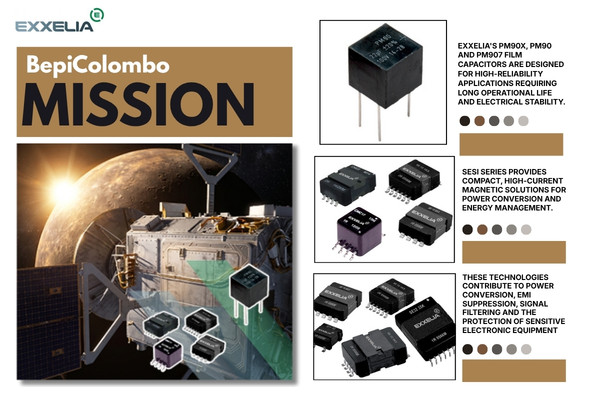
In one of Europe’s most ambitious deep-space programs, these components are doing the heavy lifting for power conversion, electromagnetic compatibility (EMC), and long-term signal filtering.
Launched in 2018 as a joint effort between ESA and the Japan Aerospace Exploration Agency (JAXA), BepiColombo wasn’t a straight shot. Reaching Mercury requires a complex series of gravity-assist flybys around Earth, Venus, and Mercury itself.
That means the onboard electronics have spent nearly a decade enduring severe thermal cycling, deep-space vacuum, and relentless radiation, all just to get into position to study the planet’s magnetic field and surface composition.
Built for the Long Haul: Space-Grade Film Capacitors
You can’t send a repair crew to Mercury. Space-bound electronics need to maintain rock-solid electrical performance for years, completely untouched.
To meet that bar, the mission relies on Exxelia’s PM90x, PM90 and PM907 film capacitors which are designed for high-reliability applications requiring long operational life and electrical stability.
Built with a self-healing metallized polyester dielectric and a low-inductance design, these capacitors are locked inside an epoxy-sealed thermoplastic case.
They operate flawlessly from -55°C up to +125°C, handling DC voltage ratings anywhere from 50 V to 1250 V, making them highly versatile for demanding power architectures.
The PM907 series, available in both radial and surface-mount configurations, brings high insulation resistance and an exceptionally low dissipation factor to the table—making it perfectly optimized for the probe’s high-frequency switched-mode power supplies.
Locking Down Power Integrity
Beyond capacitors, Exxelia also supplied its CMC Series common mode chokes and SESI Series power inductors for spacecraft electronic subsystems stable.
The CMC Series is tasked with attenuating common-mode electromagnetic interference (EMI). It maintains incredibly low insertion losses, ensuring the probe’s highly sensitive instruments easily clear strict EMC requirements without signal degradation.
Meanwhile, the SESI Series handles power conversion and energy management. These are compact, high-current inductors  designed specifically to shrug off extreme aerospace environments, maintaining high efficiency and mechanical stability across drastic temperature swings.
Out in deep space, power distribution and signal integrity are matters of mission survival. By providing reliable EMI suppression, precise signal filtering, and rugged power conversion, Exxelia’s components ensure BepiColombo’s critical systems stay fully operational when it matters most.
To Know More: CLICK HERE