



Deep-tech sector in India is surging in AI, data science, and cybersecurity, but a new Indeed Hiring Tracker (IHT) report reveals that women remain sharply underrepresented across the Deep-Tech jobs, from entry-level roles to senior leadership. The data paint a picture of a skills-rich pipeline that is not yet translating into gender-balanced hiring, pay, or progression in India’s most advanced technical domains.
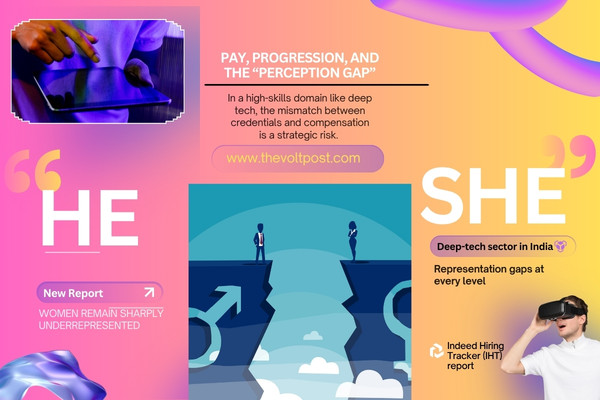
Representation gaps at every level
The survey shows that women’s presence is constrained right at the start of the deep-tech jobs pipeline. Nearly half of employers (43%) say women make up only 0-10% of their entry-level deep-tech hires in specialised fields such as AI/ML, data science, and cybersecurity.
More strikingly, no organisation in the study reported female representation above 50% at any seniority level, underscoring that the gap persists even after decades of broader STEM-talent growth.
At the same time, job-seeking activity among women in deep-tech is stable where 43% of women respondents reported actively applying for roles in Q4, compared with 42% in Q3. That stability suggests the underrepresentation is less about willingness to enter the field and more about structural entry barriers, filtering mechanisms, and hiring-process dynamics.
Pay, progression, and the “perception gap”
Beyond hiring, the tracker spotlights how pay and progression differ for women in deep-tech organisations. About 38% of employers report that women take longer than men to reach mid?level roles, pointing to slower internal mobility or uneven promotion rates.
On compensation, the data reveal a divergence between company-level claims and employee-level perceptions:
- Around 32% of employees feel colleagues of the opposite gender earn more for similar work, including 34% of women who believe men earn more and 31% of men who believe women earn more.
- While 67% of employers say there is no gender pay gap at senior levels, 27% of employees perceive that the gap actually widens as seniority increases.
When women candidates do land offers, many feel short-changed, only 42% of women believe their latest job offer fully reflects their deep?tech skill set, hinting at a disconnect between specialised expertise and compensation in AI-centric roles.
What workers want-transparency and objectivity
Employees and employers broadly agree on what could help close equity gaps. When asked which interventions would be most effective, respondents prioritised:
- 67% cited transparent salary bands as a key lever for fairer pay.
- 51% pointed to clear promotion criteria to reduce ambiguity in career progression.
- 47% highlighted bias?free evaluation processes to ensure skills, not stereotypes, determine advancement.
Yet implementation lags behind ambition while 44% of organisations report conducting internal gender pay-parity reviews, only 14% have actually implemented targeted compensation corrections based on those assessments.
Negotiation, offers, and long-term trajectories
The tracker also flags subtle behavioural differences in how offers are handled. Male candidates are more likely to negotiate salaries, which can compound small-differences into substantial long?term pay gaps over multiple career moves. Women, by contrast, show greater openness to smaller incremental hikes, with 23% willing to accept raises of 10% or less, potentially limiting their ability to catch up in fast-moving deep-tech salary bands.
Indeed India’s Managing Director, Sashi Kumar, stresses that in a high-skills domain like deep tech, the mismatch between credentials and compensation is a strategic risk. Structural barriers-ranging from assessment design to workplace flexibility-can shape who ultimately accesses AI and robotics? focused roles, even when formal education is broadly similar.
 Methodology and scope