

Synaptics and Google Research are set to showcase real-world Edge AI applications at Google I/O 2026 using the newly introduced Synaptics Coralboard. Built to help developers move quickly from prototyping to production, the Coralboard offers a flexible and accessible platform for building next-generation Edge AI solutions.
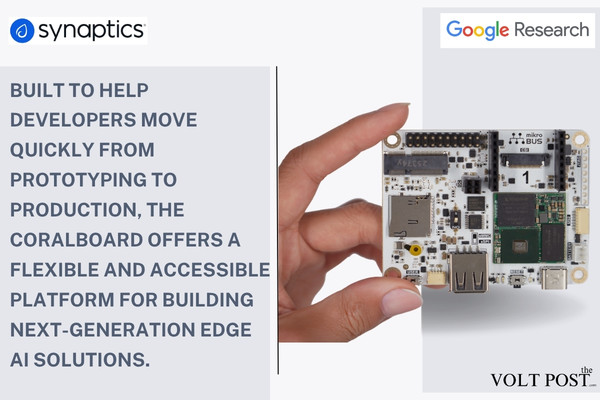
At its core, the board is powered by the Synaptics Astra SL2610 platform, combining the company’s Torq NPU with Google Research’s Coral NPU technology. This pairing enables efficient, multimodal AI processing directly on-device, supporting use cases across vision, audio, and generative AI.
Designed for always-on, power-efficient performance, the Coralboard features a compact, developer-friendly form factor with a wide range of built-in interfaces. It runs on a 2GHz Astra SL2619 dual-core SoC, includes 2GB DDR4 memory, and integrates an NPU subsystem capable of 1 TOPS for both CNN and transformer workloads.
The board supports camera input, display connectivity, microphones, LEDs, and more, while optional add-ons such as Wi-Fi, Bluetooth, USB, and sensor modules expand its capabilities for rapid prototyping.
One of the highlights at Google I/O will be “Jellectronica,” an interactive AI-powered music experience created in collaboration with Google. The setup uses a Coralboard running an NPU-accelerated YOLOv8 model to track jellyfish movements from a live Monterey Bay Aquarium feed.
These movements are then translated into real-time control signals for music generation using Google DeepMind’s Lyria Realtime model showcasing how Edge AI can blend vision and generative AI in creative, real-world applications.
Attendees will also get hands-on access to the Coralboard, with a chance to take home a unit designed for a seamless out-of-box developer experience. With built-in support for hardware-accelerated Gemma 3 270M and the open-source MLIR-based Synaptics Torq toolchain, developers can build, optimize, and deploy AI models using a consistent workflow.
The limited-edition Synaptics Coralboard will be on display at the Gemma pavilion during Google I/O 2026, highlighting how accessible platforms like this are helping accelerate the development of practical Edge AI solutions.
 Leadership Comments
“Edge AI is evolving as a frontier for innovation. Coralboard gives developers a powerful new way to turn breakthrough AI into real-world experiences at the Edge,” said Yossi Matias, Vice President & Head of Google Research.
“We are very excited to put the Synaptics Coralboard directly into developers’ hands at Google I/O,” said Billy Rutledge, Director, Google Research. “Coralboard makes it dramatically easier to bring advanced AI to the Edge. By pairing efficient, AI-native hardware with an open software stack, this platform lowers the barrier to building private, always-on experiences that run all day in power-constrained environments. Our collaboration reflects a shared commitment to accessible, secure Edge AI for developers everywhere.”
“Gemma helps developers bring capable generative AI to smaller, efficient devices. With the Coralboard, developers can quickly test, tune, and deploy Gemma-based experiences for real-world Edge AI use cases,” said Olivier Lacombe, Product Director, Google DeepMind.
“We’re at a tipping point where AI is moving out of the cloud and into everyday devices. The Coralboard is designed to accelerate that shift—giving developers and OEMs a fast path to build and deploy real-time, multimodal AI products for the Edge at scale. Together with Google, we’re helping enable a new class of intelligent, always-on systems where performance, power efficiency, and on-device intelligence define the user experience,” said Vikram Gupta, SVP & GM, Edge Compute & Connectivity Solutions Division, Synaptics.
“We designed this platform to remove friction for developers. It is compact, feature-rich, and easy to extend, so teams can spend less time setting up hardware and more time building differentiated Edge AI applications,” said Robert Otreba, CEO, Grinn Global.