



Thanjavur, the historic “Rice Bowl of South India” has always been a hotspot for culture, learning, and bold ideas. Just look at the Brihadiswara Temple, a 1,000-year-old marvel of engineering that’s still turning heads. Now, SASTRA University is carrying that torch forward from its techno-rural campus in Thirumalaisamudram, driving real tech progress.
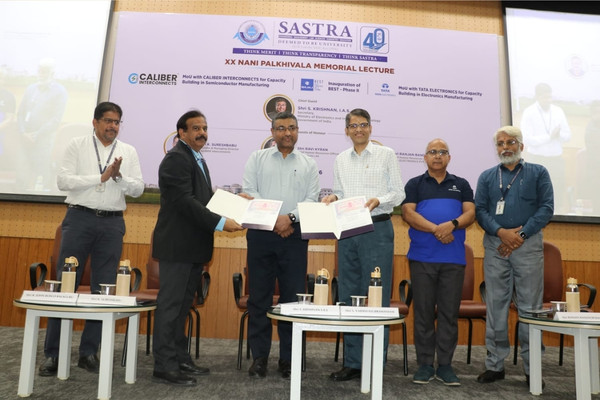
In a big win for India’s electronics and semiconductor push, SASTRA just inked separate MoUs with Tata Electronics and Caliber Interconnects. These deals are all about building a steady stream of industry-ready talent to fuel the country’s chip ambitions.
Under the partnerships, SASTRA’s rolling out a BSc in Electronics with Tata and an MSc in Applied Electronics alongside Caliber. Both programs blend solid academics with hands-on work, internships, and real-world projects designed by industry pros.
The MoU signings happened with Mr. S Krishnan, IAS, Secretary of MeitY watching on, alongside leaders from government, industry, and academia.
It was a clear signal of everyone’s buy-in to supercharge India’s ESDM and semiconductor ecosystem. The event also kicked off cutting-edge labs on SASTRA’s Thanjavur campus for electronics manufacturing, firmware, e-mobility, and semiconductor testing/packaging, all backed by Bajaj Auto, Tata Electronics, and others.
Ranjan Bandyopadhyay, Tata Electronics’ CHRO, pointed out how his company spans the full semiconductor chain from design to chips to ready devices. He stressed the need for a tough domestic ecosystem, especially after seeing global supply chains buckle.
At the 20th Dr. Nani Palkhivala Memorial Lecture, Mr. Krishnan talked up blending digital-physical infra with skilling. India’s digital economy – It’s jumping from 12% of GDP in 2021-22 to 20% by 2030. Electronics exports have hit nearly $40 billion already, with eyes on a $1 trillion sector.
K Suresh Babu, Caliber Interconnects‘ Founder and MD, called this a game-changer for closing the academia-industry gap. The MSc will dive into semiconductor testing, advanced packaging, and chiplet assembly with a curriculum they co-built. Caliber’s pitching in with hands-on training for students and faculty, access to their packaging facilities, real production-line learning, internships, and project work.
Suresh also flagged how tough it is for Indian students abroad to land internships, time to build world-class ones right here. With SASTRA’s top-notch setup, faculty, and leadership, it’s the perfect spot to train semiconductor pros who can compete globally.
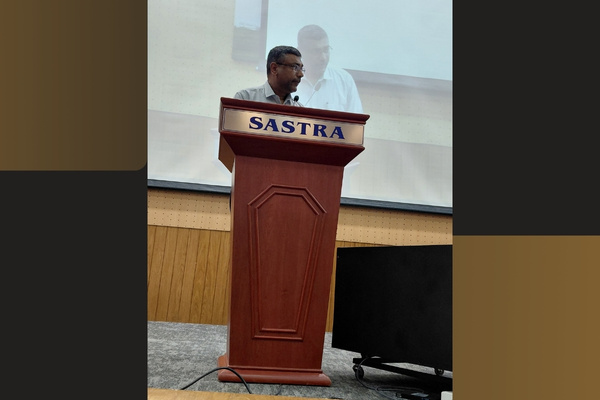 Prof. S Vaidya Subramaniam, Vice Chancellor, doubled down on the university’s focus on excellence and nation-building.
He highlighted how India’s electronics game has leveled up from basic assembly to advanced manufacturing and SASTRA’s gearing students to lead that charge. He gave a shoutout to partners for Phases I and II infrastructure.
This is textbook industry-academia teamwork, showing how collaboration speeds up skills and self-reliance in semiconductors. SASTRA, one of India’s top engineering and research hubs is proving it’s all about innovation with real-world impact.