



As Samsung Electronics’ foundry (semiconductor contract manufacturing) and high bandwidth memory (HBM) businesses, which had been adversely affecting its performance, improve, the company is predicted to surpass 10 trillion won in operating profit for the first time in roughly a year in the third quarter of this year.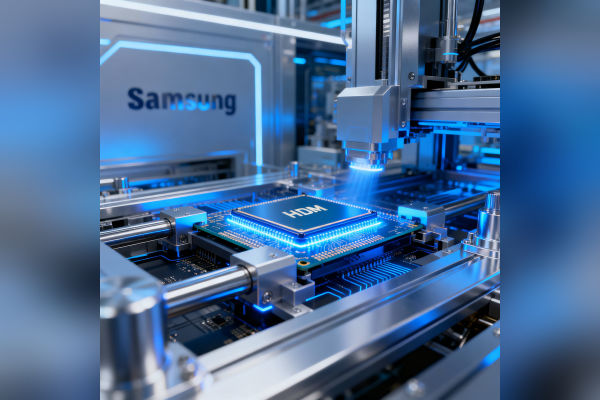
There are also predictions that Samsung Electronics will hit the historic milestone of a 100,000 won share price due to the Galaxy series’ ongoing strong global sales and upcoming mass production of the Exynos 2600, a mobile application processor (AP) built on the 2-nanometer (nm) process.
Samsung Electronics recently completed setting up the HBM4 (6th generation) mass manufacturing system, and industry sources reported on September 23 that the company is anticipated to start production for customer delivery as early as the end of this year.
Samsung Electronics lost its top spot in the DRAM market to SK Hynix as a result of its delayed response to the HBM market, which is a crucial component of AI accelerators.
Heat generating difficulties caused supply delays to Nvidia, the largest semiconductor design company in the world, even though HBM3E development was accelerated to catch up.
However, the atmosphere has recently reversed as Nvidia gave a positive evaluation of Samsung Electronics’ HBM3E. An industry insider explained, “This is interpreted as a signal that the heat generation problem of HBM3E has been resolved,” adding, “The supply of HBM4 following HBM3E is just a matter of time.”
Samsung Electronics’ performance is probably going to improve better if it gains more market share in the HBM market. In the second quarter of last year, Samsung Electronics reported sales of 74.07 trillion won and operating profit of 10.44 trillion won; however, since then, profits have been falling.
This was mostly brought on by lagging behind in the HBM market and missing out on the growth of the AI sector. Operating profit actually dropped from 10 trillion won to 9.18 trillion won in the third quarter of last year, then to 6.5 trillion won in the fourth quarter, 6.69 trillion won in the first quarter of this year, and finally to 4.7 trillion won in the second quarter.
In comparison to the same time last year, operating profit has been cut in half. The DS division, which manages the semiconductor business, had a major impact; in the second quarter, operating profit plummeted to 400 billion won.
Samsung Electronics’ foundry unit, which had been struggling financially, was revived when it got a deal worth almost 23 trillion won to develop Tesla’s next-generation microprocessor, AI6. Furthermore, on August 6 (local time), it was announced that Samsung Electronics would provide Apple with image sensors, also known as smartphones’ eyes.
On Sept. 19, it was revealed that the company had also secured a foundry contract for IBM’s next-generation data center chip Power11. IBM is one of the top 5 companies in the data center central processing unit (CPU) market.
Additionally, there is a chance that the foundry industry will receive more orders. Whether Samsung Electronics will mass-produce the Exynos 2600, which is being developed utilizing the more advanced 2nm process, is the industry’s main concern.
From design to manufacturing, Samsung Electronics’ non-memory divisions (System LSI and Foundry) manages the Exynos chip. It was only used on a few models in the Galaxy S series in the past owing to problems with yield and heat generation.
However, expectations for mass manufacturing are rising as a result of recent high scores for the Exynos 2600’s performance and quality from international verification bodies.
Exynos 2600 is likely to be included in every variant of the upcoming top smartphone, the Galaxy S26, which is scheduled for delivery next year, if yield increases and production stabilizes.
Samsung Electronics can secure volume for its foundry division that assembles the chips and lower the cost of smartphones by using its own chip.
Above importantly, it is anticipated that Samsung Electronics’ foundry will be given the task of producing semiconductors for Qualcomm, a multinational semiconductor corporation that has not contracted for production since 2022 because of heat generating concerns.
If Qualcomm following in the paths of Apple, IBM, and Tesla, Samsung Electronics’ foundry business may fully recover.
As its semiconductor business improves and its smartphone business continues to show strong sales in Japan, Southeast Asia, and the Middle East, the financial investment industry predicts that Samsung Electronics’ performance will start to increase significantly from the third quarter of this year.
According to their estimation, Samsung Electronics will return to the 10 trillion won operating profit club in the third quarter of this year with sales of 82.7 trillion won and operating profit of 10.7 trillion won.
They have even increased the target stock price of Samsung Electronics to 105,000 won and forecast that operational profit will rise to 12 trillion won in the fourth quarter.
Additionally, KB Securities increased the target price for Samsung Electronics from 90,000 won to 110,000 won.
Leadership Comment
Kim Dong-won, head of KB Securities Research Center, said, “Samsung Electronics’ sales next year are expected to increase by 12% year-on-year to 358 trillion won, and operating profit is expected to increase by 66% to 53.4 trillion won, achieving the highest performance in 8 years,” adding, “We present it as the most preferred stock in KOSPI.”
To Know More: CLICK HERE