


ROHM has added a powerful new tool to its online design ecosystem – the ROHM PLECS Simulator, now available on the company’s official website. Built on the trusted PLECS® simulation engine, this online tool lets power electronics and system designers quickly simulate how ROHM power devices behave in real circuits without having to spin hardware first.
In power electronics design, simulation has become an essential stand-in for expensive, time-consuming bench builds and prototypes.
Back in 2020, ROHM introduced the ROHM Solution Simulator, which made it possible to verify power devices and ICs together in one environment and has steadily grown to support more topologies and device models over time.
Thanks to its high-precision SPICE models, that tool earned a reputation for producing waveforms that closely match real hardware behavior, giving designers strong confidence in their results.
However, many engineers working in early design phases needed something faster and more focused especially for quickly narrowing down the best power device based on loss and thermal performance.
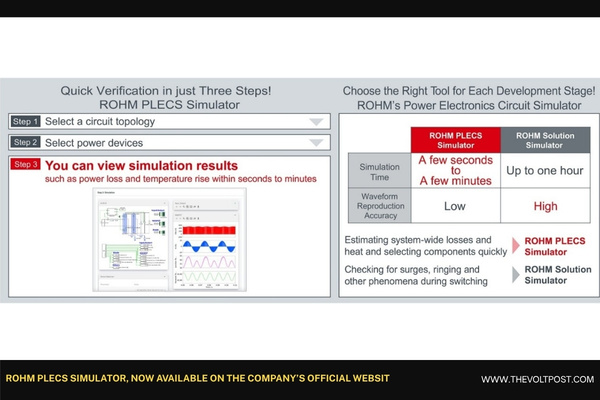
The new ROHM PLECS Simulator is built to address exactly that need, with a clear emphasis on loss and thermal calculations. Users can pick a power electronics topology from a list on the website, choose from ROHM’s portfolio of power devices, and then simulate power losses and temperature rise in just seconds to a few minutes.
This dramatically cuts the time and effort required to select the optimal device at the concept and architecture stage of a project. The platform already supports 20 different circuit topologies, and ROHM plans to keep expanding both the device models and topologies, including support for SiaC devices, IGBTs, and power modules.
By combining the strengths of both tools, designers can now cover the full simulation workflow more efficiently. The ROHM PLECS Simulator delivers rapid upfront analysis in PLECS® for loss and thermal behavior, while the ROHM Solution Simulator provides detailed, high-accuracy waveform verification later in the design.