



Renesas Electronics has expanded its lineup of AC/DC and power adapter solutions with a new GaN-based Half-Wave LLC (HWLLC) platform designed to deliver 500W or more for next-generation IoT, industrial, and infrastructure systems.
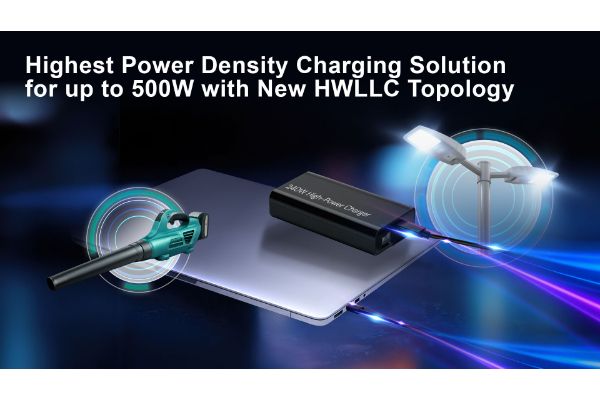
This advanced HWLLC converter architecture scales from compact 100W-class designs up to 500W, paving the way for ultra-efficient, high-speed chargers for devices like power tools, e-bikes, and other appliances without the bulk, heat, or inefficiency of older topologies.
At the core of this launch are four new controller ICs built on Renesas’ proprietary Zero-Standby Power (ZSP) technology.
Leading the lineup is the RRW11011, an interleaved PFC and HWLLC combo controller optimized for high power density and efficiency. Its phase-shift control PFC smooths out ripple, shrinks component size and cost, balances current, and enhances system robustness.
The combo design also helps reduce operating temperature while supporting a wide 5V-48V output range ideal for USB Extended Power Range (EPR) and other variable-load charging systems.
Complementing the RRW11011 are three key components:
- The RRW30120, a USB Power Delivery (PD) protocol and closed-loop controller capable of 240W max USB PD power delivery.
- The RRW40120, a half-bridge GaN gate driver.
- The RRW43110, an intelligent synchronous rectifier controller.
Together, they power a 240W USB EPR adapter design that achieves an industry-leading 3W/cc power density and up to 96.5% peak efficiency.
Renesas’ wide 500W HWLLC power envelope extends its target applications far beyond traditional USB-C fast chargers. It now covers high-demand devices like large TVs and monitors, as well as higher-wattage appliances such as vacuums, power tools, outdoor lighting, and medical systems.
By bringing 240W USB EPR charging to market, Renesas is helping manufacturers replace bulky proprietary chargers used in laptops, gaming systems, and smartphones with smaller, more efficient solutions.
Renesas’ compact, high-power charging technology is already in use in Belkin’s GaN-based Z-Charger, which integrates Renesas’ ZSP chip and SuperGaN® depletion-mode (d-mode) GaN technology.
GaN Drives the Next Leap in Power Design
Gallium Nitride (GaN) remains at the heart of Renesas’ power innovation. The company’s SuperGaN d-mode devices deliver higher switching speeds, better efficiency, and improved thermal performance all while reducing the size of magnetics and overall system losses.
Using a cascode configuration, SuperGaN offers a higher threshold voltage and drop-in compatibility with standard silicon gate drivers, making adoption faster and easier for engineers seeking compact, high-efficiency power solutions.
Renesas Electronics HWLLC approach also eliminates transformer windings and reduces component count compared to traditional LLC designs, cutting complexity while enabling smaller magnetics and greater design reuse across product lines.
The result is a scalable AC/DC platform that simplifies BOM management, boosts reliability, and helps OEMs meet stringent energy-efficiency standards with standout no-load and standby performance.
Renesas will showcase the HWLLC solution at booth #1219 during the Applied Power Electronics Conference (APEC) in San Antonio, Texas, from March 22–26, 2026.
Availability
The four new devices enabling the HWLLC solution are available today in addition to an evaluation board. The EBC10293 240W USB PD EPR Evaluation Board includes integrated PFC, high-efficiency AC/DC conversion and USB PD control in a compact, high-power density design.
 Leadership Comment
“The Belkin Z-Charger is a major step toward a new era of ultra-low standby power consumption in fast charging,” said Jenny Ng, General Manager of Belkin Asia.
“Renesas’ HWLLC ecosystem brings interleaved PFC and resonant power conversion into a single, harmonized solution that delivers ultra-compact, wide-range AC/DC power with proven efficiency, low standby consumption and trusted integration support,” said Rohan Samsi, Vice President, GaN Business Division at Renesas Electronics. “By strategically developing four advanced controller ICs, we’ve created the most optimized, coordinated ecosystem where each element contributes to higher density, improved thermals, reduced EMI/noise and greater operating efficiency.”