



By showing that qubits can be produced in standard 300 mm CMOS production lines using advanced CMOS process flows, imec and Diraq are bringing quantum hardware development much closer to the industrial ecosystem that already supports conventional semiconductor manufacturing.
Quantum chips are starting to move out of the lab and into standard semiconductor production lines, signalling a major shift in how quantum hardware could eventually be built at scale.
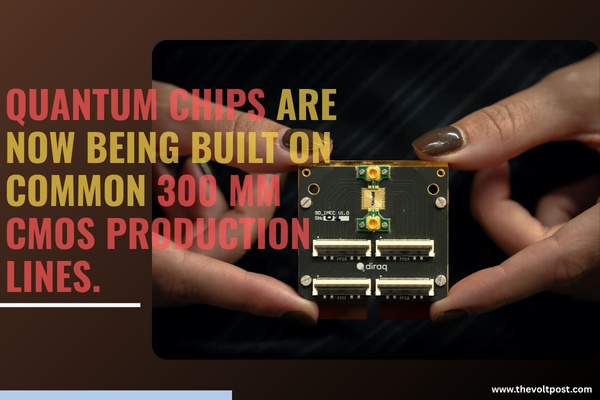
Researchers at imec in Belgium and Diraq in Australia have demonstrated a chip with eight working silicon spin qubits fabricated on 300 mm CMOS production lines, the same kind of equipment used for mainstream logic chips in phones and laptops.
This builds on earlier results where the team showed that one or two qubits could be reliably manufactured using industrial processes, and now confirms that coherence can be maintained as designs scale to multiple interconnected qubits.
Today, many quantum chips are still made in highly specialized research cleanrooms, relying on bespoke process steps that are hard and expensive to scale.
By showing that qubits can be produced in standard 300 mm CMOS production lines using advanced CMOS process flows, imec and Diraq are bringing quantum hardware development much closer to the industrial ecosystem that already supports conventional semiconductor manufacturing.
The qubits in these experiments are silicon spin qubits, created by trapping single electrons in structures derived from familiar transistor architectures.
At cryogenic temperatures, the spin state of each electron acts as a qubit that can exist in superposition and be entangled with others, while still benefiting from the same materials, lithography and process control used in advanced CMOS lines.
Because silicon spin qubits reuse so much of the standard semiconductor stack, they are seen as a particularly promising path toward manufacturable quantum processors, rather than a separate hardware universe that needs its own bespoke factories.
For chipmakers and their customers, that opens the possibility that future quantum processors could be built on the same high?volume infrastructure that already underpins classical computing.
For data centers and AI infrastructure, the implications are significant. If quantum processors can be fabricated on ordinary lines, they could eventually be integrated alongside CPUs, GPUs and dedicated AI accelerators, sharing packaging, interconnects, cooling and other platform technologies instead of requiring entirely separate ecosystems.
 Over time, that kind of hybrid approach could lower the cost and complexity of bringing quantum capabilities into workloads such as optimization, simulation and secure communication.
The imec–Diraq work is not a finished quantum computer and it does not solve all of the hard problems around scaling and error correction.
Quantum chips are starting to look less like fragile, one?off lab experiments and more like future products that can run down the same assembly lines as today’s most advanced silicon.