
MEL Systems and Services (MELSS), an engineering and technology solutions company serving the electronics, aerospace, and defence sectors, has entered into a joint venture with US-based Valtech Corporation to strengthen the supply chain for the semiconductor and solar power industries.
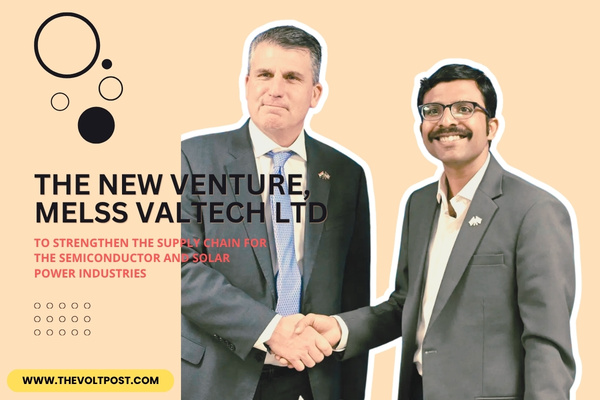
The new venture, MELSS Valtech Ltd, will establish a manufacturing facility in Chennai to produce specialty chemicals and plastic products used in the production of solar cells and semiconductor devices.
MELSS, which was earlier part of the Murugappa Group before becoming an independent company in 1995, already has a broad presence in industrial and technology services.
Its businesses include sourcing capital goods and equipment for the semiconductor sector, factory automation, digital transformation, automated test equipment, and simulators for railways and Indian defence applications.
Valtech, meanwhile, is a US-based specialty chemical company with a global footprint across high-performance markets including photovoltaics, semiconductors, computer disk drives, precision optics, ophthalmic lenses, medical devices, instrumentation, precision metalworking, ceramics, and LED manufacturing. Its products are used in silicon and photovoltaic wafer processing, including ingot mounting, slicing, and precision cleaning applications.
Overall, the new JV named MELSS Valtech Ltd looks like a timely move. With India pushing harder on semiconductor manufacturing and solar supply chain resilience, local production of these critical materials could help reduce import dependence and build out the country’s industrial base.
According to N Ramachandran, Executive Chairman of MELSS, these materials and the related technology are currently not manufactured in India and are almost entirely imported. He said the company sees strong opportunity in the JV, MELSS Valtech Ltd, especially as India steps up efforts to expand semiconductor fabs and OSAT facilities. Production at the new plant is expected to begin as early as October, and the first phase of the project will not require heavy capital investment. “Our idea is to source locally as much as possible,” he said.