



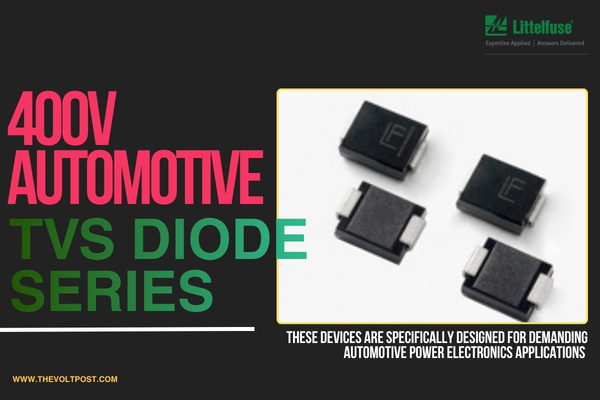
Littelfuse has introduced its new TPSMC, TPSMD, and TP5.0SMDJ high-voltage TVS diode series, expanding its TP Series portfolio. These devices are specifically designed for demanding automotive power electronics applications such as battery disconnect units (BDUs), high-voltage HVAC systems, and PTC heaters.
As electric vehicle architectures continue shifting toward higher voltages and wide-bandgap technologies, components like GaN and SiC MOSFETs, along with IGBTs, are increasingly exposed to harsh voltage transients.
Events such as load dumps and inductive switching can generate significant electrical stress. Traditionally, engineers have had to rely on multiple low- or mid-voltage TVS diodes connected in series to handle these conditions, an approach that adds complexity, consumes more PCB space, and increases BOM costs.
The new TPSMC, TPSMD, and TP5.0SMDJ series simplifies this challenge by offering higher standoff voltages up to 400 V along with strong peak pulse power capability, all within a single automotive-grade device.
This allows designers to streamline protection circuits while improving overall system robustness and efficiency.
Key Features and Benefits of High-Voltage TVS Diode Series
- High standoff voltage (?400 V) supports single-device protection in high-voltage automotive designs
- Peak surge current up to 300 A and peak pulse power up to 5 kW handle demanding transient conditions
- Ultra-fast response time (typically <1 ps) ensures effective transient suppression
- AEC-Q101 qualified and PPAP capable, meeting automotive reliability standards
- DO-214AB (SMC) surface-mount package helps reduce PCB space and simplify layouts
- IEC-61000-4-2 ESD protection up to 30 kV enhances system-level robustness
- Lower component count compared to multi-device setups helps reduce BOM costs
Built for Next-Gen Automotive Systems
Positioned as a first-to-market solution, the TPSMC, TPSMD, and TP5.0SMDJ series addresses the needs of emerging high-voltage automotive platforms.
By enabling single-device protection, these TVS diodes help reduce design complexity, minimize the number of components required, and open the door to using lower-rated GaN, SiC MOSFETs, or IGBTs ultimately improving efficiency while lowering overall system cost.
TPSMC, TPSMD, and TP5.0SMDJ Series Overview
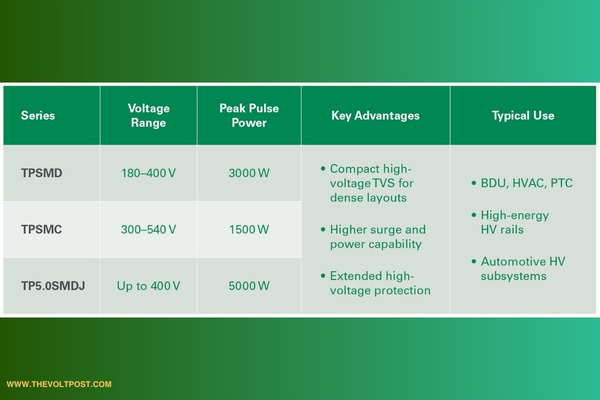
All series are available in unidirectional and bidirectional configurations.
Markets and Applications
- Automotive electronics
- Battery Disconnect Units (BDU)
- High-voltage HVAC compressors
- PTC cabin and battery heaters
- High-voltage DC power distribution
Key Comment
“These high-voltage TVS diodes were developed specifically for next-generation automotive power architectures,” said Charlie Cai, Director of Product Marketing, Littelfuse. “By enabling single-device transient protection in BDU, HVAC, and PTC applications, our customers can simplify designs, reduce BOM cost, and even select lower-rated power semiconductors to improve efficiency and system performance.”
 Availability
The TPSMC, TPSMD, and TP5.0SMDJ Automotive-Grade high-voltage TVS diode series are available in tape and reel format in quantities of 3,000. Sample requests are accepted through authorized Littelfuse distributors worldwide.
For a listing of Littelfuse distributors, please visit Littelfuse.com.
Additional information is available on the TPSMC, TPSMD, and TP5.0SMDJ product page.