


NASA’s Artemis II mission has successfully returned to Earth after a ten-day journey that took the crew closer to the Moon and farther from our planet than any previous crewed spaceflight. The safe return of the four astronauts also serves as powerful validation that Infineon Technologies’ radiation-hardened (rad-hard) semiconductors operate reliably even in the harshest conditions of deep space.
From power supply and control systems to critical data communications, Infineon’s rad-hard devices from its IR HiRel (high reliability) division formed part of the electronic backbone inside the Orion capsule.
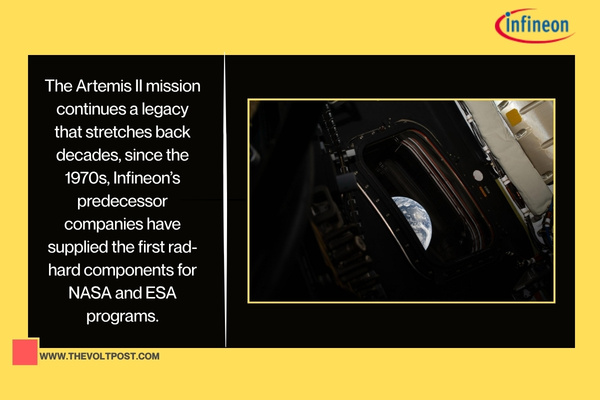
The Artemis II mission continues a legacy that stretches back decades, since the 1970s, Infineon’s predecessor companies have supplied the first rad-hard components for NASA and ESA programs.
Over the years, Infineon IR HiRel has supported hundreds of missions, including navigation satellites, the International Space Station (ISS), and today’s Artemis program. Infineon’s rad-hard components have traveled more than 20 billion kilometers from Earth further than any other human-made object.
In its official press release, the german semiconductor major states that the company continues to invest in research, development, and manufacturing of top-performing rad-hard semiconductors for the global space industry.
In space, the demands on semiconductors are extreme. Beyond the protection of Earth’s magnetic field, high-energy particles can strike electronics directly, causing permanent damage or even mission-critical failures.
Infineon’s rad-hard technology addresses these risks not through bulky shielding, but through semiconductor architectures that are inherently radiation-resistant.
All devices are qualified to the most stringent international standards, including MIL-PRF-38535 Class V, MIL-PRF-19500, ESA’s ESCC standards, and NASA EEE-INST-002, ensuring they can perform reliably over long missions.
At Infineon, innovation is approached at the system level, where semiconductor technology, radiation-hard assurance, and packaging work together.
This holistic design boosts electrical performance, improves thermal behavior, and enhances long-term reliability, while also reducing weight and volume. In space, every gram matters, Infineon’s rad-hard components deliver a distinct system-level advantage.
Gallium Nitride Takes The Next Step
Infineon is also pushing the use of new semiconductor materials in space applications. Gallium nitride (GaN) enables lower switching losses, higher power density, and higher switching frequencies, reducing power losses and the need for bulky magnetic components and therefore saving even more weight.
Leveraging its internal manufacturing capabilities and tightly controlled processes, Infineon has developed an award-winning rad-hard 100-V GaN transistor, qualified to JANS (Joint Army-Navy-Space) under MIL-PRF-19500.
This brings GaN from a promising concept to a proven, flight-ready technology for the most demanding space missions. Infineon’s JANS-qualified device is the first and only internally manufactured rad-hard GaN transistor on the market.
Infineon’s rad-hard portfolio spans silicon power MOSFETs and GaN transistors, gate drivers, solid-state relays, rad-hard memories, and RF devices.
Supported by in-house radiation testing and guaranteed long-term product availability, Infineon positions itself less as a mere component supplier and more as a strategic technology partner for the entire space industry.
 Leadership Comments
“Space programs require technologies and partners they can rely on for decades. Infineon is a critical technology partner, and we are proud to have once again contributed to the success of a historic space mission,” said Mike Mills, Senior Vice President and General Manager of IR HiRel at Infineon.
“The space industry is evolving rapidly: more missions, more data, more electrification – while facing increasing pressure on size, weight and power consumption. In this equation, semiconductors are becoming a central focus in space. The fact that our components performed flawlessly from the first to the last minute of the Artemis II mission is no coincidence. It is the result of decades of engineering expertise, state-of-the-art qualification processes and a deep understanding of what semiconductors must deliver in space,” concluded Mike.