


India’s electronics manufacturing industry is building real momentum, thanks to consistent policy support, the maturing of industrial clusters, and the global push to diversify supply chains. That momentum will be on full display at electronica India and productronica India 2026, running from April 8-10 at India Expo Mart, Greater Noida.
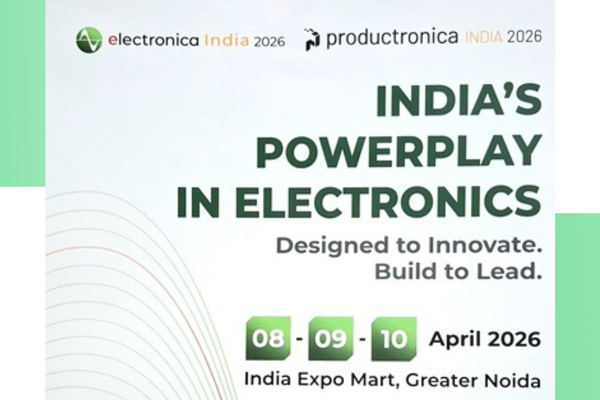
This is North India’s edition of South Asia’s largest B2B electronics trade fairs, and it’s increasingly positioned at the heart of India’s electronics-manufacturing story.
With participants from over 50 countries-including Germany, China, the United States, Japan, and Taiwan-the event highlights how deeply India’s electronics ecosystem is becoming integrated into global networks.
Across the two editions in Greater Noida and Bengaluru, the platform brings together more than 60,000 visitors and over 1,000 exhibitors, making it one of India’s largest and most important meeting points for the electronics industry.
The 50% expansion in scale, anchored in these two hubs, underscores its growing role in shaping the country’s electronics-manufacturing landscape.
The Government of Uttar Pradesh is the host state for this edition, reinforcing the rising importance of the Noida–Greater Noida corridor as a manufacturing hotspot. The region has attracted a dense cluster of OEM assembly units, electronics manufacturing services (EMS) providers, and component suppliers, supported by focused policy measures and continuous infrastructure development.
Industry leaders trace this acceleration to programmes like the Production Linked Incentive (PLI) scheme and the proposed Electronics Component Manufacturing Scheme (ECMS). Together, these initiatives are helping India build domestic capabilities, cut import dependence, and make the electronics supply chain more resilient.
To broaden the event’s appeal, Rohit Sharma has been associated with the edition as brand ambassador, aiming to raise the sector’s visibility beyond core electronics professionals and spotlight its growing economic significance.
India’s evolving role in global supply chains
Electronics manufacturers worldwide are actively reshaping their sourcing strategies to move away from single-geography dependencies. India is increasingly emerging as a credible alternative across components, design, and full-scale manufacturing. What started as exploratory talks has now shifted to procurement-driven decision-making, with companies actively evaluating suppliers, partnerships, and investments on the ground.
electronica India and productronica India have evolved into a business-led platform where sourcing decisions, supplier evaluations, and partnerships are not just discussed, they’re closed. The focus remains firmly on supply-chain localization, deeper component-manufacturing capabilities, and resilience against global disruptions.
Supporting programmes tuned to India’s priorities
The supporting programme line-up at the 2026 edition directly reflects these priorities:
- UP Electronics Leadership Summit – spotlighting Uttar Pradesh’s manufacturing roadmap and investment outlook.
- ELCINA Supply Chain Summit – with dedicated sessions on the Electronics Component Manufacturing Scheme (ECMS).
- Automotive Display Conference (organised by ICEA) – examining how electronics are being integrated into next-generation automotive systems.
- Bharat PCB Tech Conference (led by ELCINA) – deep-diving into India’s printed circuit board ecosystem.
- SMT Thought Leadership Summit – exploring manufacturing processes and the adoption of new technologies.
- Startup Pavilion – supported by the Uttar Pradesh government to bring early-stage innovation into the main electronics ecosystem.
- Industry podcasts – featuring candid insights from sector leaders and decision-makers.
PCB partnership aimed squarely at supply?chain gaps
A standout highlight of this edition is the launch of BPCA – Bharat’s platform for printed circuits and assemblies, a strategic collaboration between the Electronic Industries Association of India (ELCINA) and Messe Muenchen India. Printed circuit boards remain one of the most critical gaps in India’s electronics value chain, still heavily reliant on imports.
By bringing together global know-how, Indian manufacturers, and policy stakeholders, BPCA is designed to speed up capacity building, push localization, and strengthen India’s broader component ecosystem.
For an industry looking to build end-to-end value-creation in India, that kind of coordinated platform could be a real accelerator.
Industry and organiser perspectives
Bhupinder Singh, President – IMEA, Messe München & CEO, Messe Muenchen India, says, “electronica India and productronica India is scaling in line with the industry it serves. What stands out this year is the intent shift, companies are coming in with defined sourcing plans, partnership frameworks, and timelines for execution. The platform is increasingly being used to close decisions, not just initiate conversations. Our focus remains on enabling meaningful industry connections that translate into long-term business outcomes.”
Dr Reinhard Pfeiffer, CEO, Messe München, notes, “India’s role in global electronics manufacturing is becoming more substantive. The alignment between policy initiatives, industry investment, and market demand is establishing a solid foundation for sustained growth. From a global perspective, we see increasing interest in India both as a manufacturing destination and a strategic partner in building resilient and diversified supply chains.”
“The Government of Uttar Pradesh is committed to strengthening the state’s position as a key hub for electronics manufacturing in India. With focused policy support, infrastructure development, and investor facilitation, we are working to enable both domestic and global companies to scale their operations here. Hosting electronica India and productronica India reinforces our intent to bring together the entire ecosystem in one place and accelerate industry growth,” mentions Shri. Alok Kumar, Principal Secretary, Department of IT and Electronics, Government of Uttar Pradesh.
Rajoo Goel, Secretary General, ELCINA emphasises that, “India’s next phase of growth in electronics manufacturing will depend on strengthening its component ecosystem. There is a clear need to build domestic capabilities across key segments of components including printed circuit boards, materials and other critical inputs. Thanks to MeitY, the ECMS Scheme conceptualised by ELCINA, has lent huge impetus to these sectors. Platforms like BPCA, electronica India and productronica India play an important role in aligning industry, policy, and technology towards this objective.”
Pankaj Mohindroo, Chairman, ICEA states, “India’s electronics manufacturing journey is now entering a phase where scale must be matched with depth. As demand expands across sectors such as mobile devices and automotive electronics, the focus is increasingly on  building a resilient, locally integrated manufacturing ecosystem. In this context, industry platforms and collaborative forums play a critical role. By bringing together manufacturers, component suppliers, technology partners, and policymakers, these engagements enable faster alignment, encourage investment across the value chain, and help address bottlenecks in real time. Such interactions are essential to strengthening domestic capabilities, deepening value addition, and enhancing India’s long-term global competitiveness in electronics manufacturing.”