



CuspAI launches the AI Materials Foundry, a networked infrastructure that ties together data, labs, compute and scientific expertise under a single agentic platform. The aim is to remove the materials bottleneck that currently slows progress in semiconductors, clean energy and advanced manufacturing.
More than 45 organizations are joining as founding members. NVIDIA will power the compute backbone, while Meta’s Fundamental AI Research team contributes its Universal Model for Atoms (UMA), a frontier?level atomistic chemistry model for materials science.
At the core of the AI Materials Foundry is CuspAI’s proprietary platform, MIRA, which orchestrates full discovery cycles, from generative design of new materials through simulation, synthesis route planning and coordinated experimental validation, built on what the company describes as the largest curated experimental materials datasets in the world.
The effort is grounded in a clear view of what software?led materials discovery requires: large?scale, high?quality training data so AI predictions are trustworthy; sufficient compute to screen, at molecular resolution, billions of candidate structures; synthesis infrastructure to translate digital designs into physical samples; and deep domain expertise to interpret machine?generated leads and turn them into real?world materials.
CuspAI positions the AI Materials Foundry as the first attempt to assemble all four pillars into production?grade infrastructure for industrial materials discovery.
By moving beyond the limits of a single lab and into a global ecosystem, the Foundry is designed to create a “compounding intelligence loop” where breakthroughs in one program can shorten discovery timelines across the entire network.
CuspAI points to its work with Finnish chemicals company Kemira as an example screening a search space of around 300 trillion molecular structures, the platform produced 20 validated novel candidates in six months, a process that previously took years.
One flagship Foundry project already underway is a multi?year partnership with Singapore’s Agency for Science, Technology and Research (A*STAR). The collaboration combines AI?driven discovery with autonomous synthesis capabilities across semiconductors, carbon capture and advanced electronics, illustrating how the model is meant to span both digital and physical R&D.
Within the Foundry programme, partners gain access to state?of?the?art AI for Science workflows and agentic materials discovery, including deployment of MIRA as an autonomous scientific agent inside existing R&D environments. The workflow starts with a partner defining what they need, a compound with a specific thermal stability, a semiconductor with a target bandgap, a catalyst with a particular reaction profile, or a polymer that must hit a given cost point.
MIRA then generates candidate structures using generative models trained on CuspAI’s comprehensive experimental dataset, runs property predictions at scale across millions of options, and selects the most promising. It designs synthesis routes that match the capabilities of labs in the network and dispatches work to suitable facilities based on skills, geography and throughput, tracking outcomes and feeding results back into the models to continually refine future predictions.
Industrial confidentiality is a core design principle. Every partner operates within a private Foundry instance, ensuring that proprietary data and IP remain isolated even as the broader ecosystem benefits from shared learnings and validated experimental results. At the simulation layer, the Foundry relies on kUPS, an open?source molecular simulation toolkit built by CuspAI in collaboration with NVIDIA’s ALCHEMI (AI Lab for Chemistry and Materials Innovation) team, and on Meta’s UMA model, which enables fast, accurate atomic?scale simulations across the periodic table. kUPS is being integrated with ALCHEMI to provide a continuous pipeline from candidate generation through property prediction at GPU scale.
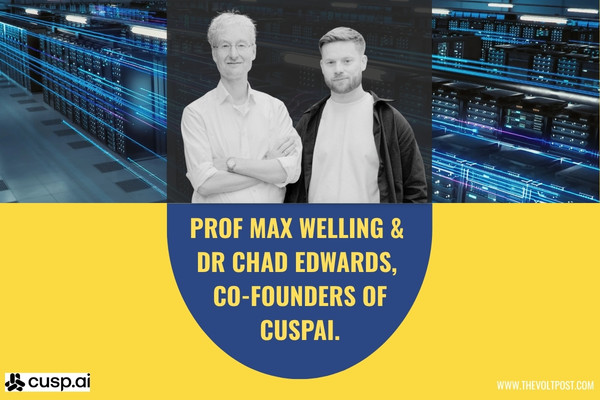
CuspAI’s leadership and scientific architecture are tightly aligned with the problem they are trying to solve. CTO and co?founder Professor Max Welling co?invented the variational autoencoder (VAE) and equivariant neural network architectures that underpin much of modern generative molecular design.
Chief Scientific Officer Professor Aron Walsh FRS is recognized as one of the leading figures in computational materials science. John Giannandrea, who previously led AI research at Google and served as Apple’s SVP of Machine Learning and AI Strategy, is helping establish US Foundry operations.
Critically, CuspAI has built its advantage on data. The company has secured exclusive AI training rights to foundational experimental materials records, including the Cambridge Structural Database via CCDC and the Inorganic Crystal Structure Database via FIZ Karlsruhe. It also holds licensed access to materials science content from Wiley and other major scientific publishers.
These datasets are combined with frontier atomistic models from Meta and enriched by every validated experimental result generated through Foundry programmes, creating a feedback loop in which the quality and breadth of the data asset expands over time.
The list of founding partners underscores how broadly the initiative reaches across the materials and manufacturing value chain, from global industrials to specialist labs and data providers.
Corporate partners include companies such as:
3M, AMD, Applied Materials, ASMPT, Caelux, Fujifilm, Goodyear, Henkel, Hitachi High?Tech, Hyundai Motor Group, Johnson Matthey, JSR Corporation, Kemira, Kioxia, Lam Research, LG CNS, Merck, Meta, Mitsui Chemicals, NVIDIA, Oxford PV, Qnity Electronics, Resonac, Samsung, Shimadzu, SoftBank Corp., Tokyo Electron (TEL), Topsoe, Umicore, Universal Display Corporation (UDC) and VisionPower Semiconductor Manufacturing Company.
 On the lab and research side, members include:
A*STAR, AMOLF, ATLANT 3D, Avantium, Big Chemistry, Cambridge University, the Dutch Institute for Fundamental Energy Research (DIFFER), Eindhoven University of Technology, the Henry Royce Institute, hte – the high throughput experimentation company, IMEC, the Technical University of Denmark (DTU), Tyndall National Institute, the University of Amsterdam and VSParticle. Data partners such as CCDC, ICSD/FIZ Karlsruhe and Wiley round out the network.
To Know More: CLICK HERE