



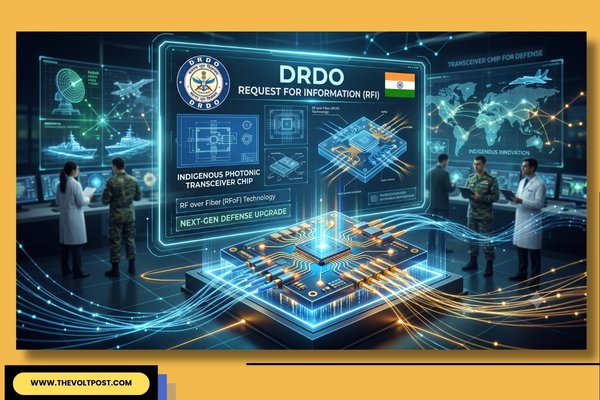
India’s Defence Research and Development Organisation(DRDO) has officially launched a Request for Information to develop an indigenous photonic transceiver chip. The move signals a major leap in upgrading the country’s defense infrastructure through advanced Radio Frequency over Fiber technology.
Traditional radar architectures often face severe limitations regarding signal degradation over extended distances.
By leveraging Radio Frequency over Fiber, the proposed transceiver chip will directly convert electrical radio signals into optical signals for transmission across fiber optic networks.
Once the signal reaches its destination, a photodiode converts it back into an electrical format. This optical pathway ensures incredibly low signal loss and offers much wider bandwidth capabilities compared to conventional copper wiring.
For modern combat scenarios and electronic warfare, immunity to outside interference is a critical operational requirement. Because the signal travels as light, photonic transmission provides natural resistance to electronic jamming and deception.
This inherent immunity to electromagnetic interference makes the new transceiver architecture highly attractive for deployment in contested environments where secure and stable radar connectivity dictates mission success.
For the local electronics and semiconductor ecosystem, this Request for Information represents a lucrative opportunity to collaborate on high end defense technology. The initiative of DRDO is specifically seeking an Omnilight Photonic Transceiver. As India accelerates its domestic manufacturing goals, producing a fully homegrown photonic chip will bridge the gap between optical waveform generation and practical field deployment in advanced radar systems.
 The development aligns with broader efforts to integrate light based components into military hardware.
The transition away from traditional radio wave reliance toward optical signal processing is expected to yield radar units that are more compact and energy efficient.
Industry partners and semiconductor manufacturers now have a clear window to step up and provide the critical engineering required to bring this next generation technology to the production line.