


Responsible Corporate & Social Infrastructure Advisory: UCF’s Gateway to Sustainable Growth of Urban Infrastructure & Clean Energy.
India’s urban transition is entering a decisive phase. The Urban Challenge Fund (UCF), with its Rs 1 lakh crore Central Financial Assistance (CFA) and a targeted Rs 4 lakh crore investment pipeline through FY 2030 – 31, marks a structural shift in how cities are financed, planned, and delivered. This conditional CA is also pushing 50% of project cost to funded from market, implying opportunities for private investment, financial lenders, innovative financial instruments, PPPs, etc.
By design, it moves away from entitlement-based grants towards a competitive, market-linked framework, where cities must demonstrate financial discipline, project viability, and the ability to crowd in private capital.
However, most urban local bodies (ULBs), particularly in Tier-II and Tier-III cities, lack the institutional capacity to navigate capital markets, structure risk-sharing frameworks, or meet the stringent due diligence expectations of investors. This is where corporate advisory becomes foundational.
This shift, while necessary, introduces a new reality: governments are no longer just grant-makers; they are co-investors exposed to market risks, execution failures, and governance gaps. In this context, responsible & blended corporate cum social infrastructure advisory is not an optional layer; whereas it is the prerequisite for the success of UCF projects.
Importantly, UCF’s emphasis on circularity, waste management, and water infrastructure opens a parallel and highly strategic opportunity: the integration of waste-to-energy ecosystems, including compressed biogas (CBG).
India’s pathway to net zero by 2070 and aim to reach non-fossil fuel energy capacity of 500 gigawatts by 2030 can very well be supported by urban local bodies leveraging UCF as well. As India simultaneously scales its National Circular Bioenergy push, urban waste streams such as municipal solid waste, sewage sludge, and organic residues are no longer liabilities but feedstock for energy generation.
This convergence positions cities not just as consumers of infrastructure, but as producers of clean energy within a circular economy framework.
Firstly, UCF readiness and strategy will determine which cities can even enter the competitive pipeline. Advisory frameworks help assess a city’s fiscal health, revenue streams, and creditworthiness, while aligning projects with reform-linked criteria set by central institutions.
Increasingly, this also includes evaluating the commercial viability of waste-to-energy and CBG-linked projects, where revenue streams may be derived from tipping fees, energy offtake agreements, and by-products such as organic manure. Without this groundwork, cities risk being excluded from the very opportunities meant to catalyse their growth.
Secondly, well-advised and structured PPP models and transactions as well as innovative financial instruments, are central to de-risking projects. Under the UCF, where both public and private capital are at stake, advisory-led structuring ensures balanced risk allocation, bankable concession agreements, transparent procurement processes, and prudent implementation.
This becomes even more critical for waste-to-energy and biogas projects, which involve feedstock aggregation risks, technology performance variables, and long-gestation returns. Robust structuring can convert these complexities into bankable opportunities, particularly when aligned with assured offtake and pricing frameworks emerging in the bioenergy ecosystem.
Thirdly, Detailed Project Reports (DPRs) must evolve from compliance documents to investment-grade blueprints. Financial institutions and investors today demand rigorous cash-flow modelling, sensitivity analysis, and clear revenue pathways. For circular infrastructure projects, this requires integrating multi-revenue models: energy sales, municipal waste management, waste processing fees, carbon credits, and fertiliser outputs. A robust and multi-sectoral input, which encompasses urban infrastructure management and clean energy, ensures that DPRs capture these dimensions, making projects credible in the eyes of lenders and capital markets.
Fourthly, municipal bonds and innovative financing mechanisms represent a critical frontier. The UCF explicitly encourages cities to tap debt markets and explore blended and climate finance instruments. Waste-to-energy and CBG projects are particularly well suited for such financing, given their alignment with climate goals, emissions reduction, and resource efficiency.
Yet, bond issuance requires robust financial disclosures, credit ratings, and investor confidence areas where advisory firms play a pivotal role. Structured correctly, these instruments can unlock long-term capital for circular urban infrastructure, while diversifying funding sources beyond traditional budgetary support.
Importantly, structured infrastructure and corporate advice extends beyond financial structuring. It also acts as a bridge between policy intent and on-the-ground execution. Independent advisory oversight can strengthen governance frameworks, introduce risk mitigation tools such as credit enhancements, and ensure transparency across project lifecycles. In doing so, it protects both public funds and private investments while enabling cities to transition towards integrated waste management and energy recovery systems.
The stakes are particularly high for Tier-II and Tier-III cities. These cities represent the next frontier of India’s urbanisation story, emerging as industrial clusters, logistics hubs, and centres of consumption. The UCF’s focus on ‘Cities as Growth Hubs,’ ‘Creative Redevelopment,’ and ‘Water and Sanitation’ aligns with this trajectory.
The addition of decentralised waste-to-energy and biogas infrastructure can further strengthen their economic resilience by generating local energy, creating rural-urban linkages for feedstock supply, and improving environmental outcomes. However, without robust advisory support, these cities may struggle to translate opportunity into execution.
The Urban Challenge Fund is, therefore, not just a financing mechanism; it is a governance and capability test. Its success will depend on whether cities can transition from being project implementers to becoming credible market participants – and increasingly, participants in a circular, resource-efficient urban economy. Responsible corporate advisory, grounded in rigour, transparency, and long-term value creation, will be the difference between capital formation and capital misallocation.
Conclusion
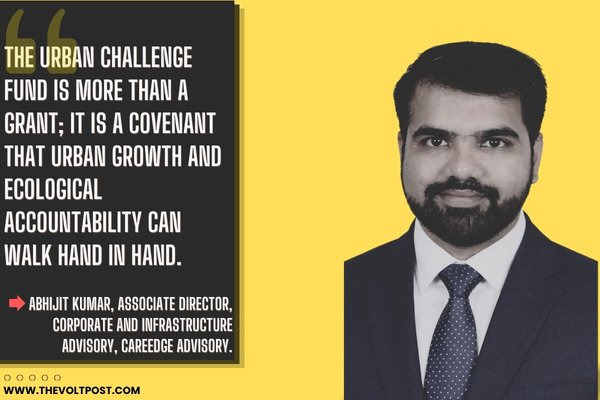
“Well-advised and structured transactions in the infrastructure sector are not merely about  building what cities need today; it is about architecting the responsible pathways cities will thank us for tomorrow. The Urban Challenge Fund is more than a grant; it is a covenant that urban growth and ecological accountability can walk hand in hand. When Waste-to-Energy converges with this vision, discarded burden transforms into renewable power, and cities move from consumption to regeneration.”
“This is the essence of Net Zero and not an endpoint, but a continuous discipline for turning liability into legacy. As advisors, our role is to be the quiet architects of this transition, ensuring that every megawatt reclaimed and every rupee deployed serves both people and planet.”– Abhijit Kumar, Associate Director, Corporate and Infrastructure Advisory, CareEdge Advisory.
(This article is authored by Abhijit Kumar, Associate Director, CareEdge Advisory and is edited by Vagisha, Lead Editor, CareEdge Advisory)