



Polymatech Electronics says its newly operational, fully automated memory module manufacturing line positions the company to serve rising demand across high-performance computing, enterprise, industrial and embedded applications as AI and data-centre expansion reshape the global memory landscape.
The build-out of AI servers, HPC systems and data-centre infrastructure is shifting how semiconductor manufacturing capacity is allocated worldwide. As memory makers prioritise advanced products for AI and server workloads, customers are placing greater weight on availability, product qualification, diversified manufacturing and continuity of supply, asserted its official press release.
Automated manufacturing in Singapore
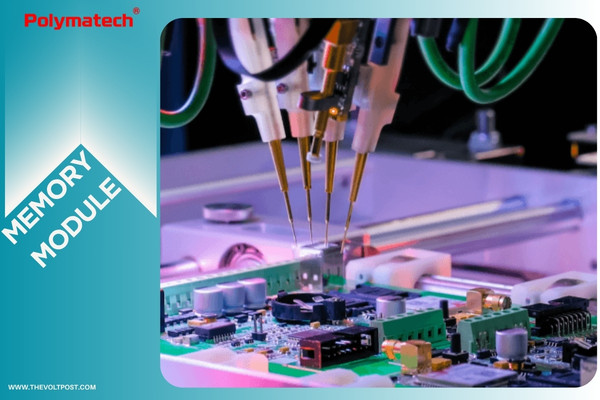
Polymatech’s advanced memory module manufacturing capability is now running at its Asia-Pacific hub in Singapore.
The automated line brings together high-precision assembly, dispensing, placement, inspection, testing and process control to deliver consistent, repeatable output with tight quality oversight.
The company emphasises that its role is in memory module assembly and manufacturing; it does not fabricate DRAM or NAND memory die.
Manufacturing, not speculation
Polymatech says its memory strategy is not about stockpiling commodity inventory to ride short-term price swings.
Instead, it is building the business around manufacturing capability, product qualification, supply continuity and long-term customer requirements particularly in high-reliability environments where traceability, lifecycle support and stable supply are critical.
Its model combines globally sourced semiconductor components and materials with automation, precision manufacturing and disciplined process control, a mix the company believes is increasingly attractive as customers reassess supply chains and seek qualified alternatives for specialised products.
AI is reshaping the memory landscape
AI is driving a structural shift in memory and storage demand. AI servers and HPC platforms require large memory resources, while growth in enterprise computing, industrial automation, healthcare electronics, telecoms and edge computing is lifting demand across conventional and specialised memory categories.
Polymatech views these trends as a long-term transformation rather than a short-term pricing opportunity.
Real-world validation through AI infrastructure
Before wider commercial release, Polymatech plans to put its memory products through rigorous qualification and real-world validation under demanding AI and data-centre operating conditions.
As part of this approach, Polymatech-manufactured memory products are intended to be evaluated and deployed, subject to platform-specific technical qualification within AI and data-centre infrastructure being developed by SilicaDrive Pte. Ltd., an independent Singapore-headquartered AI technology and infrastructure company.
SilicaDrive has outlined a strategy that spans AI software, GPU and server infrastructure, and a phased build-out of high-density, AI-ready data-centre capacity in India.
The proposed deployment is meant to give Polymatech a demanding operating environment to validate performance, reliability, stability and endurance under AI and data-centre workloads before qualified products are progressively offered to external customers.
The programme is designed to complement laboratory qualification and manufacturing quality controls with extended field experience.
From manufacturing to qualification to market
Polymatech’s route to market follows a clear sequence: manufacture, qualify, validate under demanding conditions, then expand into external markets.
The company believes this offers a differentiated path for memory products used in applications where reliability and supply continuity are critical.
The validation programme is also expected to generate operating data and engineering feedback to support continuous product and process improvement ahead of wider commercial deployment.
Rather than relying solely on component specifications, Polymatech intends to build its memory business around manufacturing discipline, qualification and demonstrated operating performance.
A globally connected manufacturing platform
Polymatech’s principal Indian manufacturing base is at Oragadam in the SIPCOT industrial corridor near Chennai, Tamil Nadu. In Singapore, its Asia-Pacific hub provides advanced electronics manufacturing, including LED Chip-on-Board packaging and the new memory module assembly capability.
The company is also developing a major semiconductor and advanced-electronics manufacturing campus at Nava Raipur Atal Nagar, Chhattisgarh, expanding its footprint within India.
Internationally, its manufacturing and technology network spans India, Singapore, the United States, Estonia and France, creating a diversified platform for manufacturing, technology development, supply-chain resilience and international customer access.
Polymatech expects the convergence of AI, HPC, data centres, edge computing, industrial automation, medical electronics and connected infrastructure to raise the strategic importance of memory and storage products over the coming decade.
Leadership Comment
“What we are witnessing is not simply an increase in memory prices. AI is changing the allocation of semiconductor manufacturing capacity globally,” said Dr. Eswara Rao Nandam, Managing Director & Chief Executive Officer, Polymatech Electronics Limited. “As advanced capacity is increasingly directed toward AI and data-centre applications, customers across computing, industrial, medical and enterprise markets require dependable and qualified manufacturing sources. That is where we see an important opportunity for Polymatech.”
 “Shortages come and go. Manufacturing capability remains,” Dr. Nandam said. “We are not building a business around scarcity. We are building the capability to serve customers when availability, reliability and continuity become strategic considerations — as a manufacturer, not merely as a distributor or trader of components.”
“Memory is becoming part of the critical infrastructure of the AI economy,” Dr. Nandam added. “Our objective is to participate in that opportunity through manufacturing capability, product engineering and dependable supply. The value we intend to create is through manufacturing and long-term customer relationships, rather than trading temporary shortages.”
“We believe products intended for critical computing infrastructure should prove themselves under demanding operating conditions before being offered broadly to the market,” said Dr. Nandam. “Our approach is to manufacture, qualify and subject these products to rigorous real-world use within AI infrastructure, learn from their performance, and then take proven products to customers globally.”
“Our objective is straightforward,” Dr. Nandam said. “Build the product, prove the product and then take the product to the world.”
To Know More: CLICK HERE