
The South Korean government is about to unleash a major push into next-generation power semiconductors, the same chips that quietly keep AI data centers running smoothly. Officials are planning to invest 500 billion won, roughly $329 million, in research and development under the country’s Ultra-Innovation Economy Project. The country aims to position itself as a leader in the fast-growing market for power semiconductors that AI infrastructure depends on.
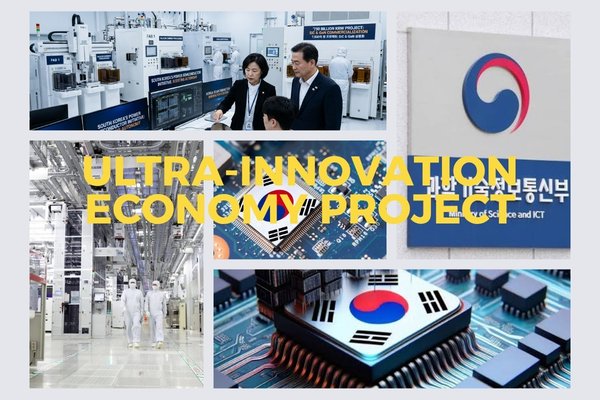
This move mirrors the country’s earlier success with DRAM memory, where Samsung and SK Hynix turned mass production into a global cash cow.
Now, policymakers see power semiconductors as the next big opportunity, especially as AI data centers demand massive amounts of stable, efficient electricity.
Reliable Power Stability is Critical
AI data centers are energy beasts. They need reliable power stability, precise distribution, and high efficiency to keep running without overheating or tripping the grid. Power semiconductors do the heavy lifting here.
They manage and convert electricity, stabilize grids as renewable sources come online, and ensure data centers operate at peak performance.
The technology is already expanding beyond data centers into defense, robotics, and aviation.
Advanced chips like silicon carbide (SiC) and gallium nitride (GaN) outperform traditional semiconductors in high temperature, high voltage, and high frequency environments.
A $494 Million Opportunity and Growing Concerns
According to Sedaily, the total investment could stretch to 750 billion won, or about $494 million, as the program expands.
Prime Minister Koo Yun-cheol, who also serves as Minister of Trade, Industry and Energy, recently convened a meeting to outline a commercialization strategy for advanced power semiconductors. The government wants companies that actually use these chips to join the development process, speeding up the shift from lab research to mass production.
There’s a growing worry in South Korea that improving its position in power semiconductors, the country could become more dependent on foreign suppliers. That dependency would be a strategic vulnerability, especially as AI data centers continue to expand globally.
 A Prime Moment to Establish a Strong Foothold
The plan isn’t just about funding research. It aims to create a complete package that includes materials, devices, modules, and system demonstrations.
This approach is designed to streamline the path from development to factory floor.
As AI data centers grow in number and scale, South Korea sees this as a prime moment to establish a strong foothold before the market becomes too crowded.
To read the full report: CLICK HERE