
Frenetic Electronics announces new features that actually solve the magnetic challenges its customers face. No guesswork, just industry-driven solutions launches new planar magnetics design and simulation tool.
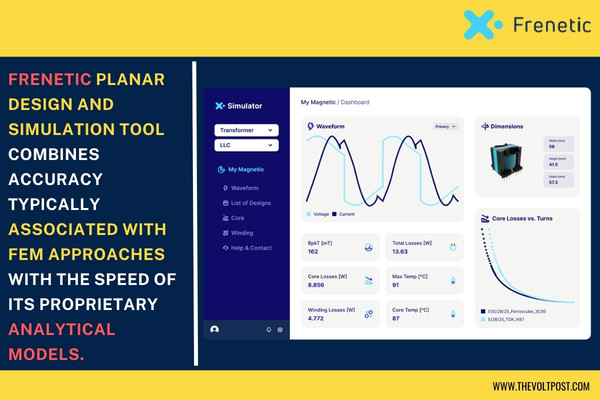
Planar magnetics got complicated, Frenetic made them simple
As power electronics push toward higher switching frequencies and tighter, integrated designs, planar magnetics are becoming the standard.
But they’re also way more complex to design, parasitics, thermal constraints, integration requirements all fighting at once.
Frenetic’s new planar magnetics design and simulation tool is touted to handle this complexity head-on.
Automotive thermal constraints solved
In automotive, thermal limits and power density demands are getting brutal. Frenetic added two capabilities that directly address this:
- Potting simulation: Accounts for how resin materials surrounding transformers affect thermal and electromagnetic behavior
- Liquid cooling plate modeling: Models metallic cooling structures integrated into transformers and connected to liquid cooling systems
Both are critical for high-power automotive applications where heat management is non-negotiable.
One platform, multiple industries
Frenetic Simulator serves automotive, aerospace, and data centers, each with wildly different constraints.
Instead of building generic features, Frenetic evolves the platform by working directly with these industries and understanding how magnetic design challenges differ across applications.
 Leadership Comments
Explains Dr Chema Molina, founder and CEO of Frenetic: “The challenge was not only to enable planar magnetics design and simulation, but to do so while maintaining the level of accuracy engineers expect. Frenetic Planar — our design and simulation tool — addresses this by combining the accuracy typically associated with Finite Element Method (FEM) approaches with the speed of its proprietary analytical models. This allows engineers to quickly explore and validate designs with an average of ~94% accuracy in just a few minutes, enabling significantly faster iterations compared to traditional workflows. We introduced this function to our customers at the end of last year and already around 80% are using it.”
Continues Dr Molina: “These developments respond to real challenges faced by engineers designing high-performance magnetic components for next-generation power electronics systems. But our evolving capabilities are not developed in isolation, they originate from a growing demand among Frenetic’s customers. Looking ahead, Frenetic will continue to evolve its platform around the foundations already described: closer collaboration with industry, faster and more accurate design capabilities, and the integration of AI to support early-stage engineering decisions. As further proof of the adoption of our tools, many Chinese companies are already integrating them into their engineering workflows. To support this, we are adding local agents: most recently we signed a deal with Szdore Electronics who will represent us in the China and Asian markets.”
Check out the tools: Frenetic Simulator | Frenetic Electronics