

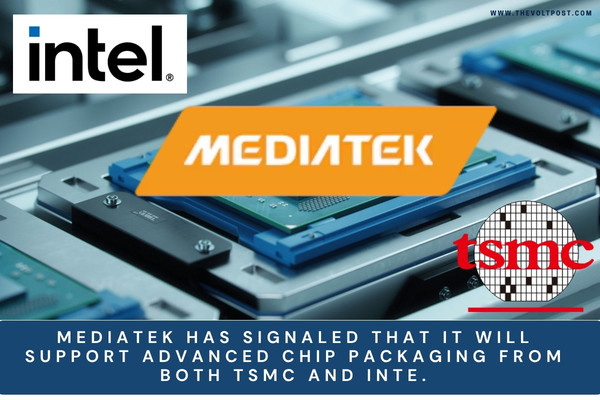
MediaTek has signaled that it will support advanced chip packaging from both TSMC and Intel, a move that gives customers more flexibility as demand for AI chips keeps rising. The Taiwanese chip designer’s strategy matters well beyond Taiwan, because it reflects a broader race to secure packaging capacity for the next wave of custom silicon and data-center processors.
For India, the shift is especially relevant. As domestic cloud providers, AI startups, handset brands and electronics manufacturers look to scale compute-heavy products, access to efficient advanced packaging could become as important as access to leading-edge fabrication itself.
What MediaTek said
According to Reuters, MediaTek Senior Vice President Vince Hu said the company is among the few custom silicon providers that can work with both TSMC’s CoWoS and Intel’s EMIB, allowing customers to choose the approach that best fits their design goals. CoWoS is already widely used in AI chips, while EMIB is Intel’s competing advanced packaging technology.
The key point is not just technological diversity. It is said to bring resilience in a market where advanced packaging has become a bottleneck, and customers increasingly want alternatives rather than a single supplier path.
Advanced Packaging Strategic Differentiator
Advanced chip packaging has moved from a back-end manufacturing detail to a strategic differentiator for AI hardware.
It helps combine multiple chips into one high-performance module, improving bandwidth, power efficiency and system integration for workloads such as training and inference.
That makes packaging a central issue for companies building AI accelerators, custom ASICs and data-center silicon.
With demand climbing, suppliers that can tap more than one packaging ecosystem may gain an edge in customer choice, cost control and delivery timelines.
Why India Should Care
India’s semiconductor ambition is still developing, but the ecosystem is moving quickly through design, assembly, testing and electronics manufacturing initiatives.
Backing multiple packaging options strengthens the case for a more diversified global supply chain, which can benefit Indian device makers and AI infrastructure players looking for stable sourcing.
AI Chip Market is Becoming More Modular
The company’s position also highlights how the AI chip market is becoming more modular and customer-driven. Rather than locking into one packaging partner, the company is presenting itself as a vendor that can align with different manufacturing paths depending on performance, availability and customer needs.
That approach could become more common as chip designers try to navigate supply constraints and secure capacity for next-generation AI workloads.
In practical terms, it may also pressure other chip firms to adopt similar multi-partner strategies to stay competitive.
 Advanced Chip Packaging is Now Strategic Infrastructure
For the global semiconductor industry, this is another sign that advanced packaging is now strategic infrastructure. For India, it reinforces the importance of building a full-stack semiconductor ecosystem that includes design, packaging, testing and backend manufacturing, not just chip fabrication.
References: Reuters report on MediaTek’s dual packaging support; Reuters syndicated coverage with direct quotes and packaging details; additional industry context from Nikkei and TrendForce.