


Global unicorn remain heavily concentrated in a handful of countries, with the United States in the lead. The U.S. is home to 900 unicorns, nearly half of the global total and lists many of the world’s most valuable private companies, including SpaceX, OpenAI, Anthropic, Stripe, Databricks and Waymo.
The term “unicorn” was coined in 2013 by venture capitalist Aileen Lee to describe privately held startups valued at more than $1 billion, companies so rare they felt almost mythical. Back then there were only a few dozen worldwide, so the label genuinely signaled exceptional success. A little over a decade later, the scene looks very different: an unprecedented influx of venture capital and rapid growth across the global tech ecosystem have pushed the number of unicorns into the thousands.
As of May 2026, there are 1,757 startups valued at $1 billion or more. To see which industries and regions are producing the most new global unicorn and which private companies are drawing the biggest investor interest, the team at BestBrokers analysed the latest data from Crunchbase, TechCrunch and PitchBook.
Which countries house the most unicorns in 2026?
Global unicorn remain heavily concentrated in a handful of countries, with the United States in the lead. The U.S. is home to 900 unicorns, nearly half of the global total and lists many of the world’s most valuable private companies, including SpaceX, OpenAI, Anthropic, Stripe, Databricks and Waymo.
This dominance reflects the country’s deep VC ecosystem, leading research universities and tech hubs like Silicon Valley that consistently spawn high-growth startups.
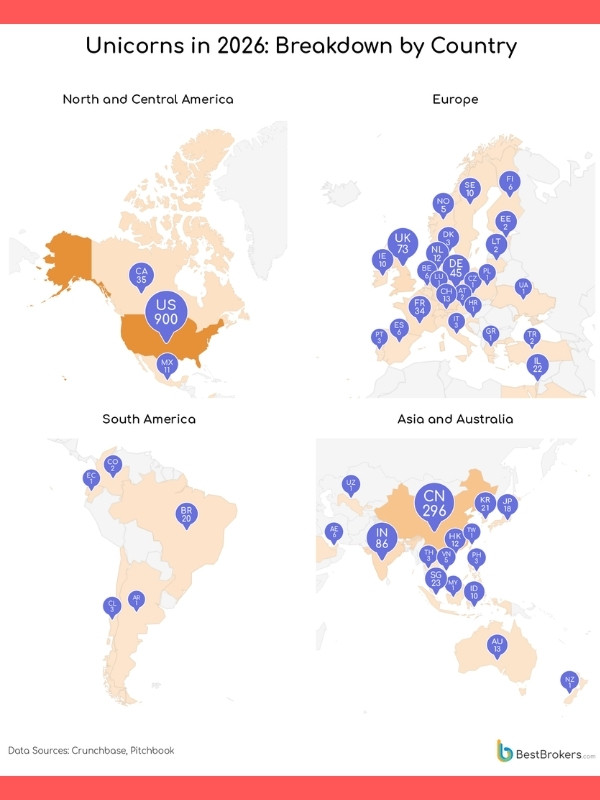
China comes second with 296 unicorns, buoyed by its enormous domestic market and a strong tech sector; ByteDance remains one of its crown jewels.
India has emerged as another major hub with 87 unicorns, driven by rapid digital adoption and a huge consumer base, standout private players include Reliance Jio and Reliance Retail.
Singapore also has a dense concentration of unicorns and hosts major e-commerce players such as Shein.
In Europe and beyond, counts are smaller but significant. The United Kingdom leads Europe with 73 unicorns, many in fintech, including Revolut and Checkout.com.
South and Central America together host about 38 unicorns, led by Brazil and Mexico, while notable regional names include QuintoAndar, iFood, C6 Bank, Plata and Ualá.
The Largest Unicorn Companies in the World in 2026
A small group of private firms now command valuations that rival the largest public companies.
At the top is Elon Musk’s SpaceX, which after its merger with xAI became the first private company to pass a $1 trillion valuation; OpenAI follows closely with an $852 billion valuation after huge investments from major tech players.
Other giants include ByteDance at $600 billion, Stripe at $159 billion, and India’s Reliance Jio and Reliance Retail at roughly $180 billion and $101 billion respectively.
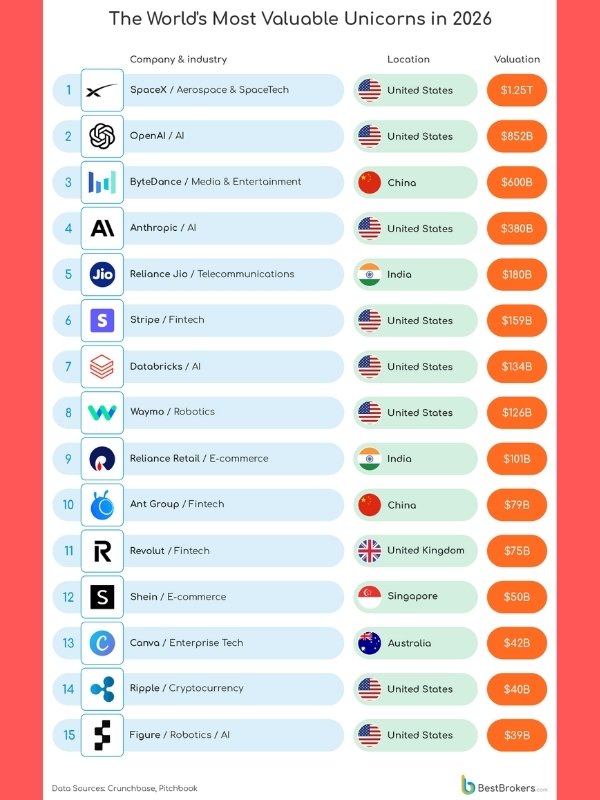
These valuations reflect explosive growth in AI, space tech, digital infrastructure and consumer internet companies.
AI leads new global unicorn creation in 2026
AI companies made up the largest share of startups reaching $1 billion in 2026.
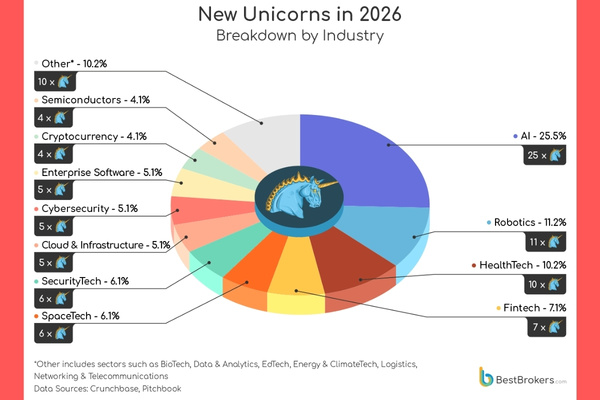
Of the 98 firms that crossed the threshold this year, 25 (about 25.5%) operate in AI, spanning infrastructure, tools built on large language models, and specialised enterprise solutions underscoring AI’s central role in today’s funding landscape.
Robotics, HealthTech and fintech trends
Robotics is the second-largest sector for newly minted unicorns in 2026, with 11 companies capturing investor interest as humanoid systems and embodied AI advance.
HealthTech is close behind with 10 new unicorns, including digital health platforms and AI-driven diagnostics, signalling continued investor confidence in technology-driven healthcare.
Fintech contributed seven new unicorns this year, spread across the U.S., U.K., India, Bahrain and the Netherlands. These winners tend to be infrastructure-rich and globally oriented, with notable names including Rogo and KreditBee.
Defence, space and other sectors
Defence & SecurityTech and Aerospace & SpaceTech each produced six new unicorns in 2026 till now, reflecting higher defence budgets and ongoing interest in autonomous systems and commercial space ventures.
Other sectors that produced unicorns this year include semiconductors, cloud infrastructure, cybersecurity, enterprise software, energy and climate tech, logistics and education.
Top new unicorns in 2026
Among companies that first reached $1 billion in 2026, London’s Ineffable Intelligence tops the list at $5.1 billion, driven by heavy investment in large-scale AI systems.
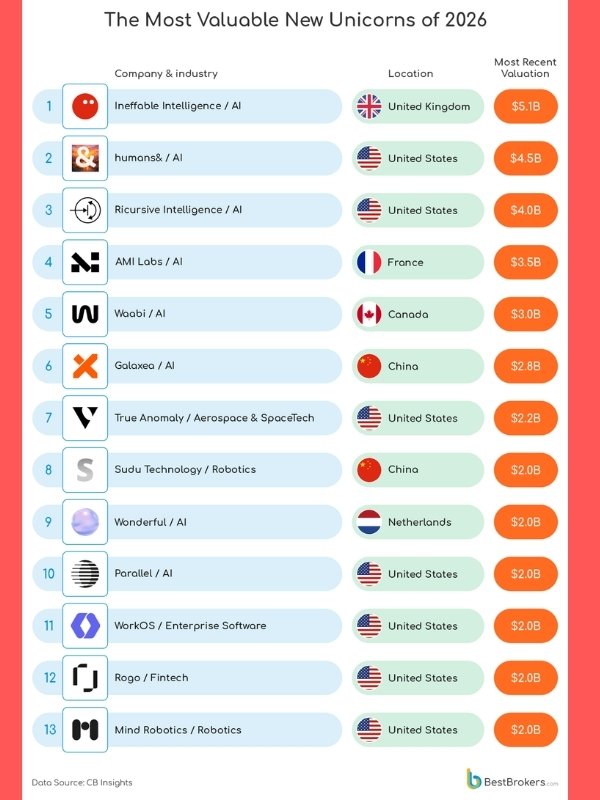
Other standout newcomers include humans& ($4.5B), Ricursive Intelligence ($4B), AMI Labs ($3.5B) and Waabi ($3B), highlighting how AI startups across multiple countries continue to command premium valuations.
Geographic breakdown of 2026’s new unicorns
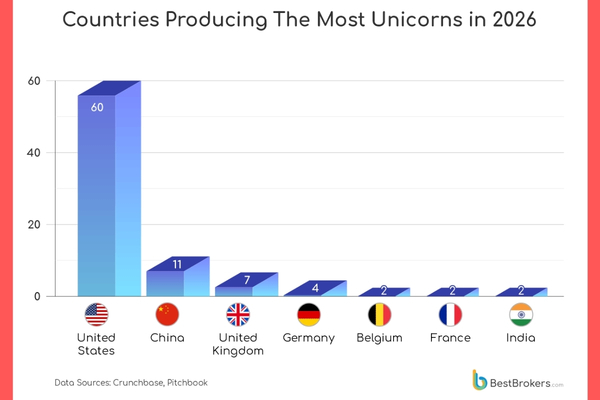
The U.S. dominated new global unicorns in 2026, accounting for 60 of the 98 companies that crossed the $1 billion mark, followed by China (11) and the U.K. (7). Germany, France, Belgium and India also produced new unicorns this year, demonstrating the continued global spread of high-value startups.
Methodology
To build this snapshot, BestBrokers used the Crunchbase Unicorn Board as a primary reference for privately held companies valued at $1 billion or more, supplementing those listings with data from PitchBook and reporting from TechCrunch and other public sources.
Companies were grouped by country, industry and valuation using the most recent funding and valuation announcements available at the time of writing.
Because private valuations and funding rounds change rapidly, these figures reflect the most current data at publication but may evolve over time.
*All views expressed in this report are of BestBrokers and do not reflect the views of The Volt Post. The Volt Post is not responsible for the opinions, figures, or statistics presented here.