Manufacturing has never been more sophisticated. Engineering systems model products down to the micron. Digital twins simulate performance under real-world conditions. Execution systems coordinate thousands of components across global supply chains, down to the minute. On the product and process side of the equation, the transformation has been genuine and substantial.
But there is a third pillar that rarely gets the same attention: the people actually building and servicing these products. And here, progress has stalled.
Walk onto most factory floors and you will find workers still relying on paper manuals, static documents, and procedures someone assembled by hand. Products and processes have entered the modern era. Walk onto most factory floors and you will find workers still relying on paper manuals, static documents, and procedures someone assembled by hand. Products and processes have entered the modern era. The way knowledge reaches the people doing the work has not.
This gap is not just an inconvenience. It is the single greatest bottleneck standing between billions in digital investment and the operational results those investments were supposed to deliver.
The Two Ends That Never Connected
I describe this as the first mile and last mile problem of the digital thread. The first mile is capturing knowledge from engineers and experienced workers and turning it into structured, reusable instructions.
The last mile is delivering that knowledge to the technician or operator at the moment they need it, in a form they can immediately act on.
For decades, both ends have depended on manual effort that is slow, labor-intensive, and disconnected from engineering systems. Engineers design a product in sophisticated digital environments.
Then someone has to interpret that information and manually convert it into instructions, training materials, and service documentation. That translation step takes weeks or months, requires constant coordination, and starts over every time a design changes.
By the time the content reaches the workforce, it has been stripped of context, interactivity, and the spatial understanding the engineering model originally carried. The digital thread, for all its promise, has a knowledge gap in manufacturing at the point where it matters most.
Every time product complexity increases and the knowledge delivery method stays the same, the gap widens. The risk of errors goes up. Training takes longer.
The cost of getting it wrong compounds. The paper manual is the typewriter of manufacturing. Engineering and automation moved on long ago. The people side is still typing.
A Crisis Compounding From Both Directions
The knowledge bottleneck would be serious enough on its own. What makes it urgent is a workforce shift tightening the constraint from both ends.
Experienced workers are retiring at a pace that outstrips hiring, and when they leave, they do not just take labor off the floor. They take decades of practical wisdom that was never formally captured.
It lived in their hands, their habits, and their instincts for what could go wrong. Every retirement becomes a small institutional crisis, and most organizations do not realize the scale of the loss until it shows up in scrap rates, rework, and warranty claims.
Meanwhile, the new generation entering manufacturing grew up surrounded by interactive, visual technology. They tap a screen and get answers. They watch videos.
They learn by doing. Then they arrive at work and the tools for doing their job feel like relics compared to every other part of their lives. The disconnect is a retention problem as much as it is a productivity problem.
Some companies believe they have addressed this by digitizing existing documents, creating visual aids and PDFs, and deploying them on computers and tablets on the shop floor.
But this is replacing the typewriter with an electric typewriter. The authoring tool changed. The screen changed. The knowledge delivery experience for the worker is exactly the same.
They are still reading a static document, still interpreting information on their own, still hoping the content reflects the latest design revision. The device got smarter. The knowledge delivery did not.
AI as the Force Multiplier for the First Mile
Consider what the first mile actually requires today. Someone takes engineering drawings, captures screenshots, photographs prototypes, and manually assembles all of it into step-by-step procedures.
That process is phenomenally labor-intensive, and the effort compounds every time product complexity increases or a design revision comes through. Inevitably, shortcuts get taken just to keep up. Steps get simplified.
Visual detail gets left out. Context gets lost. And those shortcuts have real repercussions on the execution side: ambiguous instructions lead to errors, rework, quality escapes, and longer training cycles.
This is exactly where AI can have the most dramatic impact. AI co-pilots working alongside subject matter experts can help automate the creation of rich, interactive work instructions directly from 3D CAD data.
Instead of manually rebuilding procedures from screenshots and photos, experts work with AI to generate structured, visual, multimedia instructions in a fraction of the time. The expert stays in control of the content. AI handles the heavy lifting of structuring, sequencing, and illustrating it.
The ultimate goal is a connected 3D work instruction that originates from the engineering model and updates automatically when designs change.
But that is not the only path to value. AI can also unlock knowledge that is already sitting inside the organization, trapped in legacy documents, service manuals, and engineering files that nobody has time to convert.
It can capture expertise directly from videos of experienced workers performing procedures, and generate structured instructional steps from that footage. For companies facing an imminent wave of retirements, the ability to capture decades of institutional wisdom in days rather than months is transformative.
The first mile of the digital thread finally closes at a pace that matches the speed at which products and processes are evolving.
Closing the Last Mile
Capturing knowledge is only half the equation. It also has to reach the right person at the right moment. This is where many strategies stall. Organizations generate better content but push it through channels that were never designed to make complex work intuitive.
To be fair, the industry has not stood still. Execution systems like MES guide workers through tasks, enforce sequencing, and track completion.
That is a real step forward from the paper manual. If paper was the typewriter and the digitized PDF was the electric typewriter, MES work instructions are the word processor. Some teams go further still, embedding photos, diagrams, and annotated images into those instructions to help workers visualize the task.
Think of it as desktop publishing: the document looks better and communicates more clearly.
But every step in that progression, from typewriter to electric typewriter to word processor to desktop publishing, is still producing the same thing: a document. Each iteration made the document a little better, a little faster to produce, a little easier to read.
None of them changed the fundamental experience of the worker interpreting a static piece of content and mentally mapping it onto the physical product in front of them.
And those visual aids are manually created, manually maintained, and disconnected from the engineering model. Every time a design changes, someone has to update the screenshots, reshoot the photos, redo the callouts. With product complexity accelerating, that manual process simply cannot keep up.
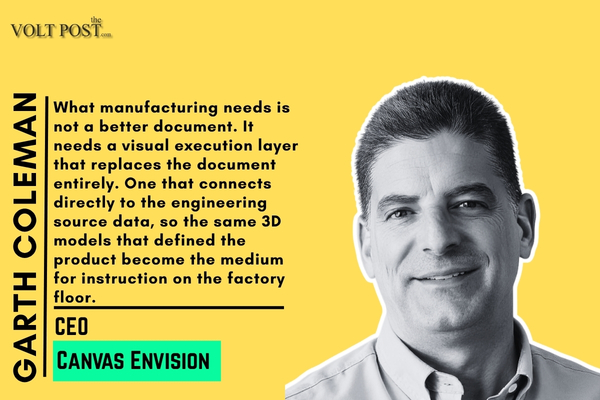
What manufacturing needs is not a better document. It needs a visual execution layer that replaces the document entirely. One that connects directly to the engineering source data, so the same 3D models that defined the product become the medium for instruction on the factory floor.
Workers see exactly what needs to happen, in sequence, in context, on whatever device fits the task. When designs change, the instructions reflect those changes because they originate from the same product definition. The visual experience is not pasted on top of a document. It is the instruction.
Critically, this cannot be a one-way broadcast. Workers need to capture feedback, flag issues, confirm quality steps, and generate performance data that feeds back into the systems upstream.
When that loop closes, the same product data that guided engineering can improve manufacturing, support field service, and inform the next design cycle. The digital thread stops being a pipeline and becomes a living system.
Connected Knowledge, Not Just Connected Machines
The manufacturing sector will need more workers in the coming years, not fewer. The organizations that thrive will be the ones that use AI to make every new worker more capable from day one: capturing wisdom before it disappears, structuring it into guidance the next generation can learn from, and delivering it visually at the moment of execution.
The new generation of manufacturing workers grew up with interactive technology. Give them the right tools and they will perform. Hand them a typewriter and they will leave.
The industry has spent two decades connecting machines, systems, and data streams. That investment was necessary and valuable. But the most important node in any factory is not a machine. It is the person standing in front of one.
Smart factories need connected knowledge, not just connected machines. The technology to close the knowledge gap exists today. The bottleneck was never about processing power, automation, or data. It was always about getting the right knowledge to the right person at the right moment. Solve that, and everything else the industry has built starts delivering its full value.
About The Author:
Garth Coleman, CEO of Canvas Envision is a strategic innovator with more than two decades of experience in enterprise software, Garth brings a unique blend of technical depth and business leadership to Canvas GFX. He is recognized for advancing product lifecycle management (PLM), 3D visualization, and generative AI technologies that help organizations turn complexity into competitive advantage.
Before joining Canvas GFX, Garth held multiple vice president roles at Dassault Systèmes, where he helped define global strategies for 3D visualization, PLM, and AR/VR solutions. He also led initiatives to accelerate generative AI adoption across brand marketing and product organizations, driving efficiency and innovation at scale. His deep expertise in scaling products and businesses positions Canvas GFX for its next chapter of growth and market leadership.
Combining the analytical discipline of an engineer with the strategic mindset of a business leader, Garth focuses on translating innovation into measurable business results. His leadership reflects a clear understanding of how product vision, market strategy, and customer experience come together to drive growth.
He earned his Bachelor of Engineering & Society from McMaster University and his MBA, Summa Cum Laude, from Babson College.
All the opinions in this article are solely those of Garth Coleman, CEO of Canvas Envision. The Volt Post takes no responsibility for the opinions, figures, and statistics mentioned in the column.