


L&T Semiconductor Technologies (LTSCT) and the Indian Institute of Science (IISc), Bangalore, inked a strategic Memorandum of Understanding (MoU) to work together on the creation of a national 2D Innovation Hub on the second day of Semicon India 2025. The advancement of research and translation in 2D material-based semiconductors and quantum technologies is greatly aided by this strategic relationship.
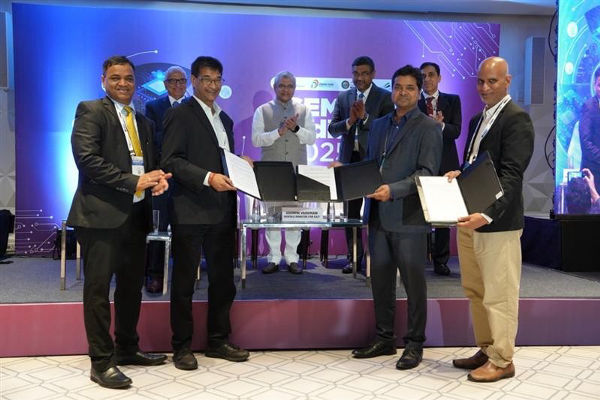
“India will be at the forefront of global semiconductor R&D under this proposed hub. It will flaunt a top-notch facility dedicated to next-generation semiconductor innovation and beyond-silicon-chip technologies”, asserted its official release.
LTSCT plans to strategically contribute to this purpose by first providing labor, facilities, and ecosystem links, then moving on to infrastructure development, enabling local toolchains, and integrating these technologies.
As the host organization, IISc will simultaneously advance translational research and innovation in semiconductor and quantum 2D applications, build platform technologies, and establish wafer-scale cleanroom and production capabilities.
By establishing wafer-scale fabrication facilities, consistent process flows, and sophisticated device prototyping for logic, memory, sensing, analog, and quantum circuits, IISc will serve as the Hub’s anchor.
Additionally, it will provide common infrastructure, encourage business, academic, and R&D lab cooperation, prepare the workforce of the future, and promote translational research and intellectual property development.
Subject to official government approval, the MoU documents the parties’ shared intention to work together to create and expand the Hub.
LTSCT will use a phased engagement model to complement this. It will offer research fellowships, collaborative PhD supervision, lab and tool access, and CSR-linked funding for talent and infrastructure in the short term.
In the medium run, it will leverage L&T’s experience in designing and building semiconductor R&D facilities and establish ecosystem connections with international partners in the fields of computers, industrial automation, energy, aerospace, and defense.
LTSCT and IISc are pursuing a bold trajectory to semiconductor leadership via the National 2D Innovation Hub.
The alliance aims to establish India as a top location for 2D/quantum chip research, smooth industry integration, and globally competitive productization over the course of the following ten years.
In addition to providing the country with top-notch R&D capabilities, the program seeks to provide the expertise, intellectual property, and manufacturing capacity required to influence the semiconductor industry, propel downstream adoption in key industries, and fuel India’s rise in the global technological value chain.
Leadership Comments:
Commenting on the occasion, Sandeep Kumar, Chief Executive, LTSCT, said, “This partnership signals much more than strategic intent. It marks India’s rise as a force in semiconductor innovation. By combining LTSCT’s industrial strengths with IISc’s academic excellence, we will accelerate indigenous capability, IP creation, and a future-ready manufacturing pathway. Our collaborative ambition is to unlock new value chains and empower emerging sectors, ensuring India’s semiconductor future is built on deep innovation and commercial relevance.”
Prof. Mayank Shrivastava, Professor & Chair, Department of Electronic Systems Engineering, IISc, said, “Building the National 2D Innovation Hub is a profound demonstration of India’s scientific leadership and collaborative strength. This partnership reflects IISc’s commitment to cutting-edge scientific leadership and LTSCT’s long-term vision to play a catalytic role in India’s deep-tech and semiconductor ecosystem. It will enable the acceleration of India’s journey toward leadership in 2D electronics and quantum technologies.”