


Unexpected Maker has officially launched the SeriesD line of ESP32-S3 development boards, introducing an exciting new feature: support for both internal and external antennas, made possible through a software-controlled RF switch. These compact, feature-rich modules are tailored for advanced IoT applications and offer a significant level of wireless flexibility for developers.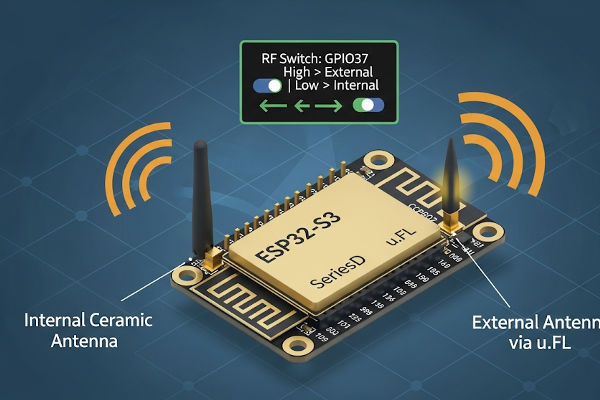
A Next-Level ESP32-S3 Development Board
The SeriesD boards are built around the ESP32-S3-MINI-1 module and feature a dual-core Xtensa LX7 processor capable of running at up to 240 MHz.
In terms of memory, the board includes 8MB of QSPI flash and 2MB of PSRAM, providing ample space and speed for even complex embedded tasks.
What sets the SeriesD apart is the inclusion of both a PCB antenna and a u.FL connector for an external antenna, enabling dynamic selection between them via GPIO37.
The software-configurable RF switch makes this process seamless for developers, allowing flexible wireless deployment in different environments without needing to swap hardware.
Compact but Capable
Despite its small 25.4 x 17.8mm form factor, the SeriesD is designed to be powerful and practical. It supports USB Type-C for power and programming, and features a CH343 serial-to-USB chip for robust data transfer.
Additionally, the board includes a reset button, boot button, and RGB LED, enhancing usability during development.
The layout also provides easy access to 23 I/O pins, which support multiple peripherals including SPI, I2C, UART, ADC, and PWM—making it ideal for hobbyists, makers, and professionals alike.
Optimized for Wireless Flexibility
The standout dual antenna feature is particularly valuable in scenarios where signal reliability is critical.
Users can switch between the built-in ceramic antenna and an external antenna depending on the surrounding signal conditions, enclosure materials, or range requirements.
This dynamic antenna switching can be controlled in firmware using ESP-IDF, Arduino, or CircuitPython, offering full flexibility across development stacks. GPIO37 is used to toggle the RF path, with high selecting the external antenna and low selecting the onboard one.
Developer Friendly Ecosystem
Unexpected Maker has ensured compatibility with popular development environments and has published pinout diagrams and schematic references to help streamline the onboarding process.
The board’s high build quality and developer-focused design follow in the footsteps of the company’s previous releases like the TinyPICO and FeatherS3.
Additionally, the SeriesD is designed for breadboard-friendly prototyping, while also offering castellated edges for easy integration into custom PCBs.
Targeted Use Cases
The SeriesD ESP32-S3 board is positioned as an ideal solution for:
- Low-power edge computing
- Smart home devices
- Wireless sensor networks
- Industrial automation
- Battery-powered portable devices
- Wearables
Its powerful MCU and robust wireless capability make it particularly well-suited for applications that need both compute performance and stable connectivity in varied environments.
Growing Lineup of ESP32-Based Development Tools
With the SeriesD, Unexpected Maker adds another smartly engineered product to its growing lineup of ESP32-based development tools.
The introduction of a dual antenna system with software-controlled switching is a forward-looking addition that provides developers with more control over wireless performance.
Whether you’re building a commercial IoT product or tinkering with prototypes, this new board offers flexibility and power in a compact, thoughtfully designed package.