


Microchip Technology has announced two new milestones for its Radiation-Tolerant (RT) PolarFire technology, continuing to support the changing needs of space system developers: the availability of engineering samples for the RT PolarFire System-on-Chip (SoC) FPGA and the MIL-STD-883 Class B and QML Class Q qualification of the RT PolarFire RTPF500ZT FPGA.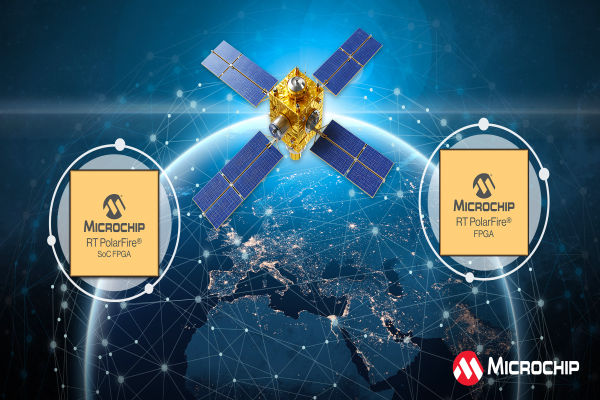
These accomplishments highlight the company’s almost 60-year history of spaceflight and its dedication to providing highly reliable, low-power technologies for the most demanding space applications, as affirmed in its official release.
Industry standards that specify stringent testing and qualification procedures for microelectronic components used in high-reliability applications, such space and defense, include MIL-STD-883 Class B and Qualified Manufacturers List (QML) Class Q.
The U.S. Department of Defense created MIL-STD-883, which describes procedures for mechanical, electrical, and environmental testing to guarantee device dependability in harsh environments. The Defense Logistics Agency (DLA) oversees QML Class Q, which validates that manufacturers continuously produce parts that satisfy these exacting specifications.
Since RT PolarFire devices use nonvolatile technology, they are not vulnerable to radiation-induced configuration memory upsets like conventional SRAM-based FPGAs. By doing away with the requirement for outside mitigation strategies, this lowers the total cost and complexity of the system.
Satellite designers can optimize Size, Weight, and Power (SWaP) without sacrificing mission-critical reliability thanks to RT PolarFire FPGAs, which use up to 50% less power than mid-range SRAM-based competitors.
By providing improved Single Event Latch-up (SEL) radiation performance and greater robustness for inflight programming in comparison to the original RTPF500T, the PolarFire RTPF500ZT FPGA expands the possibilities of the family.
The RT PolarFire SoC FPGA engineering samples enhance Microchip’s line of space-qualified products. This SoC combines a flight-proven FPGA design with a real-time, Linux®-capable, RISC-V®-based CPU subsystem, allowing for both predictable real-time performance and flexible software support.
The RT PolarFire SoC FPGA has a roadmap to QML Class V and Class Y, making it a good choice for applications where high reliability is crucial, such as payload control, avionics, and central satellite processing.
RT PolarFire devices are supported by the Libero® SoC Design Suite, a comprehensive IP library, reference designs and solution stacks tailored for space applications. RT PolarFire SoC FPGAs also integrate with Microchip’s Mi-V ecosystem for RISC-V development.
Additionally, development kits and hardware platforms are available to facilitate rapid prototyping, hardware validation and system integration, enabling engineers to efficiently bring mission-critical space systems from concept to deployment.
Microchip’s latest milestones in radiation-tolerant FPGA technology reflect ongoing progress in addressing the stringent requirements of contemporary space missions. With a focus on continuous improvement and industry collaboration, the company is well positioned to support the next generation of satellite, avionics and deep space systems.
Additional information, technical documentation, and development resources can be found on the Microchip radiation-tolerant FPGA website.
Leadership Comments
“Microchip Technology has a proven track record of supporting critical space missions, spanning low Earth orbit, satellite platforms and deep space exploration,” said Shakeel Peera, vice president of marketing and strategy for Microchip’s FPGA business unit. “Our commitment to stringent quality standards, compliance with international regulations and long-term product reliability has solidified Microchip’s reputation as a trusted provider of aerospace hardware. As the industry demands higher performance, increased logic density and robust security, we remain dedicated to innovating solutions that address the evolving needs of modern space systems.”
Pricing and Availability
Purchase directly from Microchip or contact a Microchip sales representative or authorized worldwide distributor.