

The R&S FSWP has been updated by Rohde & Schwarz for future applications. The frequency range is increased to 56 GHz with the new R&S FSWP-B56G option. It combines the benefits of a high-end phase noise tester and an intuitive signal source analyzer with the help of external high-end sources acting as local oscillators.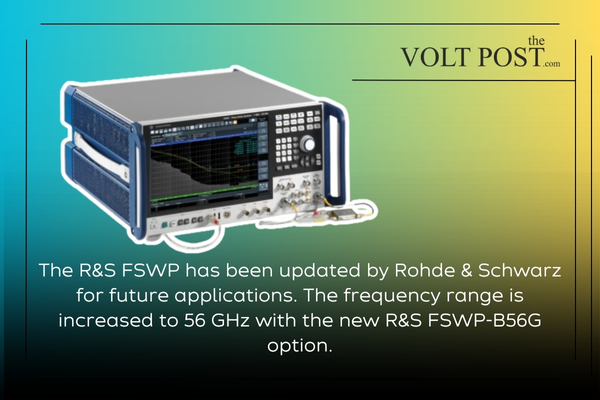
Rohde & Schwarz has increased the internal signal source’s frequency range to 54 GHz for additive and residual phase noise measurements on amplifiers. Furthermore, a brand-new, incredibly simple technique for measuring noise figures has been included.
The industry standard for phase noise testing, the Rohde & Schwarz R&S FSWP phase noise analyzer and VCO tester, just received a significant performance increase. For radar applications as well as the development and production of synthesizers, OCXOs, DROs, and VCOs, it is the best test solution.
Rohde & Schwarz has increased the frequency range for absolute phase noise measurements from 50 GHz to 56 GHz with the new R&S FSWP-B56G option. There is no need for an external converter; it is accomplished by just pressing a button.
Satellite communication and jitter measurements in high-speed digital applications like CEI-224G (Common Electrical I/O) and ultra-fast LAN IEEE 802.3dj require these frequencies.
Speeding up measurements with external high-end signal sources
Furthermore, external signal sources can now be used as local oscillators for absolute phase noise measurements up to 56 GHz with the upgraded R&S FSWP.
Because only a few cross-correlations are required to measure the phase noise of the DUT, such as another high-end oscillator, using a high-end signal source allows users to obtain their results considerably more quickly. Users can measure up to 1000 times faster than the internal source, depending on the source’s quality.
To lock the signal source frequencies utilized as local oscillators to the DUT frequency, the R&S FSWP offers tuning outputs.
To fully benefit from cross-correlation approaches, users can measure with one or two external oscillators in this mode. Another option is to use this mode to compare two identical sources (2 DUT technique) and adjust the findings by 3 dB.
Additive and residual phase noise measurements up to 56 GHz
With the R&S FSWP-B56G variant, the device can also be used to measure additive and residual phase noise on amplifiers or other components up to 56 GHz with a 40 MHz frequency offset.
For this application, the internal source’s frequency range has been increased to 50 GHz, or up to 54 GHz with the R&S FSWP-B56G option. Up to 56 GHz can be measured by individuals using external sources.
A new marker function called “NOISE FIGURE MARKER” is also included in the R&S FSWP. By simply attaching an amplifier between the R&S FSWP’s input and the signal source’s output, users can quickly determine the noise figure of the device.
Similar to phase noise measurement, this simple new technique for determining amplifiers’ small signal noise figures is based solely on phase demodulation. Because the R&S FSWP has a signal and spectrum analyzer, it can provide the new noise figure measurement based on demodulation in the phase noise tester in addition to the Y-factor assessment based on noise sources with a calibrated ENR in the spectrum analyzer.
The updated R&S FSWP phase noise analyzer and VCO tester is available from Rohde & Schwarz as off July 2025. It will be showcased for the first time to the public at IMS2025 Exhibition from June 17 to 19, 2025, at the Moscone Center in San Francisco, CA, at the Rohde & Schwarz booth 1443.
To Know More: CLICK HERE