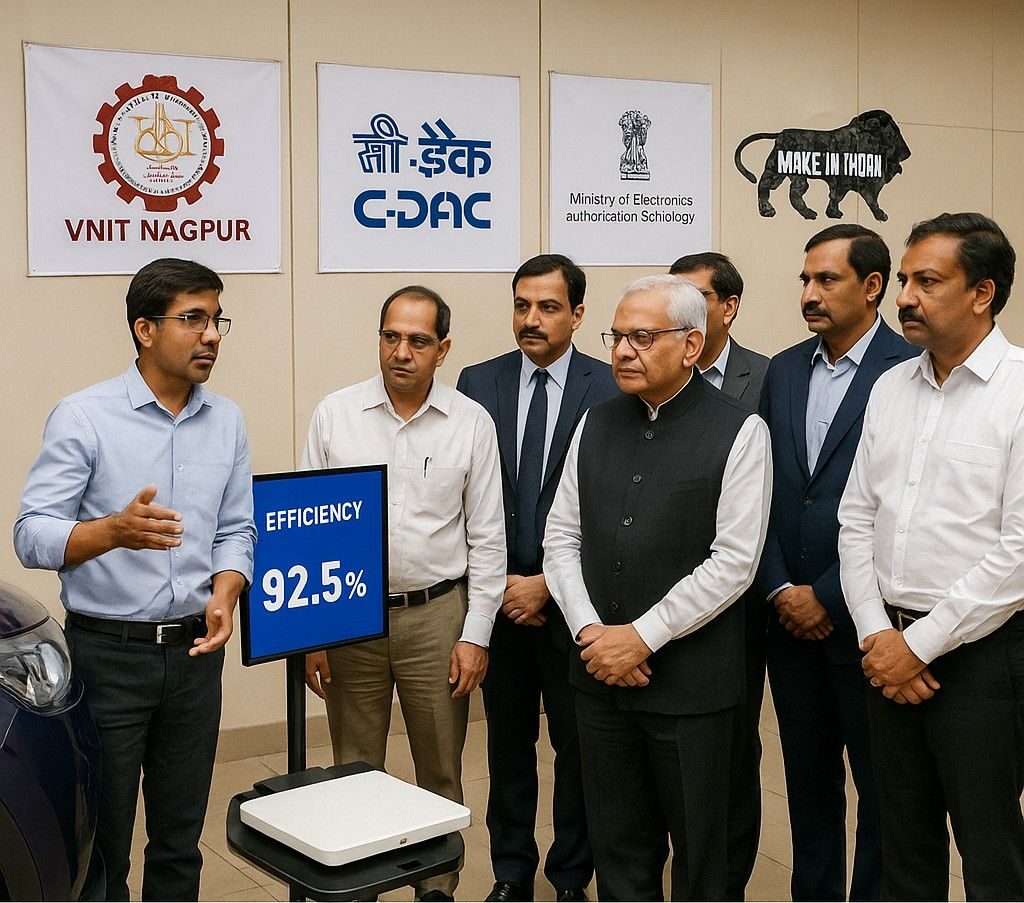
In a major leap for India’s electric vehicle (EV) ecosystem, the Visvesvaraya National Institute of Technology (VNIT), Nagpur, in partnership with the Centre for Development of Advanced Computing (C-DAC), Thiruvananthapuram, has developed the country’s first indigenous wireless EV charger.
Officials from VNIT, C-DAC, and MeitY at the unveiling of India’s first wireless EV charger, a milestone in Atmanirbhar Bharat’s clean mobility mission.
Backed by the Ministry of Electronics and Information Technology (MeitY) under the NaMPET (National Mission on Power Electronics Technology) initiative, this innovation aligns with the government’s vision for clean, self-reliant, and cutting-edge transportation solutions.
Next-Gen Charging: No Cables, No Hassle
The Wireless EV charger rated at 1.5 kW, can wirelessly charge a 4.8 kWh battery up to 90% in just three hours using a standard 230V, 50Hz AC power source. It operates at a high frequency of 88 kHz using Silicon Carbide (SiC)-based MOSFETs, achieving an 89.4% efficiency even with a 12.5 cm air gap between the transmitter and receiver coils.
According to Dr. Nitin Dhopte, lead researcher from VNIT’s Electrical Engineering Department:
“We focused on maximizing efficiency at a realistic coil distance to replicate real-world deployment in two- and three-wheelers. The results exceeded expectations, and we now have a robust, user-friendly wireless EV charger ready for industry adoption.”
Safety remains a key priority. The system includes automatic shut-off features, short-circuit protection, and intelligent fault detection mechanisms, ensuring high safety standards for both vehicles and users.
Leaders Applaud Milestone in Atmanirbhar EV Technology
The Wireless EV charger launch drew praise from government and industry leaders for advancing India’s self-reliant manufacturing capabilities:
S. Krishnan, Secretary, MeitY, remarked:
“India is poised to lead the global shift towards sustainable mobility. This charger, developed through our NaMPET initiative, is a shining example of what we can achieve through focused collaboration between academic institutions and technology development centers. Indigenous solutions like this will accelerate EV penetration in both urban and rural India.”
Dr. E.M. Annamalai, Director, C-DAC Thiruvananthapuram, added:
“Our aim was to simplify EV charging while eliminating mechanical wear and user complexity. This project proves that India can deliver cutting-edge wireless charging systems designed for Indian conditions.”
Uday Narang, Founder and Chairman, Omega Seiki Mobility, praised the innovation from an industry perspective:
“The future of urban transport lies in contactless, intelligent energy solutions. We see tremendous commercial potential in wireless charging—especially for last-mile logistics, where efficiency and uptime matter most. This project opens the door for scalable domestic manufacturing.”
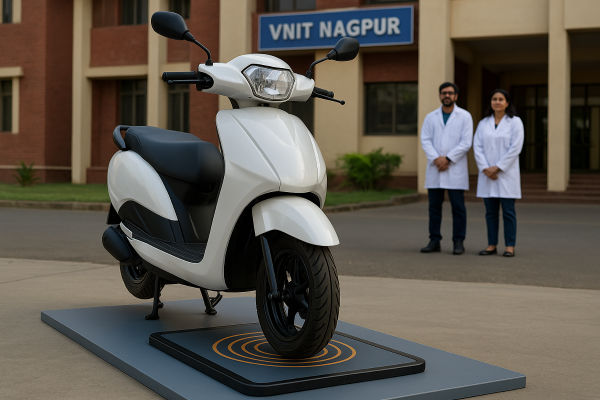
India’s first indigenously developed wireless EV charger in action at VNIT Nagpur—enabling 90% charge in just 3 hours, contact-free.
Boosting India’s EV Ecosystem
The timing of this innovation is crucial. India’s electric mobility ecosystem is evolving rapidly. In Nagpur, electric vehicles made up 22% of new vehicle registrations in 2024, up from a mere 1% in 2020. In response, the Nagpur Municipal Corporation (NMC) is working to:
Double public EV charging points from 150 to 300 by 2027
Set up 100 battery swapping stations by 2025
This local transformation supports the national goal of 30% EV penetration by 2030.
Dr. P.M. Khodke, Director of Visvesvaraya National Institute of Technology Nagpur, commented:
“This is not just a research project; it’s a platform for commercial-scale EV transformation. Our students and faculty are working alongside industry leaders to deliver Made-in-India solutions that solve India-specific challenges.”
More Innovations Coming from VNIT
The wireless charger is just one of many tech-forward projects in the pipeline. VNIT is currently co-developing a 25 kW multi-port Smart Solid-State Transformer (SST) with Virginia Tech, USA. This SST allows bidirectional, multi-voltage EV charging, smart energy management, and redirection of power from idle charging ports to active ones. It’s designed to revolutionize fleet-level EV charging.
Visvesvaraya National Institute of Technology also plans to introduce vehicle-to-grid (V2G) support in future iterations, enabling energy to flow back to the grid—turning EVs into mobile energy assets.
Training the Next Generation of EV Leaders
VNIT, in partnership with evACAD, has launched a specialized M.Tech program in Electric Vehicle Technology. The curriculum is industry-aligned and includes:
“We’re not just creating engineers—we’re creating innovators who will shape India’s EV transition. Our partnership with VNIT ensures students work on real-world systems like this wireless charger, preparing them for high-impact roles in EV R&D and manufacturing.”
From Prototype to Production
The wireless EV charger has been licensed to Global Business Solution Pvt. Ltd., a Pune-based firm specializing in EV components. Production is expected to begin in late 2025 with units targeting:
E-scooters and electric rickshaws
Urban fleet vehicles
Campus and logistics mobility
Company Director Ms. Rachana Jagtap shared:
“We aim to make wireless charging affordable, durable, and easy to install across Indian cities. The VNIT-C-DAC design gives us the right foundation for scalable deployment.”
What This Means for India’s EV Landscape
The successful development and near commercialization of this indigenous wireless EV charger reflect the maturity of India’s EV innovation ecosystem. As India pushes forward on its EV roadmap, such breakthroughs will:
Reduce dependency on imported charging systems
Promote local IP and manufacturing
Improve EV convenience and adoption, particularly in Tier-2 and Tier-3 cities
A B2B tech correspondent and tech policy observer, writing for the fast-evolving global B2B tech industry, as a budding journalist I’m disciplined to deliver insightful coverage on critical industry trends and policy developments. In my maiden stint with The Volt Post, I report pivots on sustainability and ESG (Environmental, Social, and Governance), relentlessly tracking inside news and thought leadership across the B2B tech landscape. With a track record of moderating industry-leading webinars and events, as a correspondent I practise bring authoritative analysis to the tech community. Outside the newsroom, a passion for mountain adventures and contemplative moments as a beach sand-watcher brings balance and inspiration to this multifaceted professional.