



STMicroelectronics high-performance vibration sensor with in-sensor AI offers a compelling alternative to piezosensor to fast-growing industrial condition-monitoring market.
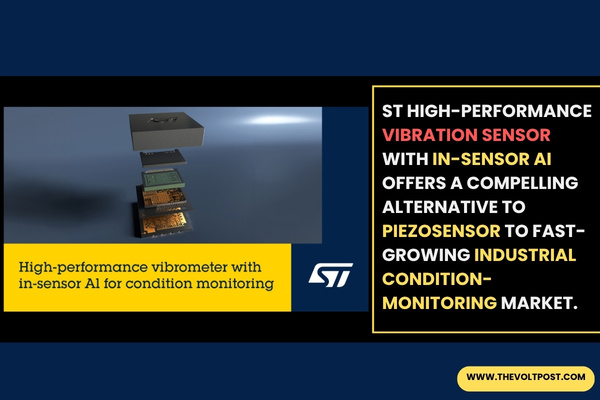
STMicroelectronics has unveiled a new intelligent vibration sensor built for industrial condition monitoring applications where accuracy, reliability, and power efficiency are critical.
Based on ST’s MEMS technology, the IIS3DWB10IS integrates:
- The company’s ISPU 2.0 (Intelligent Sensor Processing Unit), bringing advanced signal processing and on-sensor AI inference closer to the edge.
- The device is designed to capture high-frequency vibrations above 10 kHz and withstand shocks up to 200g, making it well-suited for monitoring demanding industrial equipment.
- Its compact, rugged design supports operation in harsh environments, with a temperature range extending up to 125°C.
The sensor is aimed squarely at predictive maintenance use cases, helping operators detect issues such as bearing wear early, reduce unplanned downtime, and improve overall equipment effectiveness.
As vibration analysis remains central to condition monitoring especially in industries reliant on rotating machinery solutions like this are becoming increasingly valuable across manufacturing, automotive, and process industries.
With features such as a 2048×80-bit FIFO and an integrated temperature sensor, the IIS3DWB10IS combines precision sensing with ease of deployment. It is also backed by ST’s 10-year industrial longevity program, reinforcing its suitability for long lifecycle applications.
Housed in a 4.5 mm × 4.5 mm × 1.5 mm 16-lead LGA package with wettable flanks for streamlined inspection during surface-mount assembly, the sensor is expected to be available from July 2026, with pricing starting at $25 for volumes of 1,000 units.
Vibration sensor with intelligent sensor processing unit (ISPU 2.0) brings advanced digital signal processing and AI inference closer to the sensing element.
The result is a compact, rugged device that measures vibrations and shocks up to 200g at frequencies of 10 kHz and above.
Combining digital precision and ease of use with a wide temperature range, up to 125°C, to withstand harsh environments, the vibration sensor is engineered to help customers improve equipment uptime, reduce unplanned downtime, and support predictive maintenance strategies across industrial environments.
By enabling predictive and prioritized maintenance, remote condition monitoring allows companies to improve equipment uptime and operating efficiency while eliminating unexpected failures and enhancing safety. Fortune Business Insights states the global market for this technology will exceed $5 billion by 2032, growing at over 9% CAGR1.
The IIS3DWB10IS also contains a 2048×80-bit FIFO register and an accurate temperature sensor.
The sensor’s rugged MEMS-based design supports operation up to 125°C. The IIS3DWB10IS is supported in ST’s 10-year industrial longevity program.
The IIS3DWB10IS is packaged as a 4.5 mm x 4.5 mm x 1.5 mm 16-lead LGA package with wettable flanks that facilitate automatic optical inspection in high-quality surface-mount assembly processes. The product is scheduled to be available by July 2026 from $25 for orders of 1000 pieces.
Leadership Comment
“The IIS3DWB10IS delivers unique properties for our target markets and environments. Its high dynamic range, wide bandwidth, and high-temperature capability, combined with ease of adoption and a cost-effective, simplified circuit design, allowed us to replace the incumbent piezosensor technology. Moreover, the integrated ISPU 2.0 processor positions complex signal processing and rapid AI inference close to the sensing element, enabling smarter system responses,” said Andrea Torcelli, Chief Technology Officer at  Bonfiglioli S.P.A.
“Our industrial MEMS vibration sensor delivers the dynamic range and bandwidth needed for high-end applications and extends the advantages of ST in-sensor digital processing. Integrating the ISPU 2.0, with its new hardware accelerators for fast signal processing and AI inference, sharpens equipment-wear recognition while reducing latency and power consumption,“ said Simone Ferri, APMS executive VP MEMS sub-group. “Industries can expect a new generation of condition monitoring sensors, the first compelling alternative to piezosensor, that is lightweight, easy to fit and design, ultra-accurate, and energy efficient enough for battery-powered operations.”
To Know More: CLICK HERE