



A new study from South Korea’s Hanyang University has uncovered a subtle but critical flaw in next-generation EV batteries, one that begins not during operation, but much earlier in the manufacturing process.
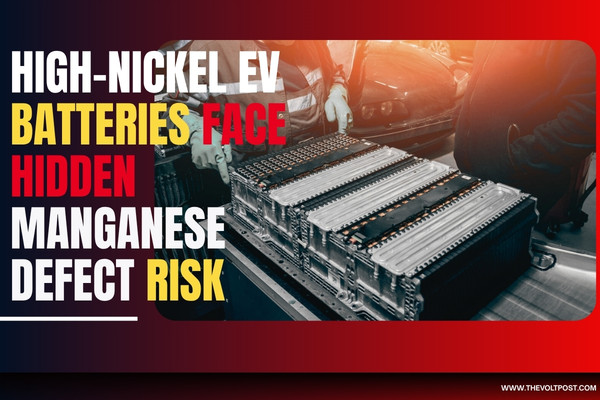
Cobalt-free, high-nickel cathodes with manganese-rich protective shells are widely seen as a promising route to cheaper, higher-energy batteries. These materials can extend driving range while reducing reliance on costly and ethically sensitive minerals like cobalt. But researchers now warn that their long-term stability may hinge on something as simple as how precursor materials are stored before production.
The study, led by Professor Jin Ho Bang and PhD scholar JinHa Shim, shows that exposure of precursor materials to air can quietly alter manganese chemistry on the particle surface. These changes lead to the formation of so-called “Jahn-Teller distorted” manganese species, defective, highly reactive regions that accelerate battery degradation.
According to the findings, these surface defects trigger a cascade of unwanted reactions, including electrolyte breakdown, transition-metal dissolution, and damage to the graphite anode. In high-nickel systems, this can nearly double the rate of capacity loss during extended cycling.
“We found that a manganese-rich shell, which is normally introduced to protect high-nickel cathodes, can instead become a catalyst for degradation if the precursor chemistry is not carefully controlled,” said Prof. Bang. “Even small variations in precursor storage history can substantially affect battery stability.”
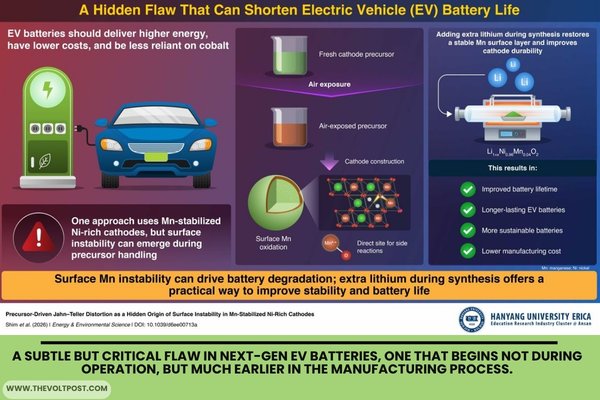 The research, published in Energy and Environmental Science (Volume 19, Issue 12), points to a relatively simple fix. By increasing the amount of excess lithium during synthesis, the team was able to suppress the formation of these defective surface phases and restore stable manganese–oxygen bonding.
With this adjustment, the modified cathodes retained more than 90% of their capacity over extended testing, marking a significant improvement in durability.
The findings arrive at a time when the battery industry is rapidly pushing toward ultra-high-nickel and manganese-rich chemistries to cut costs and improve energy density. However, the study highlights that eliminating cobalt alone is not enough; controlling manganese behavior during manufacturing is equally critical.
Rather than requiring complex redesigns or costly coatings, the researchers emphasize that better precursor handling and optimized lithium stoichiometry could offer a practical path forward for manufacturers.
“Our results show that even minor variations in precursor history can have major consequences for battery performance,” Prof. Bang added, underscoring the need for tighter process control in large-scale production.
 If adopted, these insights could help extend the lifespan of EV batteries and improve the reliability of large-scale energy storage systems, both key to accelerating the transition to cleaner energy.
Reference
Title of original paper: Precursor-driven Jahn–Teller distortion as a hidden origin of surface instability in Mn-stabilized Ni-rich cathodes
Journal: Energy and Environmental Science
DOI: 10.1039/d6ee00713a